AI SEO Pricing in Australia (2026): How Much Should Businesses Budget?


AI has changed how SEO is executed, priced, and measured in Australia. Automation and predictive models now play a central role in content optimisation, link analysis, and keyword forecasting. Businesses see faster insights and reduced manual workload, but the technology behind it also affects pricing.


AI SEO Pricing in Australia


As search technology progresses, Generative Engine Optimisation (GEO) has emerged as the next stage of digital visibility. GEO focuses on helping brands appear in AI-generated results across tools such as ChatGPT, Google AI Overviews, and Claude, where search and content discovery are now blending into conversational experiences and reshaping the relationship between AI search and SEO.


At Marketix, we help Australian businesses adapt to this shift by combining AI SEO with GEO strategies that position them within both traditional search rankings and generative platforms. For companies comparing automation and manual strategies, it helps to understand how pricing is structured before setting a realistic budget.


What Is AI SEO and Why Does It Cost Differently


AI SEO uses algorithms and natural language processing to make decisions that used to require human judgment. It analyses intent faster, identifies keyword opportunities more efficiently, and can produce content frameworks in seconds. The cost of implementing AI SEO depends on several layers.


AI SEO


  • AI Tools and Technology: Agencies invest in licensed software such as Surfer, Clearscope, or Jasper. Each subscription carries monthly or usage-based fees. High-end tools integrate directly into campaign dashboards, which adds convenience but increases total spend.

  • Data and Model Training: AI systems need access to clean and current data. Agencies spend significant time refining models to produce accurate SEO insights. That ongoing optimisation work adds to project costs.

  • Human Oversight: While AI can generate patterns and suggestions, it requires strategic oversight to avoid inaccuracies or keyword stuffing. Professional input is part of every deliverable, keeping campaigns aligned with brand tone and audience expectations.
    From Marketix’s own experience managing AI-powered campaigns, automation speeds up analysis but doesn’t replace human precision. In practice, we’ve seen that combining AI-generated recommendations with editorial review improves keyword alignment and maintains brand tone across content. That balance often defines the difference between an efficient campaign and a generic one.


Pricing for AI SEO reflects both the cost of technology and the value of expertise behind it. Businesses should also consider the experience of their chosen partner. Agencies that merge technical automation with sound SEO judgement often deliver greater returns.


Factors That Influence AI SEO Pricing in Australia


AI SEO pricing varies across agencies and industries. The range is wide, but several recurring factors shape most quotes.


Factor

Description

How It Affects Pricing

Business Size

Small businesses often require local visibility; larger firms target multiple markets.

Larger scopes mean more keywords, pages, and data analysis, increasing costs.

Competition Level

Highly competitive industries like finance or healthcare need deeper research.

Campaigns in dense markets require more AI-driven modelling and testing.

Tools and Platforms

AI-based platforms charge differently based on keyword limits, API access, and automation capacity.

Higher-tier tools push monthly retainers upward.

Content Output

AI can scale production, but human editing remains necessary.

Larger output means higher total campaign costs.

Agency Expertise

Firms specialising in AI SEO provide higher strategic input.

Their pricing reflects experience and proprietary optimisation systems.


Local market trends also matter. In Sydney, for example, agencies often price higher due to greater operational costs and higher client expectations for measurable ROI.


Based on projects handled at Marketix, pricing can differ sharply between industries. For example, clients in finance and technology tend to invest more heavily in AI SEO due to higher competition and tighter compliance requirements. Meanwhile, local service businesses such as trades or hospitality often prioritise quick visibility gains through targeted automation. These variations show how industry type directly shapes the cost structure and strategy.


Typical AI SEO Pricing Models in Australia (2026)


Pricing for AI SEO services in 2026 depends on how the agency structures its work. Most agencies follow one of three models.


1. Monthly Retainers


Many agencies charge on a monthly basis, combining strategy, AI-driven audits, and optimisation.


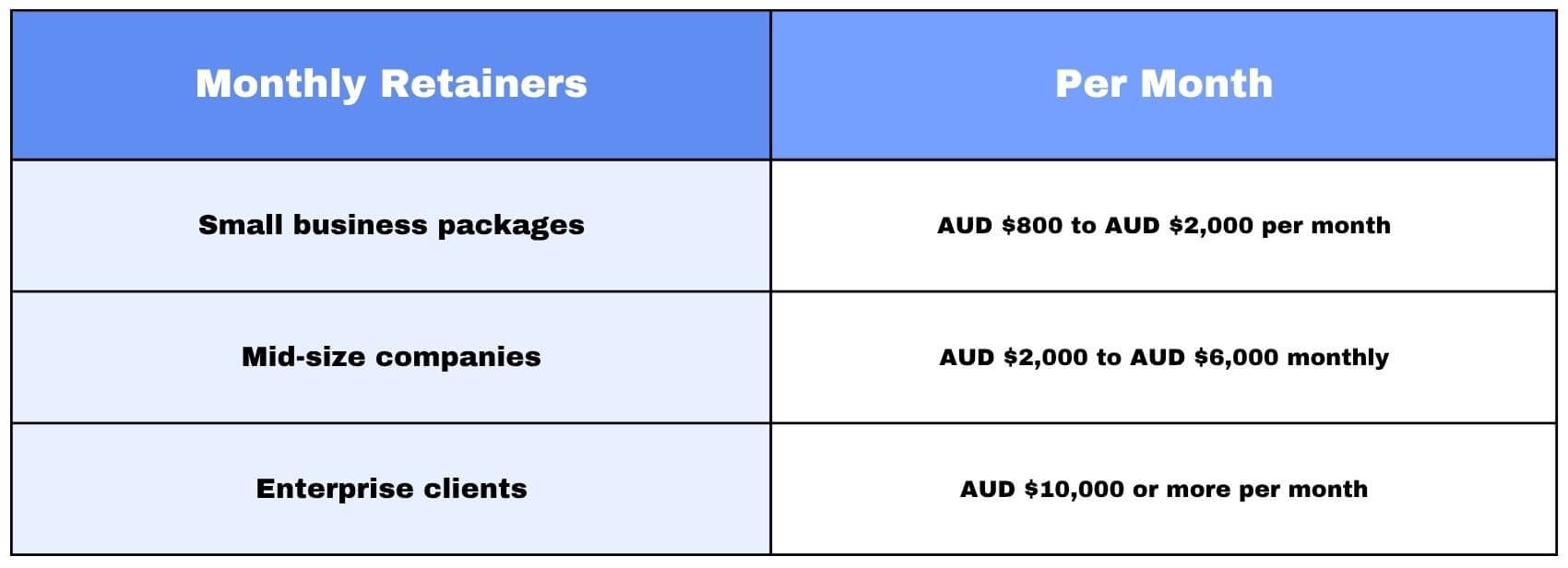
AI SEO Monthly Retainers


  • Small business packages often range from AUD $800 to AUD $2,000 per month, covering limited content and link outreach.
  • Mid-size companies generally spend AUD $2,000 to AUD $6,000 monthly for broader campaigns, including AI-assisted content production.
  • Enterprise clients may invest AUD $10,000 or more per month, integrating machine learning, multi-domain tracking, and predictive analytics.


2. Project-Based Pricing


Some businesses prefer short-term or one-off projects. A full AI SEO audit, for instance, may cost AUD $1,000 to AUD $3,500, depending on data volume. Content strategy setups or AI keyword expansion projects may range from AUD $500 to AUD $2,000.


3. Hourly or Hybrid Models


Certain consultants charge per hour, usually AUD $120 to AUD $250, combining manual oversight with automated analysis. Hybrid models may include fixed fees for foundational work and variable costs for ongoing optimisation. At Marketix, consultations are provided without hourly charges. We believe pricing should reflect results, not time spent, so every discussion focuses on strategy and performance rather than billable hours.
 

Pricing transparency varies, but the inclusion of AI tools and automation typically increases the monthly rate compared to traditional SEO. Over time, automation often reduces costs through faster decision-making and less manual repetition.


Comparing AI SEO Costs to Traditional SEO


Traditional SEO still depends on manual keyword research, content audits, and link-building. AI SEO automates much of that work through predictive modelling, data clustering, and real-time performance tracking. While the upfront investment in AI SEO can be higher, the long-term value comes from faster execution and consistent optimisation accuracy.


Comparison Area

Traditional SEO

AI SEO

Research Time

Manual, slower process

Automated analysis reduces hours

Keyword Accuracy

Based on human selection

Predictive models refine keywords in real-time

Content Generation

Human-led

AI-assisted with editorial oversight

Cost Efficiency

Lower initial spend

Higher return through automation

Reporting

Manual tracking

Real-time dashboards and insights

While AI SEO continues to streamline traditional practices, a new approach called Generative Engine Optimisation (GEO) is shaping how visibility works across AI-driven search experiences. GEO focuses on helping content appear directly in AI-generated results from ChatGPT, Google AI Overviews, and Claude, where users increasingly receive summarised answers rather than clicking through multiple web pages. As these systems evolve, recent data highlights how frequently AI-generated summaries now appear in search, which is explored in detail in our AI Overview (AIO) Statistics.


A discussion on the Realmac Software forum highlighted this shift. Some professionals argued that generative search systems could make traditional ranking metrics less relevant, while others believed SEO simply needs to adapt to how AI retrieves and references information. Many agreed that high-quality, structured content remains the foundation for both SEO and GEO success.


From Marketix’s experience, the strongest outcomes come from combining these models. Our clients benefit most when AI SEO handles large-scale data optimisation, and GEO ensures their content is visible within conversational or summarised responses. As AI search adoption grows, businesses are also seeing higher conversion rates from AI-generated search traffic, making visibility within these platforms increasingly valuable. For Australian businesses, understanding the relationship between traditional SEO, AI SEO, and GEO is now key to maintaining consistent visibility across both search engines and generative platforms.

 

How to Budget for AI SEO in 2026


Allocating budget for AI SEO should reflect both goals and growth potential. A good starting point is to estimate costs based on overall marketing expenditure. Businesses often assign 5% to 10% of total revenue to digital marketing, with SEO forming part of that share.


Here’s a practical budgeting example:


  • Small businesses: AUD $1,000 to AUD $2,000 per month for core SEO and limited automation tools.

  • Mid-sized firms: AUD $3,000 to AUD $6,000 per month for a full AI-powered content and optimisation setup.
  • Enterprise brands: AUD $10,000 or more per month for integrated AI SEO strategies, custom data analysis, and multi-site campaigns.


To balance spending, allocate funds across key areas:


  • Tools and software: around 20%.
  • Content creation and refinement: around 40%.
  • Strategy, analysis, and reporting: around 40%.


Avoid agencies offering extremely low rates with vague deliverables. High-value AI SEO relies on access to strong data, clear reporting, and skilled implementation.


Choosing the Right Partner for AI SEO Success


Selecting a reliable SEO agency for AI SEO in Australia requires technical capability, experience, and a clear understanding of new search environments. The ideal agency should be equipped to manage both traditional SEO and advanced AI-driven optimisation.


Key aspects to consider:


  • Proven performance: Look for measurable outcomes that demonstrate ranking improvements and traffic growth from AI-led strategies.
  • Transparency: A strong partner explains the tools, methods, and data used to achieve results.
  • Customisation: Effective AI SEO is never one-size-fits-all. Every campaign should align with business goals, industry dynamics, and competition levels.
  • Human oversight: Even with advanced automation, human judgement keeps tone, intent, and brand consistency intact.


Marketix combines automation, analytics, and strategy to help Australian businesses achieve meaningful results through AI SEO. Our approach now extends into Generative Engine Optimisation (GEO), helping clients secure visibility within AI-generated responses on ChatGPT, Google AI Overviews, and Claude. GEO ensures that optimised content is accurately represented when users interact with generative search tools, not just traditional search engines.


For organisations seeking an experienced Australian team that adapts SEO strategies for both search and generative systems, learn more about our AI SEO service and how we integrate GEO techniques to future-proof visibility.


Benefits of Partnering with a Skilled AI SEO Agency


Working with an experienced agency brings practical advantages that go beyond speed. The table below outlines what businesses gain from using professional AI SEO support.


Benefit

Description

Data-driven strategy

AI tools process large keyword and behavioural datasets that guide content and targeting decisions.

Faster optimisation cycles

Automated systems detect ranking shifts quickly and adjust content recommendations in response.

Improved ROI tracking

Integrated analytics show which campaigns drive measurable returns.

Reduced manual errors

Automated auditing flags technical SEO problems before they affect visibility.

Scalable content production

AI-assisted writing speeds up publication while maintaining editorial quality through review.

For growing companies, these benefits translate into consistent improvements across multiple campaigns without the delays of traditional SEO processes.


The Rise of Generative Engine Optimisation (GEO)


Generative Engine Optimisation, or GEO, represents the next step in digital visibility. It focuses on improving how content appears within AI-generated results rather than relying solely on traditional search listings. As users increasingly receive summarised answers from ChatGPT, Google AI Overviews, and Claude, visibility now depends on how effectively information can be interpreted and referenced by these systems.


The approach builds upon established SEO methods but shifts the emphasis toward clarity, structure, and content authority that large language models recognise as trustworthy. Instead of targeting search crawlers, GEO aims to make information easily understood and reusable by generative engines.


“We see GEO as an evolution of SEO rather than a replacement,” says Shoaib Mughal from Marketix Digital. “Our focus is on structuring and refining content so it can be identified and cited by AI systems. The goal is to keep Australian businesses visible as generative engines become part of everyday search behaviour.”


Generative Engine Optimisation complements SEO rather than replacing it. Businesses adopting GEO early position themselves ahead of competitors as AI-based search becomes standard across Australia.


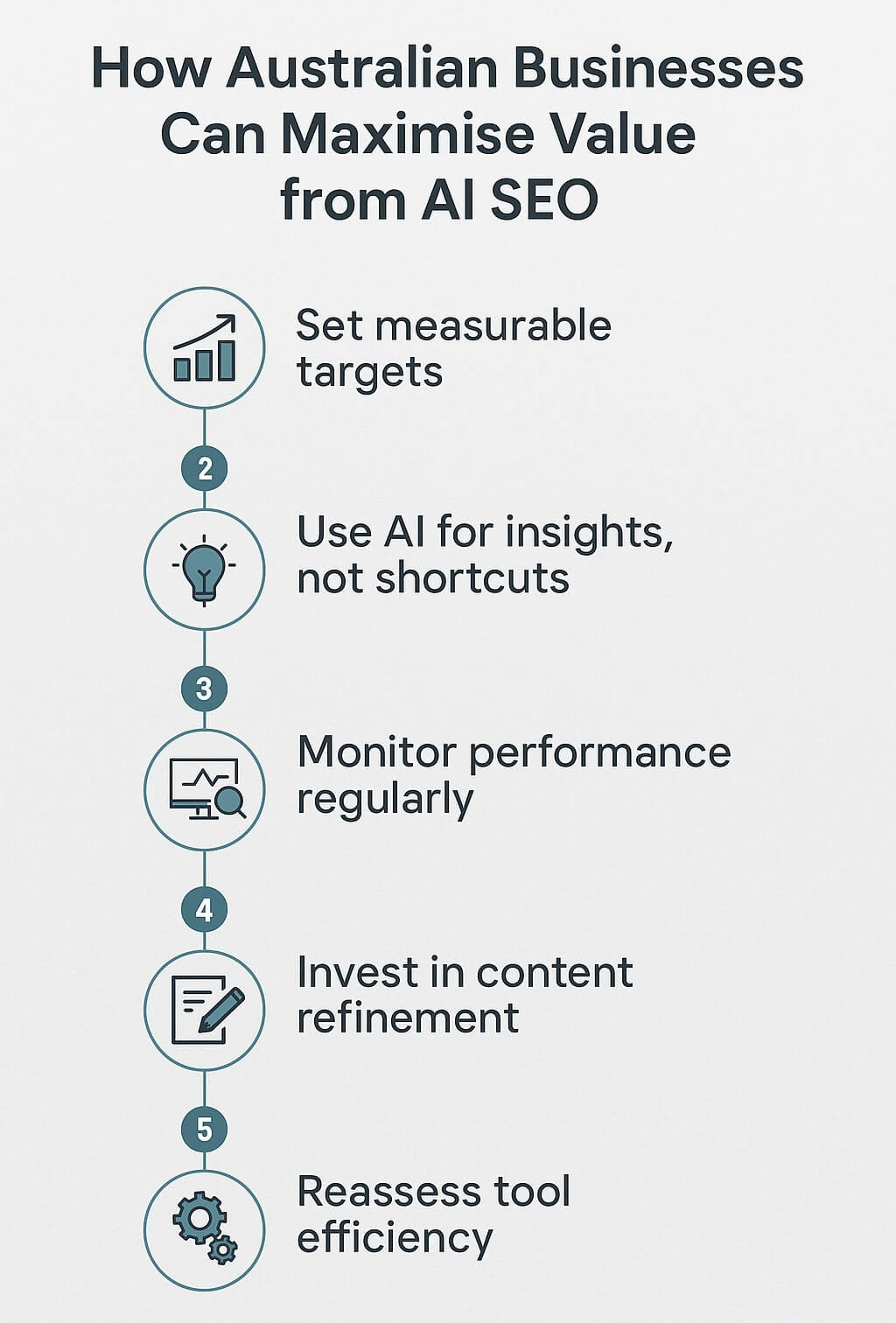
How Australian Businesses Can Maximise Value from AI SEO


Success depends on integrating AI strategically rather than using it as a substitute for expertise. Marketix recommends a structured approach built on clear goals, accurate measurement, and iterative improvement.
Set measurable targets. Define what success means: more organic traffic, better conversion rates, or improved visibility for specific pages.


  • Use AI for insights, not shortcuts. Let automation handle data-heavy tasks like keyword clustering, but maintain human review for tone and accuracy.

  • Monitor performance regularly. Real-time dashboards and predictive analytics help identify opportunities before trends change.

  • Invest in content refinement. AI-generated content still benefits from professional editing. Quality influences trust and conversion potential.

  • Reassess tool efficiency. Review subscriptions every few months to check if the data output matches actual results.


Following these steps prevents overreliance on automation and keeps campaigns grounded in business outcomes.


Common Mistakes Businesses Make with AI SEO


Even experienced marketers can face challenges when shifting to AI-driven systems. Some common missteps include:


  • Over-automation: Relying too heavily on algorithms without expert review often leads to off-brand content.

  • Neglecting strategy: AI may suggest topics, but it cannot define business priorities or audience needs.

  • Ignoring reporting accuracy: Some agencies produce data-heavy reports with limited actionable insights.

  • Underestimating setup costs: AI SEO tools require investment in both training and configuration.


Avoiding these errors helps maintain balance between efficiency and control, ensuring every dollar spent contributes to meaningful growth.


Final Thoughts


AI SEO continues to redefine how Australian businesses approach online growth. Pricing reflects the balance between technology investment and strategic expertise. Automation delivers faster analysis, yet long-term success still depends on human insight, clear planning, and consistent refinement.


Companies that view AI as a tool for smarter decision-making, rather than full automation, tend to see stronger results. The key is to integrate data-driven optimisation with experience and judgement. When those elements work together, the outcome is measurable growth, sustainable visibility, and a clear return on investment.


Ready to Improve Your AI SEO Results?

Get clear guidance and a tailored strategy for your business.