Pay-per-click (PPC) advertising remains one of the most measurable and widely used digital marketing channels. As AI, automation and increasing competition reshape platforms like Google Ads, understanding current benchmarks and industry trends has become more important than ever.
This report brings together the latest PPC statistics from Google, Alphabet, IAB Australia, Microsoft Advertising, Meta and leading benchmark studies, covering market growth, advertising spend, click-through rates, cost per click, conversion rates, automation, AI and industry-specific performance benchmarks.
The global digital advertising market has entered another period of strong expansion, and PPC remains one of its largest contributors.
Businesses increasingly prioritise channels where marketing spend can be measured directly against leads, sales and revenue, making paid search an attractive investment even during periods of economic uncertainty.
Australia reflects this trend.
Internet advertising expenditure reached $18.4 billion during 2025, increasing 11.5% compared with the previous year. Search and directories alone accounted for approximately $8.0 billion, making it the largest individual digital advertising category in the country.
That growth has continued into 2026.
During the first quarter of 2026, Australian internet advertising expenditure reached $4.9 billion, representing a 15.3% increase compared with Q1 2025. According to IAB Australia, growth broadened across more advertisers rather than being driven solely by the largest brands, suggesting that businesses of all sizes continue increasing investment in digital channels.
For PPC advertisers, these figures tell an important story.
Growing investment usually leads to greater competition within Google's advertising auctions. More advertisers bidding on commercial keywords often increases cost per click while simultaneously rewarding businesses that continually improve campaign structure, landing pages, audience targeting and conversion tracking.
The same pattern is visible internationally.
The Interactive Advertising Bureau (IAB) reported that US digital advertising revenue reached $300 billion during 2025, increasing 13.9% year on year. Search advertising remained one of the largest revenue contributors, alongside social media and digital video.
Although Australian and US markets differ significantly in size, both demonstrate the same long-term direction: businesses continue shifting advertising budgets towards measurable digital channels where performance can be optimised continuously.
Search advertising continues to outperform many other advertising formats because it reaches users when they already have intent.
Rather than interrupting someone's browsing experience, paid search appears when users actively look for a solution. Whether someone searches for "emergency plumber", "enterprise SEO agency" or "Google Ads management", those searches represent existing demand that advertisers can compete for immediately.
That commercial intent explains why search continues attracting the largest share of digital advertising budgets.
Australian search and directory advertising exceeded $8 billion during 2025, maintaining its position as the country's largest online advertising category.
Video advertising is growing rapidly, but search remains the foundation of performance marketing because it consistently delivers measurable business outcomes.
The FY2025 IAB Australia report showed that search advertising expenditure continued to grow alongside strong gains in digital video, illustrating how advertisers are increasingly combining demand capture with demand generation rather than choosing one channel over another.
From our experience at Marketix Digital, businesses that generate the strongest long-term PPC performance rarely treat search campaigns as isolated marketing activities.
Instead, they combine high-intent search campaigns with well-structured landing pages, accurate conversion tracking and ongoing optimisation to continually improve acquisition costs over time.
Businesses looking to improve campaign performance beyond industry averages often partner with a specialist Google Ads agency that focuses on ongoing optimisation, conversion tracking and commercial growth.
No discussion about PPC is complete without Google.
Despite increased competition across retail media, paid social and AI-powered discovery platforms, Google continues to generate enormous advertising revenue through Search, reinforcing its position as the world's leading PPC platform.
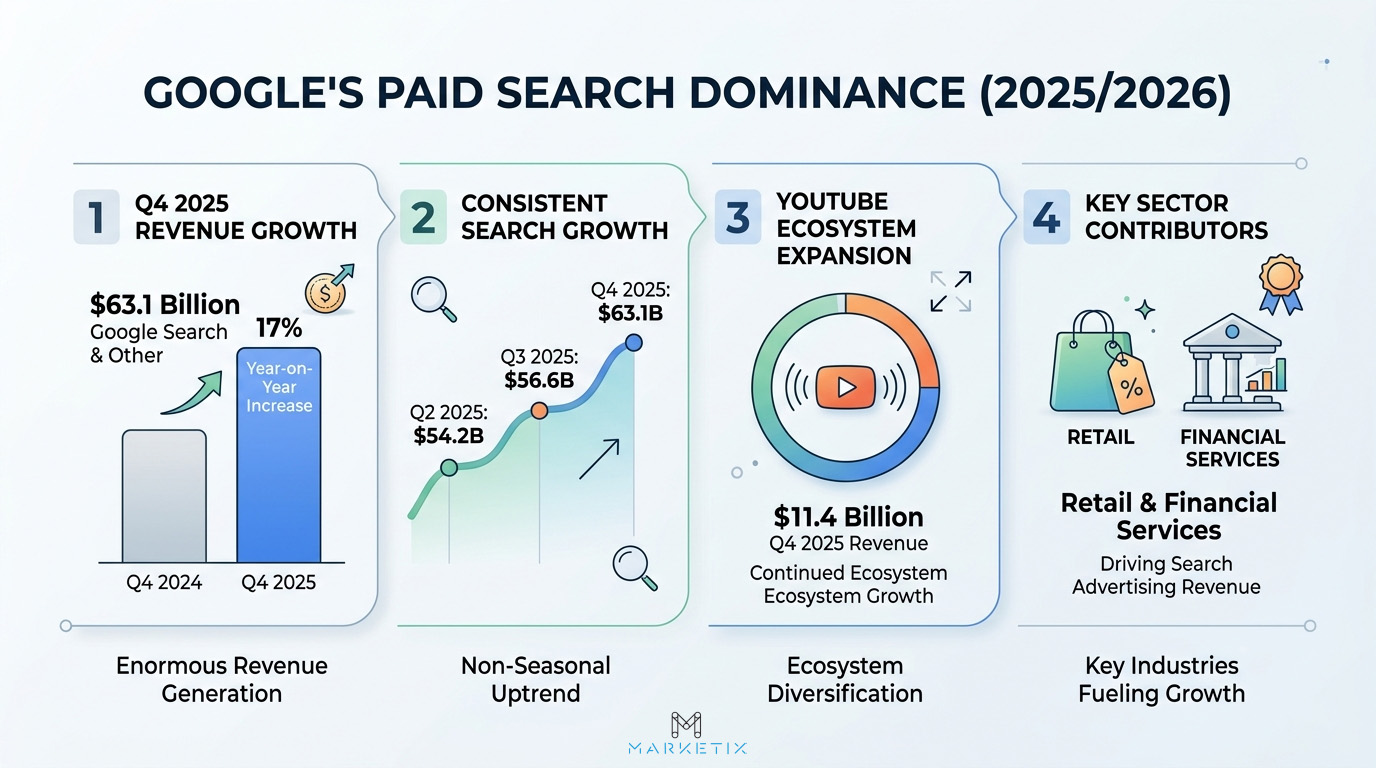
Alphabet reported that Google Search & Other advertising generated $63.1 billion during Q4 2025, representing 17% year-on-year growth. At the same time, YouTube advertising revenue reached $11.4 billion, demonstrating continued expansion across Google's advertising ecosystem.
This wasn't an isolated quarter.
Google Search & Other advertising generated $54.2 billion during Q2 2025 before increasing to $56.6 billion in Q3, showing consistent growth throughout the year rather than seasonal volatility alone.
Alphabet also identified retail and financial services as two of the strongest contributors to Search advertising growth, reflecting continued competition within commercially valuable industries.
For advertisers, Google's financial performance matters because it reflects ongoing advertiser demand.
As more businesses invest in Google Ads, competition within auctions typically increases. Success becomes less dependent on simply bidding more aggressively and more dependent on campaign quality, audience relevance, keyword selection and conversion optimisation.
Businesses evaluating whether professional campaign management is worthwhile often compare advertising budgets with management costs. Our detailed guide to Google Ads and PPC management pricing explains the factors influencing management fees and what businesses should expect when outsourcing campaign optimisation.
Market growth explains why businesses continue investing in PPC, but campaign benchmarks provide a better indication of day-to-day performance.
Metrics such as click-through rate, cost per click, conversion rate and cost per lead allow advertisers to compare their campaigns with broader industry performance while identifying opportunities for improvement.
According to LocaliQ's 2026 Search Advertising Benchmarks report, the average Google Search Ads click-through rate reached 6.64% across industries.
A higher click-through rate generally indicates that advertisers are matching search intent effectively through relevant keywords, compelling ad copy and strong offers.
It also contributes positively towards expected click-through rate, which forms part of Google's Quality Score calculation.
Click-through rate alone doesn't determine campaign success, though.
Cost per click varies significantly between industries because advertisers compete for customers with very different commercial values.
Keywords within legal services, finance or enterprise software often command much higher bids than those in retail or hospitality because each new customer may generate substantially more lifetime revenue.
The same benchmark report also highlights considerable variation in conversion rates and cost per lead across industries, reinforcing the importance of comparing campaigns against businesses with similar commercial models rather than relying on one overall PPC average.
WordStream's latest benchmark analysis, based on more than 16,000 Google Ads campaigns, reached similar conclusions. It found that average cost per lead continued increasing during 2025, illustrating how greater auction competition and higher customer acquisition costs are influencing advertiser performance across many sectors.
One important distinction is worth making.
These benchmark figures relate specifically to Search advertising. They should not be compared directly with Display campaigns, Performance Max, Shopping campaigns or paid social advertising, where user intent, targeting methods and conversion behaviour differ considerably.
As we'll explore later in this report, campaign type has become just as important as industry when evaluating PPC performance.

Comparing your Google Ads performance with a general PPC average can be misleading.
Every industry competes in a different auction environment. A solicitor targeting commercial litigation keywords faces very different advertising costs from an ecommerce retailer selling homewares, while a local plumber competes under different conditions again.
Customer lifetime value, buying intent, competition and conversion behaviour all influence campaign performance.
This is why industry-specific benchmarks are far more valuable than broad PPC averages.
LocaliQ's 2026 benchmark reports show substantial differences in click-through rate, cost per click, conversion rate and cost per lead across sectors including healthcare, home services, automotive, and real estate. Each vertical demonstrates its own performance profile rather than following one universal benchmark.
For example:
Healthcare advertisers often compete in highly specialised markets where trust and qualification significantly influence conversion rates.
Home service businesses generally benefit from strong purchase intent because many searches relate to urgent problems requiring immediate assistance.
Automotive campaigns vary considerably depending on whether advertisers promote dealerships, servicing, repairs or aftermarket parts.
Real estate campaigns typically generate lower conversion rates due to longer decision-making cycles and higher-value enquiries.
The key takeaway is straightforward: benchmark against businesses with similar customers, buying journeys and commercial objectives, not against every advertiser using Google Ads.
We've found that campaigns often appear underperforming when compared with overall averages, yet outperform direct competitors within their own industry. Context matters far more than isolated numbers.
Clicks generate traffic.
Conversions generate leads.
Profitable customer acquisition generates business growth.
While metrics such as click-through rate and cost per click remain useful indicators of campaign health, they rarely tell the complete story. A campaign producing inexpensive clicks can still lose money if those visitors never become customers.
This is why experienced PPC specialists increasingly optimise around commercial outcomes instead of traffic metrics alone.
The most valuable performance indicators typically include:
Cost per acquisition (CPA)
Cost per lead (CPL)
Return on ad spend (ROAS)
Customer lifetime value (CLV)
Lead-to-sale conversion rate
Revenue generated
Google's own case studies reflect this shift.
Travelstart reported a 27% increase in year-on-year revenue after changing its optimisation strategy from maximising conversion volume to prioritising conversion value through AI-powered bidding. Rather than treating every conversion equally, campaigns focused on attracting customers who generated greater commercial value.
That distinction has become increasingly important.
Many businesses still optimise towards the lowest possible cost per lead, yet a cheaper lead isn't necessarily a better one. A campaign producing fewer, higher-quality enquiries often delivers stronger profitability than one generating large numbers of low-intent leads.
This is also why ROAS should be interpreted carefully.
There is no universal "good" return on ad spend because profitability varies according to margins, fulfilment costs, repeat purchases, average order value and customer retention.
An ecommerce retailer may require a significantly higher ROAS than a professional services firm where one new client generates years of recurring revenue.
Despite the rapid growth of AI-powered bidding and campaign automation, Google's Quality Score remains one of the most influential factors affecting paid search performance.
Quality Score is Google's estimate of the overall relevance and usefulness of your ads, keywords and landing pages. While Google doesn't disclose the exact weighting of every factor, three core signals continue to shape Quality Score:
Expected click-through rate
Ad relevance
Landing page experience
These signals directly influence Ad Rank alongside bidding strategy.
In practical terms, advertisers with stronger Quality Scores can often achieve higher ad positions without necessarily increasing their bids. Improving relevance frequently produces better commercial outcomes than simply spending more.
Although Google no longer encourages advertisers to obsess over the Quality Score metric itself, the principles behind it remain central to campaign optimisation. Highly relevant ads that satisfy search intent typically generate stronger engagement, better user experiences and more efficient advertising costs.
For businesses, this reinforces an important principle: PPC performance is rarely determined by budget alone. Campaign structure, keyword targeting, ad messaging and landing page quality all contribute towards long-term success.
Artificial intelligence has moved from being an optional feature to becoming the foundation of modern PPC management.
Today, Google's machine learning systems influence keyword matching, bidding decisions, audience expansion, creative combinations and conversion forecasting. Microsoft's advertising platform has followed a similar path, while Meta continues investing heavily in AI-powered ad delivery.
One of Google's most notable developments is Smart Bidding Exploration.
According to Google, advertisers using Smart Bidding Exploration experienced an 18% increase in unique search-query categories producing conversions, alongside a 19% increase in conversions overall. The objective is to identify valuable searches that traditional bidding strategies may overlook while continuing to optimise towards advertiser goals.
Google has also expanded its focus on value-based bidding, encouraging advertisers to optimise campaigns around customer value rather than simply maximising conversion numbers.
This reflects a broader shift occurring throughout PPC.
Instead of asking:
"How do we generate more conversions?"
Advertisers are increasingly asking:
"How do we generate more profitable conversions?"
Google's wider digital marketing outlook for 2026 also highlights AI's growing role across campaign management, audience understanding and creative development as customer journeys become increasingly fragmented across Search, YouTube, Discover and other digital touchpoints.
Automation is reducing manual workload.
It isn't removing the need for strategic oversight.
Experienced PPC managers now spend less time adjusting bids manually and more time improving conversion tracking, creative strategy, audience targeting and business data feeding Google's optimisation algorithms.
Performance Max represents Google's biggest structural change to paid advertising in recent years.
Rather than creating separate Search, Display, Shopping or YouTube campaigns, advertisers can use a single Performance Max campaign to access Google's full advertising inventory, including:
Search
Shopping
Display
YouTube
Discover
Gmail
Google Maps
The objective is straightforward.
Google's AI determines where, when and to whom ads should appear using advertiser goals, audience signals, creative assets and conversion data.
Since its launch, Google has continued expanding reporting transparency and advertiser controls, addressing one of the largest criticisms of Performance Max's early versions.
New reporting improvements introduced during 2025 provide greater visibility into campaign performance and search themes while retaining AI-driven optimisation.
Microsoft has taken a similar approach.
According to Microsoft Advertising, advertisers using Microsoft Performance Max campaigns achieved an average 8% increase in incremental conversions, demonstrating that automated, cross-channel optimisation is becoming increasingly common beyond Google's own ecosystem.
These figures should be interpreted carefully.
They are platform-reported results rather than independent industry benchmarks. Actual performance will always depend on campaign quality, conversion tracking, audience signals and business objectives.
As automation becomes more sophisticated, the quality of conversion data has become one of the biggest competitive advantages in PPC.
Machine learning systems optimise towards the information they receive.
If conversion tracking is incomplete or inaccurate, automated bidding decisions become less reliable regardless of campaign budget.
Google reports that advertisers implementing Google Tag Gateway observed an average 14% increase in recorded conversions, illustrating how better measurement alone can improve optimisation opportunities.
Another Google case study demonstrates the problem from a different angle.
Paylocity initially matched only 12% of Google Ads leads with its CRM before improving its measurement infrastructure, highlighting how missing customer data can distort campaign optimisation and reporting.
For advertisers investing significant budgets, conversion tracking should no longer be treated as a technical afterthought.
It is the foundation that allows AI-powered bidding strategies to make intelligent optimisation decisions.
Although search advertising captures existing demand, many businesses now combine PPC with paid social campaigns to reach customers throughout different stages of the buying journey.
Search helps businesses connect with users actively looking for a product or service.
Paid social often introduces brands to audiences before that search ever happens.
Meta's financial results demonstrate continued advertiser confidence in social advertising.
During full-year 2025, Meta reported that ad impressions increased 12%, while the average price per ad increased 9%.
That momentum continued into 2026.
During Q1 2026, Meta reported a 19% increase in ad impressions alongside a 12% increase in average price per ad, suggesting advertisers continue investing despite rising competition.
Meta also attributes ongoing performance improvements to AI, reporting a 3.5% increase in Facebook ad clicks and more than a 1% improvement in Instagram conversions following enhancements to its recommendation systems.
These statistics should not be compared directly with Google Ads benchmarks.
Search advertising and paid social serve different purposes, rely on different user behaviours and measure success differently.
Several clear themes emerge from the latest Australian advertising data.
Digital advertising investment continues increasing.
Search remains the country's largest online advertising category.
Automation and AI continue influencing campaign management.
Competition within advertising auctions is intensifying.
Taken together, these trends suggest Australian businesses should expect PPC to become increasingly sophisticated rather than simply more expensive.
Success will depend less on manually adjusting bids and more on building strong measurement frameworks, producing relevant creative assets, understanding customer behaviour and feeding accurate business data into increasingly intelligent advertising platforms.
The latest PPC statistics point towards one consistent conclusion.
Businesses that treat Google Ads as a simple bidding platform are likely to struggle as automation becomes more advanced and competition continues increasing.
The strongest-performing advertisers are focusing on fundamentals that remain within their control:
Accurate conversion tracking
Commercially relevant campaign structures
High-quality landing pages
Industry-specific benchmarking
AI-assisted optimisation supported by human oversight
Continuous testing and refinement
Clicks and impressions still matter, but they are no longer the ultimate measure of success.
Campaign profitability, customer acquisition costs and long-term business growth provide a far clearer picture of advertising performance.
For businesses looking to improve campaign performance, understanding industry benchmarks is only the starting point. Applying those insights strategically is what ultimately separates average PPC campaigns from those that consistently generate profitable growth.
If you're looking for experienced support with campaign strategy, optimisation and ongoing performance management, learn more about our PPC Agency Sydney services and how we help businesses turn advertising spend into measurable commercial results.
Recent Posts
Download our 24-page SEO book to learn:
You have successfully joined our subscriber list.
Recent Posts