Most SEO Strategies Fail Because They Start in the Wrong Place
If you ask ten SEO agencies how they develop a strategy, you'll probably hear a familiar process.
Keyword research > Content planning > Site architecture > Technical SEO > Backlinks > Reporting
Each of these activities has value. The problem is that they rarely begin with the one thing that should determine every decision that follows: the commercial objectives of the business.
As a result, many SEO campaigns succeed on paper while failing where it matters most.
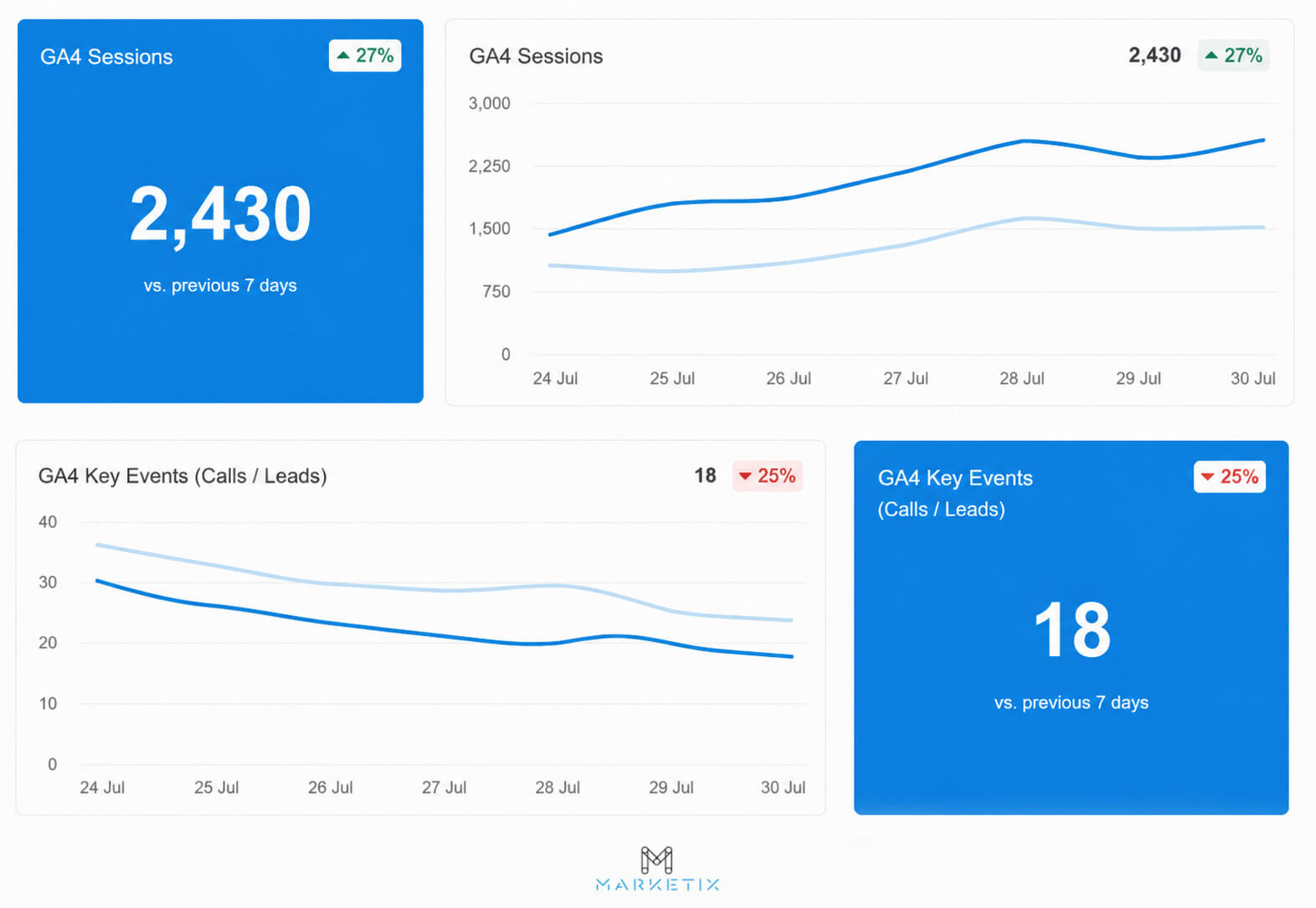
Rankings improve. Organic traffic grows. More keywords reach page one. Yet revenue barely changes, sales teams see little difference in lead quality, and businesses begin questioning whether SEO actually works.
In many cases, SEO isn't the problem.
The strategy is.
Most SEO strategies fail long before a keyword is researched or a page is published because they begin with tactics instead of business objectives.
The focus becomes how to optimise a website before establishing why the business is investing in SEO in the first place.
In our experience, we've found that the sequence matters just as much as the execution.
Which means:
A business trying to maximise profit should not have the same SEO strategy as one expanding into new markets.
An eCommerce retailer focused on customer lifetime value should not approach keyword prioritisation the same way as a local service business trying to increase booked jobs.
Before search demand, before content and before backlinks, there must be clarity around what commercial success actually looks like.
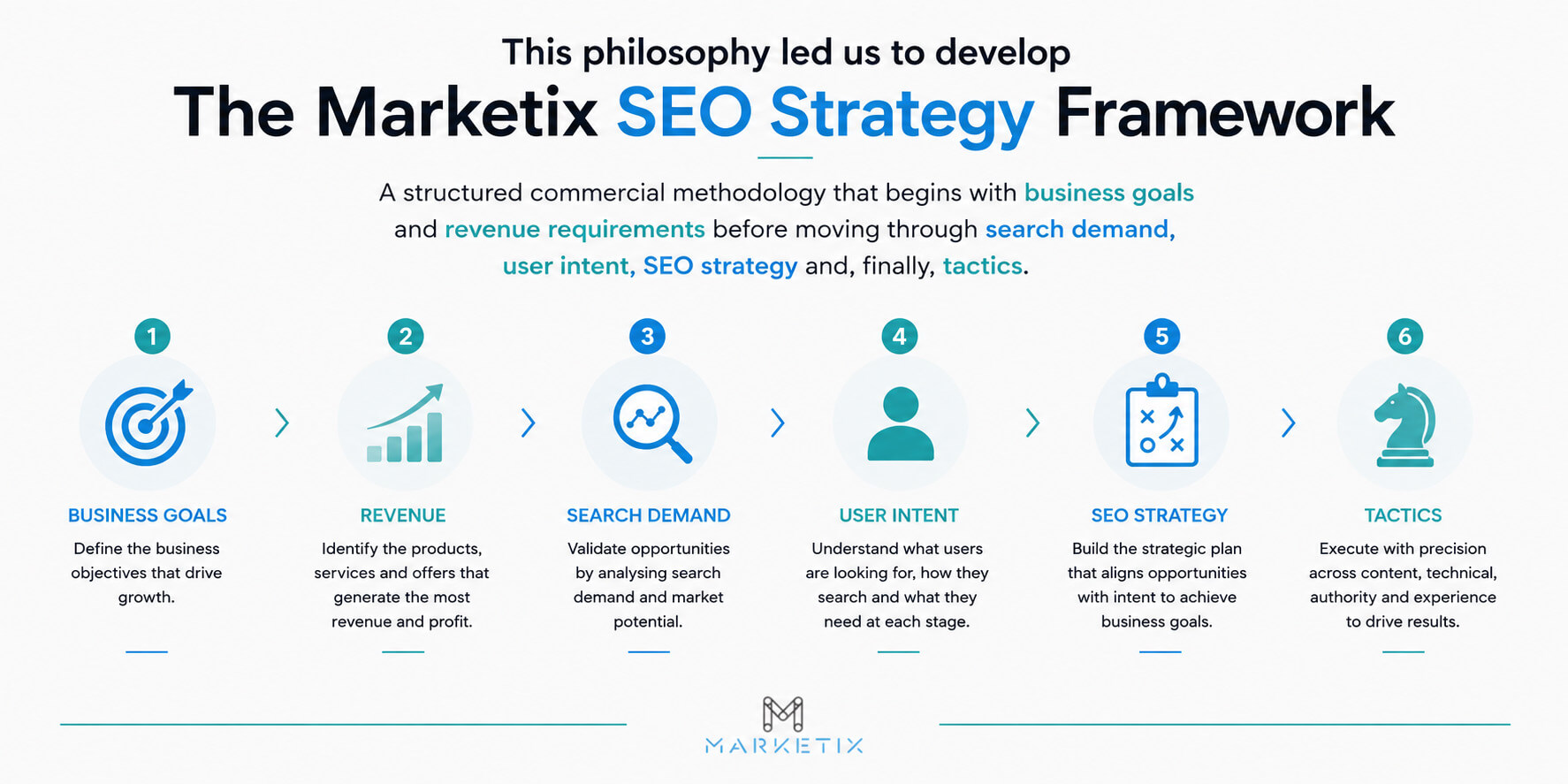
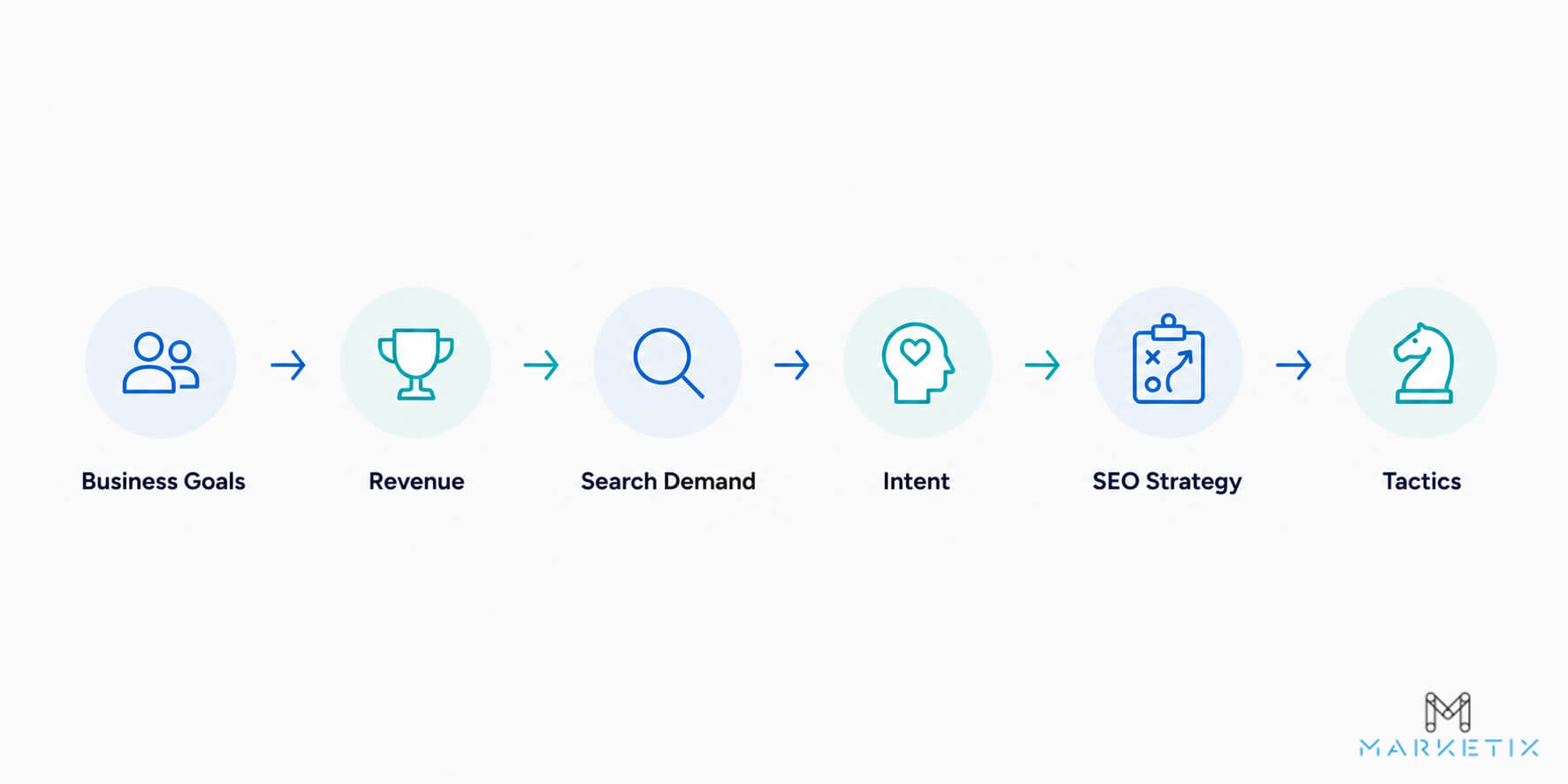
This philosophy led us to develop The Marketix SEO Strategy Framework, a structured commercial methodology that begins with business goals and revenue requirements before moving through search demand, user intent, SEO strategy and, finally, execution.
So, rather than asking "What keywords should we target?" we begin with a different question: "What business outcome are we trying to achieve?"
That single shift changes every decision that follows.
Throughout this guide, we'll explain why many traditional SEO approaches struggle to produce consistent commercial outcomes, introduce the six-stage framework we use to build SEO strategies, and demonstrate how every tactical decision should ultimately trace back to a measurable business objective.
SEO should not begin with search.
It should begin with the business.
The SEO industry has become exceptionally good at teaching tactics.
There are endless guides explaining how to conduct keyword research, optimise title tags, earn backlinks, improve Core Web Vitals and build topical authority.
New tools emerge every year to make these activities faster and more sophisticated.
Yet despite all this knowledge, many businesses continue to invest heavily in SEO without seeing proportional business growth.
Why?
Because tactics are often mistaken for strategy.
A tactic answers the question: "What should we do?"
A strategy answers: "Why are we doing it, and how does it contribute to the business?"
Those are fundamentally different questions.
Consider a business that wants to increase revenue from its highest-margin service.
A tactic-first SEO approach might identify the highest-volume keywords in the industry, produce dozens of informational articles, improve internal linking, acquire backlinks and celebrate a 40% increase in organic traffic.
From an SEO perspective, the campaign appears successful.
But if most of that new traffic comes from users who were never likely to become customers, the commercial outcome remains unchanged.
Now consider the same business through a commercial lens.
Instead of asking which keywords receive the most searches, the conversation should begin with identifying the services that generate the greatest commercial value.
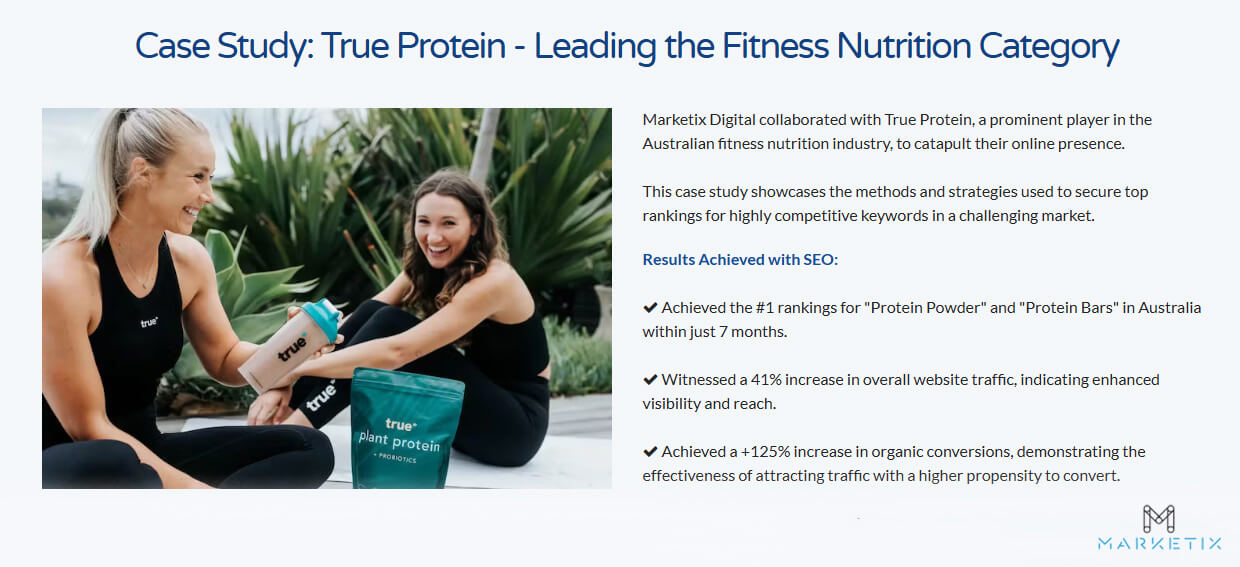
Take our work with True Protein, one of Australia's leading sports nutrition brands.
Before we researched a single keyword or planned any content, we spent time with the client's leadership team to understand the business. The discussions weren't about rankings or search volume. They focused on commercial questions:
Which product categories drive the most revenue?
Which products offer the greatest long-term growth opportunity?
Where is the business losing market share?
Which categories should become the highest priority over the next 12–24 months?
Those conversations shaped the SEO strategy.
Rather than targeting every high-volume keyword in the fitness industry, we prioritised the product categories that aligned most closely with the client's commercial objectives.
Only once those priorities had been established did we analyse search demand, map user intent, develop the site architecture and create the supporting content strategy.
The outcome was more than just improved visibility. True Protein achieved #1 rankings for highly competitive terms including "protein powder" and "protein bars", increased organic traffic by 41%, and generated a 125% increase in organic conversions.
See the full True Protein case study.
The important lesson isn't the rankings.
It's that the rankings were the result of a commercial strategy, not the starting point.
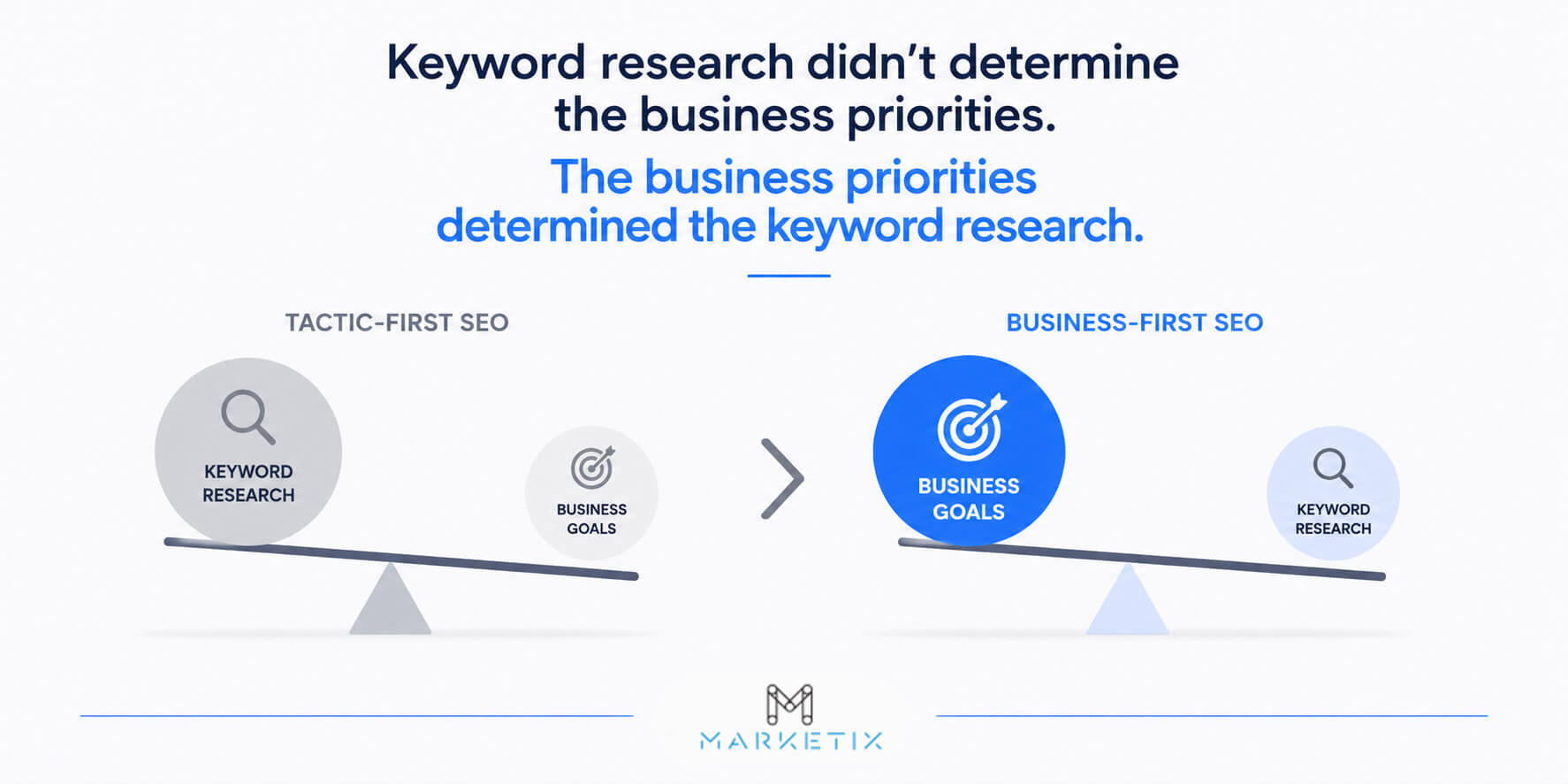
Keyword research didn't determine the business priorities. The business priorities determined the keyword research.
That's the fundamental difference between a tactic-first SEO strategy and a business-first one.
Once commercial priorities are established, the rest of the framework begins to unfold naturally.
Revenue priorities shape the opportunities worth investing in. Search demand validates whether those opportunities exist. User intent determines how potential customers search, compare and make decisions.
Only then can a genuine SEO strategy be developed, with tactics chosen to support that strategy rather than define it.
The difference isn't the quality of execution.
It's the order of decision-making.
This is where many SEO strategies quietly fail.
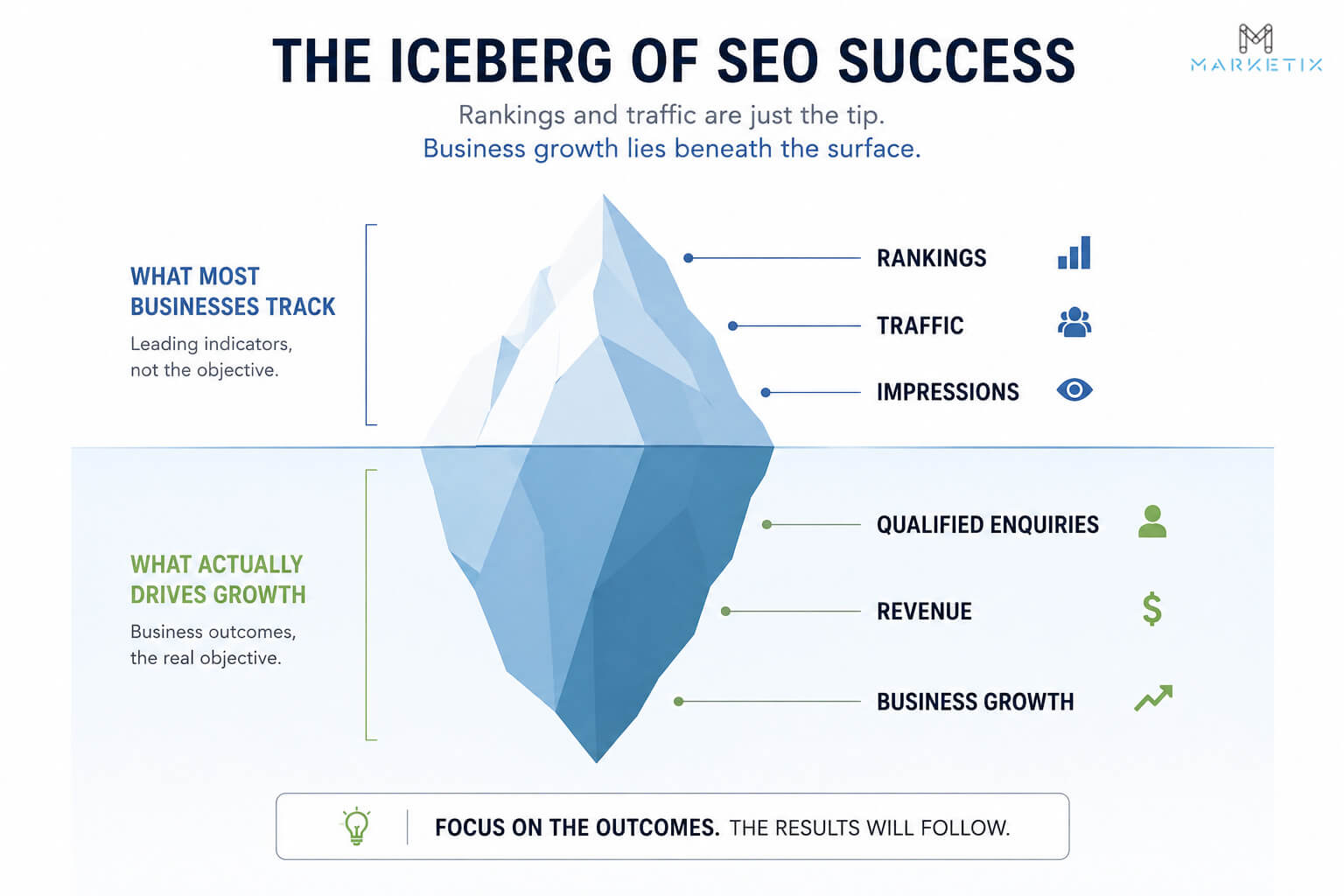
Businesses often measure rankings, impressions and traffic because they're easy to report.
Agencies naturally optimise towards those metrics because they demonstrate visible progress.
Over time, those indicators become the perceived objective rather than what they were always meant to be: signals that support business growth.
Higher rankings do not guarantee more customers.
More traffic does not guarantee more revenue.
Even page one positions have little value if they fail to attract people who are ready, willing and able to buy.
Technical optimisation, content creation, internal linking, authority building and digital PR all remain essential components of successful SEO.
The mistake is allowing those tactics to dictate the strategy instead of supporting it.
A business-first SEO strategy works in the opposite direction. It starts by understanding what the business needs to achieve commercially, then uses search as the mechanism for achieving those objectives.
That distinction may seem subtle.
In practice, it changes almost every decision that follows.
To solve this problem, Marketix Digital developed a structured framework that deliberately separates commercial strategy from SEO execution.
Instead of beginning with keywords or content, the framework starts with the business itself.
Every stage exists for a reason.
Every stage informs the next.
Skipping a stage weakens every decision that follows.
The framework is intentionally sequential because SEO should never operate independently of commercial priorities.
It begins with Business Goals, defining what the business is trying to achieve and what success actually looks like.
Those goals establish the Revenue priorities by identifying the products, services, customer segments or markets that will have the greatest commercial impact.
Once those commercial priorities are clear, Search Demand validates whether people are actively searching for those opportunities and where the greatest organic potential exists.
Understanding demand alone isn't enough. Intent reveals how potential customers think, compare options and make purchasing decisions, ensuring the strategy aligns with genuine buying behaviour rather than search volume alone.
Only after those four stages have been completed can a genuine SEO Strategy be developed.
Information architecture, keyword prioritisation, content planning, internal linking and authority building are no longer based on assumptions; they're informed by commercial objectives and customer demand.
Finally come the Tactics. Technical SEO, content production, schema, digital PR, backlink acquisition and on-page optimisation are all essential, but they exist to execute the strategy rather than define it.
This is perhaps the biggest difference between the Marketix framework and many traditional SEO approaches.
Traditional SEO | The Marketix Framework |
What keywords should we target? | What business outcome are we trying to achieve? |
Search volume drives priorities | Business goals drive priorities |
Revenue is the hoped-for outcome | Revenue shapes the strategy |
Keyword research comes first | Keyword research validates commercial priorities |
Strategy follows the tactics | Tactics execute the strategy |
SEO success = rankings & traffic | SEO success = measurable business growth |
Most agencies begin with tactics and hope they produce commercial outcomes.
We begin with commercial outcomes and allow them to determine the tactics.
Whether you're a local service business, an eCommerce retailer or a B2B organisation, the principle remains the same.
SEO is not the objective.
SEO is the mechanism through which business objectives are achieved.
Throughout the remainder of this guide, we'll examine each stage of the framework in detail, demonstrating how they work together to create an SEO strategy that is commercially grounded, measurable and directly connected to business growth.
The Six-Stage Framework
Each stage builds on the previous one, ensuring every SEO decision is guided by commercial objectives rather than tactics alone.
Every SEO strategy should begin by answering one question:
What is the business trying to achieve?
SEO cannot determine that objective. It can only support it.
A business focused on increasing profit requires a different SEO strategy from one expanding into new markets, growing market share or launching a new product.
Before researching keywords or planning content, the commercial objective must be clear because it determines where SEO investment should be directed.
Business Goal | How It Changes the SEO Strategy |
Increase profit | Prioritise high-margin products or services over high-volume keywords. |
Expand into new locations | Build location-specific landing pages and strengthen local authority. |
Increase market share | Target competitor keywords and strengthen topical authority in strategic categories. |
Grow recurring revenue | Focus on attracting customers with higher lifetime value rather than one-off sales. |
Launch a new product or service | Build content and authority around the new offering before expanding into broader topics. |
The impact of this approach becomes obvious when looking at real businesses.
For example, one of our clients, Mills Shelving, supplies retail shelving systems to businesses across Australia.
During our initial strategy sessions, we didn't begin by asking which shelving keywords had the highest search volume.
Instead, we focused on understanding how the business generated revenue.
Those discussions identified gondola shelving as one of the company's most commercially important product categories.
It consistently generated larger B2B projects, higher-value quotations and stronger long-term commercial opportunities than many other products.
That insight shaped the SEO strategy.
Rather than giving every product category equal attention, we prioritised the pages, content and supporting resources that aligned with the business's commercial objectives.
Keyword research was then used to validate the opportunity and determine how customers searched for those products, not to decide what the business should prioritise.
The same principle applies across every business model:
eCommerce SEO: Prioritise the product categories with the highest revenue potential, strongest margins or greatest long-term growth opportunities.
Local service businesses SEO: Focus on the services and locations that generate the greatest commercial value rather than the highest search volume.
B2B SEO: Prioritise the products, services or industries that lead to larger projects, higher-value quotations or long-term client relationships.
SaaS SEO: Optimise for qualified trials, demo requests and recurring subscriptions rather than website traffic alone.
Once the business goal is clearly defined, every stage that follows becomes easier.
Revenue priorities can be established, search demand can be validated, user intent can be mapped, and an SEO strategy can be developed with a clear commercial purpose.
Because SEO doesn't create business goals.
It executes them.
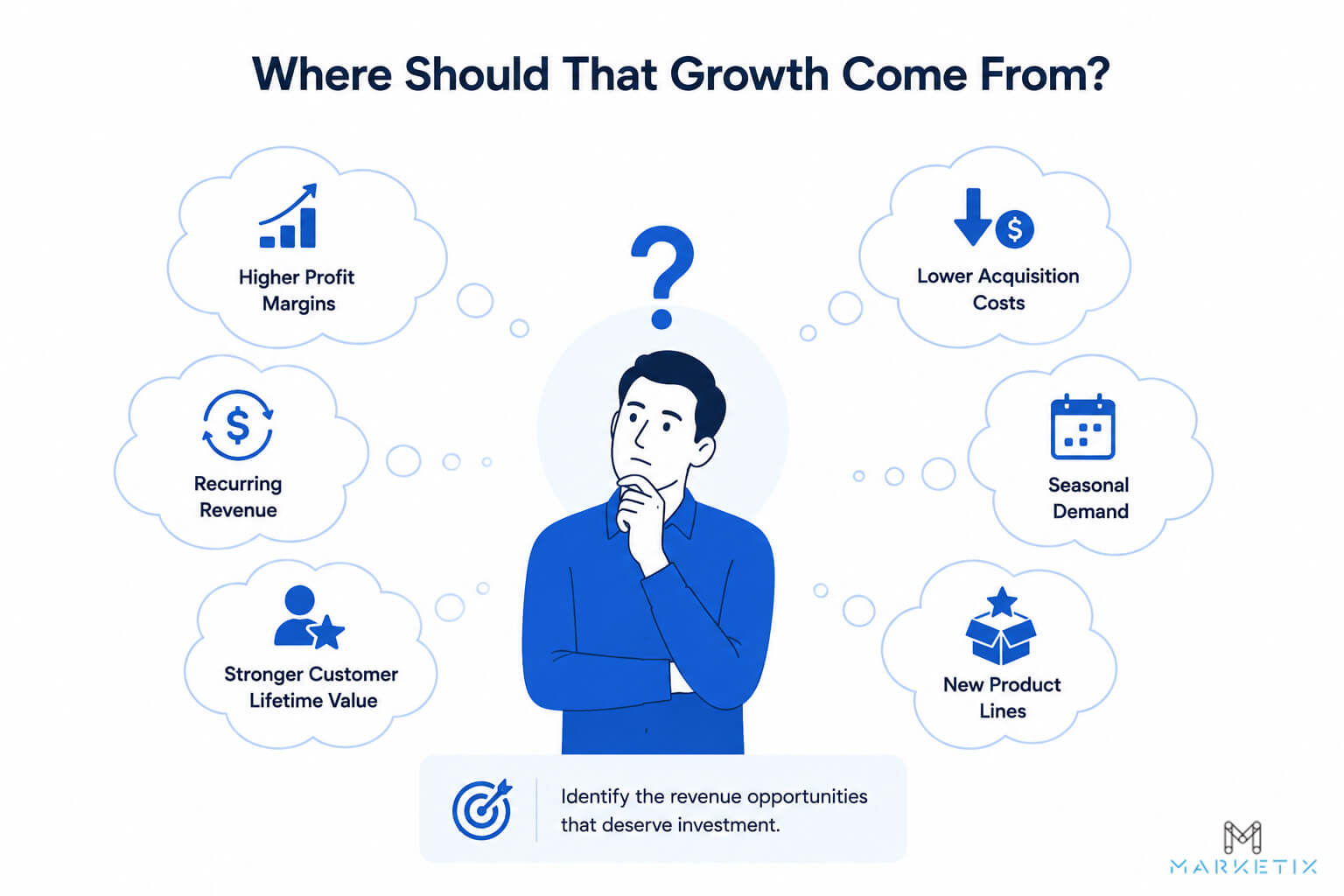
Once the business goal has been defined, the next question is:
Where should that growth come from?
This is where many SEO strategies jump straight to keyword research.
The Marketix framework doesn't.
Instead, it first identifies the revenue opportunities that deserve investment.
Not all revenue is equal.
Some products generate higher profit margins. Some services lead to recurring revenue.
Others have stronger customer lifetime value or significantly lower acquisition costs. Seasonal services may become commercial priorities during specific periods of the year, while new product lines may deserve greater visibility to support long-term growth.
SEO should reflect commercial priorities.
A business generating 20 enquiries for a premium service can be far more profitable than one generating 100 enquiries for a low-margin offering.
Likewise, a product with lower search volume may create significantly greater business value if it leads to larger projects, repeat customers or higher-value sales.
Revenue should determine what deserves to rank, not simply what receives the most searches.
Commercial Opportunity | SEO Priority |
High-margin services | High |
Recurring revenue products | High |
High customer lifetime value | High |
Strategic growth categories | High |
Low-margin or low-value offerings | Lower, unless they support broader business goals |
This becomes obvious when comparing search volume with commercial value.
High Search Volume | High Commercial Value |
More visitors | Greater business impact |
Measures popularity | Measures commercial opportunity |
Doesn't guarantee revenue | Directly supports business growth |
Used to validate demand | Determines SEO investment |
For example, an eCommerce retailer may find that a category with 2,000 monthly searches generates three times the profit of another attracting 10,000 searches.
A traffic-first SEO strategy would chase the larger keyword.
A revenue-first strategy invests where the business creates the greatest value.
The same principle applies to every business.
A law firm may prioritise commercial litigation over general legal services.
A construction company may focus on commercial projects rather than residential work.
A B2B supplier may target enterprise clients instead of high-volume, low-value orders.
The objective isn't to maximise traffic.
It's to maximise commercial return.
Once revenue priorities have been established, the next step is validating whether customers are actively searching for those opportunities.
With revenue priorities established, the next step is validating whether enough search demand exists to support them.
Once revenue priorities have been established, the next question is simple:
Are customers actually searching for these opportunities?
Business goals define what the company wants to achieve.
Revenue identifies where that growth should come from.
Search demand validates whether the market supports those priorities.

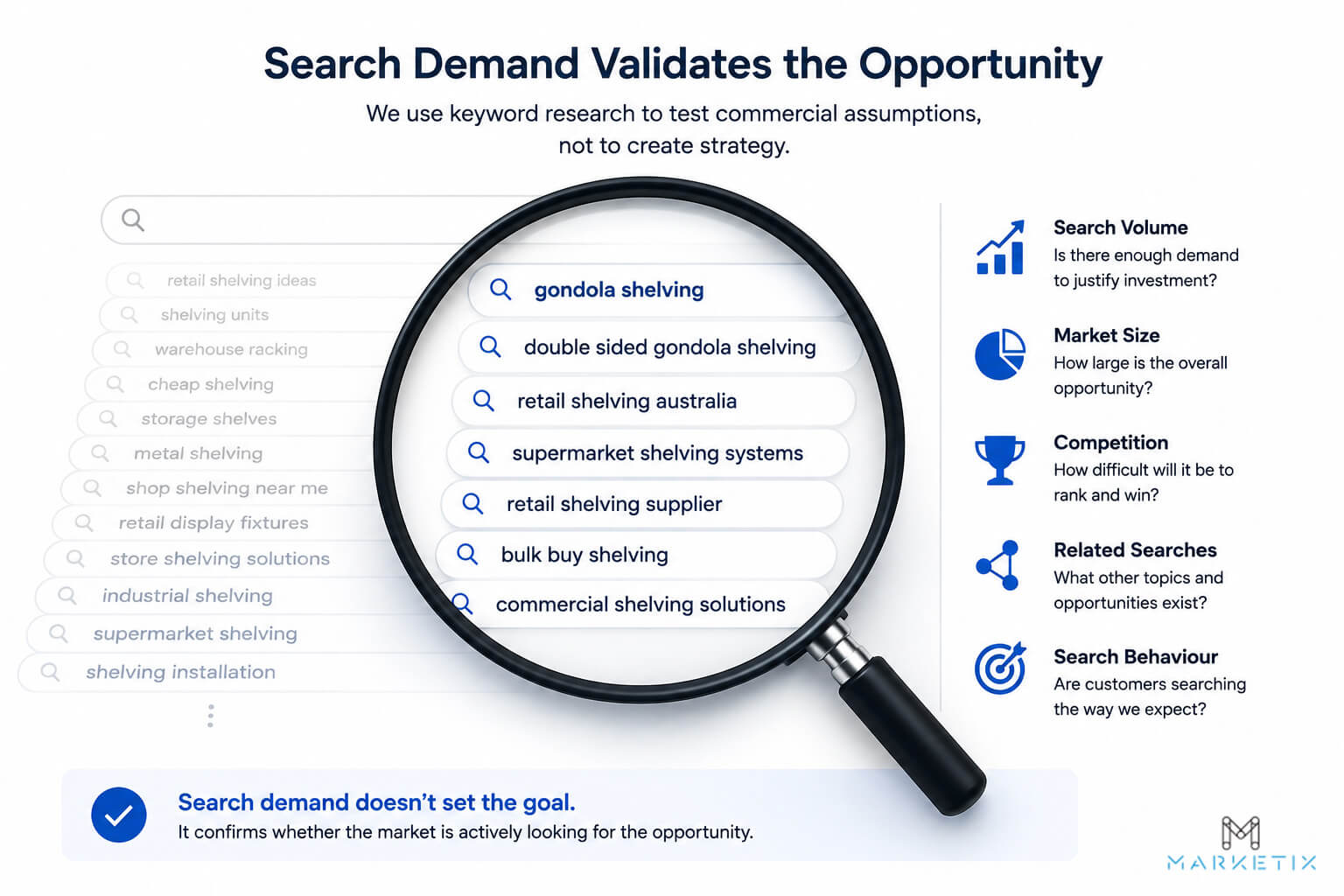
Keyword research is no longer used to decide what the business should prioritise. Instead, it validates whether the commercial opportunity is supported by real customer demand.
Search demand helps answer questions such as:
Is there enough search volume to justify investment?
How large is the potential market?
How competitive is the opportunity?
What related searches and content opportunities exist?
Are customers searching the way the business expects?
For example, a business may identify a high-margin service as its top commercial priority.
Keyword research might reveal strong search demand and a realistic opportunity to compete, or it may reveal that demand is too limited to justify a significant SEO investment.
Neither outcome changes the business objective.
It simply determines whether SEO is the right channel to support it.
"Keyword research shouldn't tell a business what to sell. It should tell us whether customers are already looking for what the business wants to grow."
Shoaib Mughal, Founder of Marketix Digital
Commercial priorities alone aren't enough.
They need to be validated by real customer demand.
Revenue identifies the opportunity. Search demand confirms whether the market supports it.
By this stage, we've identified a commercially valuable opportunity and confirmed that people are actively searching for it.
The next question is: What is the searcher trying to achieve?
Not every search has the same commercial value.
Two keywords can have similar search volume but represent completely different stages of the buying journey.
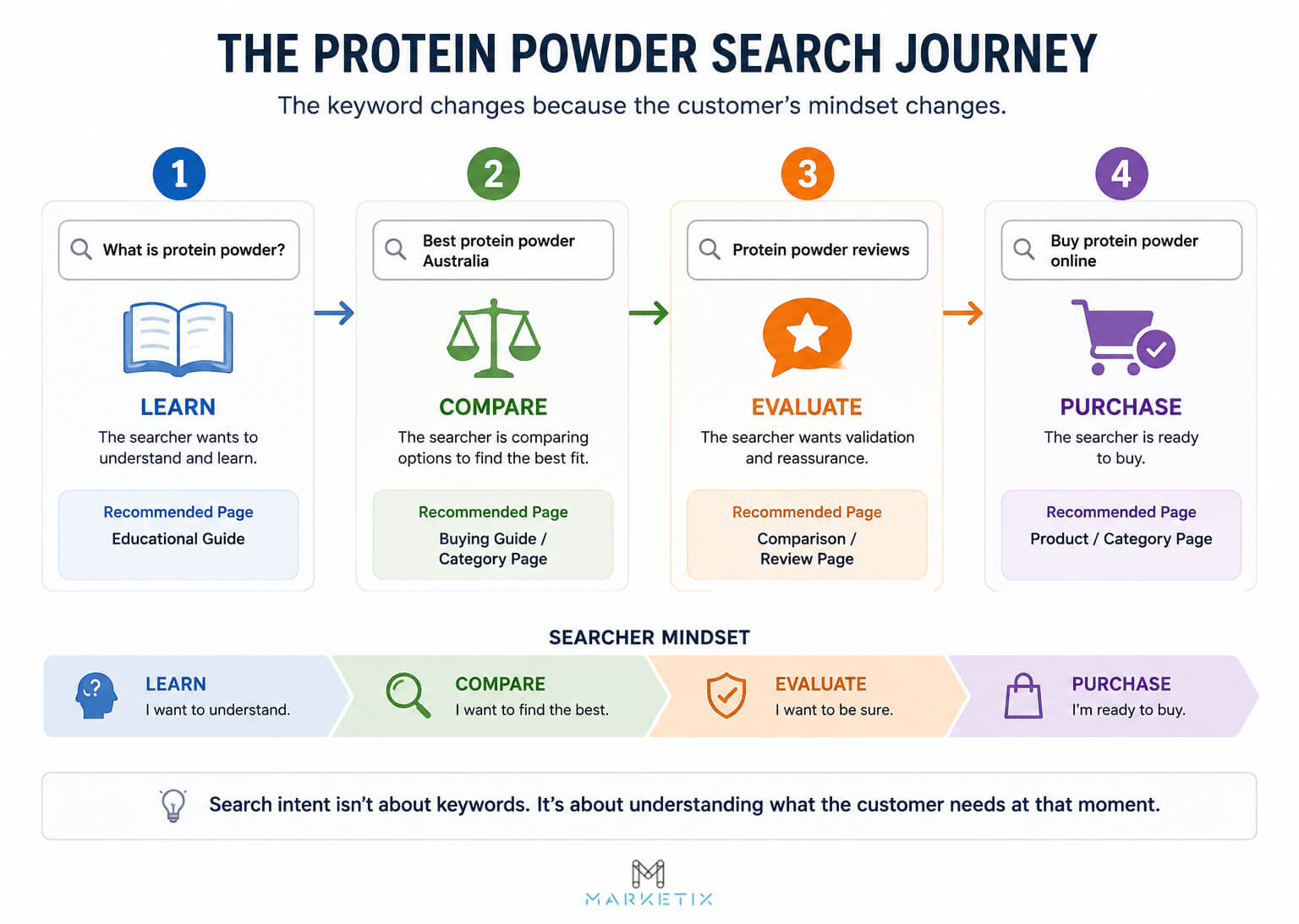
Take protein powder as an example.
Search Query | Likely Intent | Recommended Page |
What is protein powder? | Learn | Educational guide |
Best protein powder Australia | Compare | Buying guide or category page |
Protein powder reviews | Evaluate | Comparison or review page |
Buy protein powder online | Purchase | Product or category page |
Each search deserves a different experience.
Someone searching "What is protein powder?" is looking for education. A detailed guide that answers their questions and introduces related products is far more valuable than directing them to a product page.
Someone searching "Best protein powder Australia" is actively comparing options. They expect product comparisons, benefits, reviews and clear reasons to choose one brand over another.
By the time someone searches "Buy protein powder online," they're much closer to making a purchase. At that stage, pricing, trust signals, delivery information and a frictionless checkout experience become far more important than educational content.
This is why intent influences far more than keyword selection.
It determines:
The type of page you create.
The information you present.
The internal links that move users through the buying journey.
The calls to action you use.
The metrics you measure.
A page targeting "What is protein powder?" might be measured by engagement, assisted conversions and progression to commercial pages.
A page targeting "Buy protein powder online" should be measured by sales, revenue and conversion rate.
Search demand tells us whether people are searching.
Intent tells us what they're expecting to find.
Meeting that expectation is what turns organic traffic into business results.
Only now can a genuine SEO strategy be developed.
By this point, the business goals are clear, revenue priorities have been established, search demand has been validated, and customer intent has been mapped.
The strategy is no longer based on assumptions.
It's built on evidence.
This changes every strategic decision.
Strategic Element | Driven By |
Information architecture | Business goals and search demand |
Service and category pages | Revenue priorities |
Topic clusters | Customer intent and supporting searches |
Internal linking | Buying journey and page relationships |
Content priorities | Commercial opportunity |
Authority building | Strategic topics and competitive gaps |
Rather than asking, "What content should we create?", the better question is:
"What content does the business need to achieve its commercial objectives?"
Take our work with True Protein as an example.
Once the commercial priorities, revenue opportunities and customer intent had been established, the SEO strategy became much clearer.
Product category pages became the primary commercial assets, educational content supported those categories, and internal links guided users from informational searches towards purchasing decisions.
Every page had a defined purpose within the wider strategy rather than existing simply to target another keyword.
The same principle applies regardless of industry.
An eCommerce business may prioritise category pages supported by buying guides and product comparisons.
A local service business may build authority around its highest-value services while strengthening location pages.
A B2B organisation may develop topic clusters that educate decision-makers before directing them towards commercially focused landing pages.
The tactics may look similar.
The strategy is completely different because it's shaped by the previous four stages of the framework.
A well-structured SEO strategy doesn't try to rank every page for every keyword.
It prioritises the pages, topics and relationships that are most likely to achieve the business objective.
By the time execution begins, every page, internal link and content investment should have a clear commercial purpose.
That's the difference between doing SEO and having an SEO strategy.
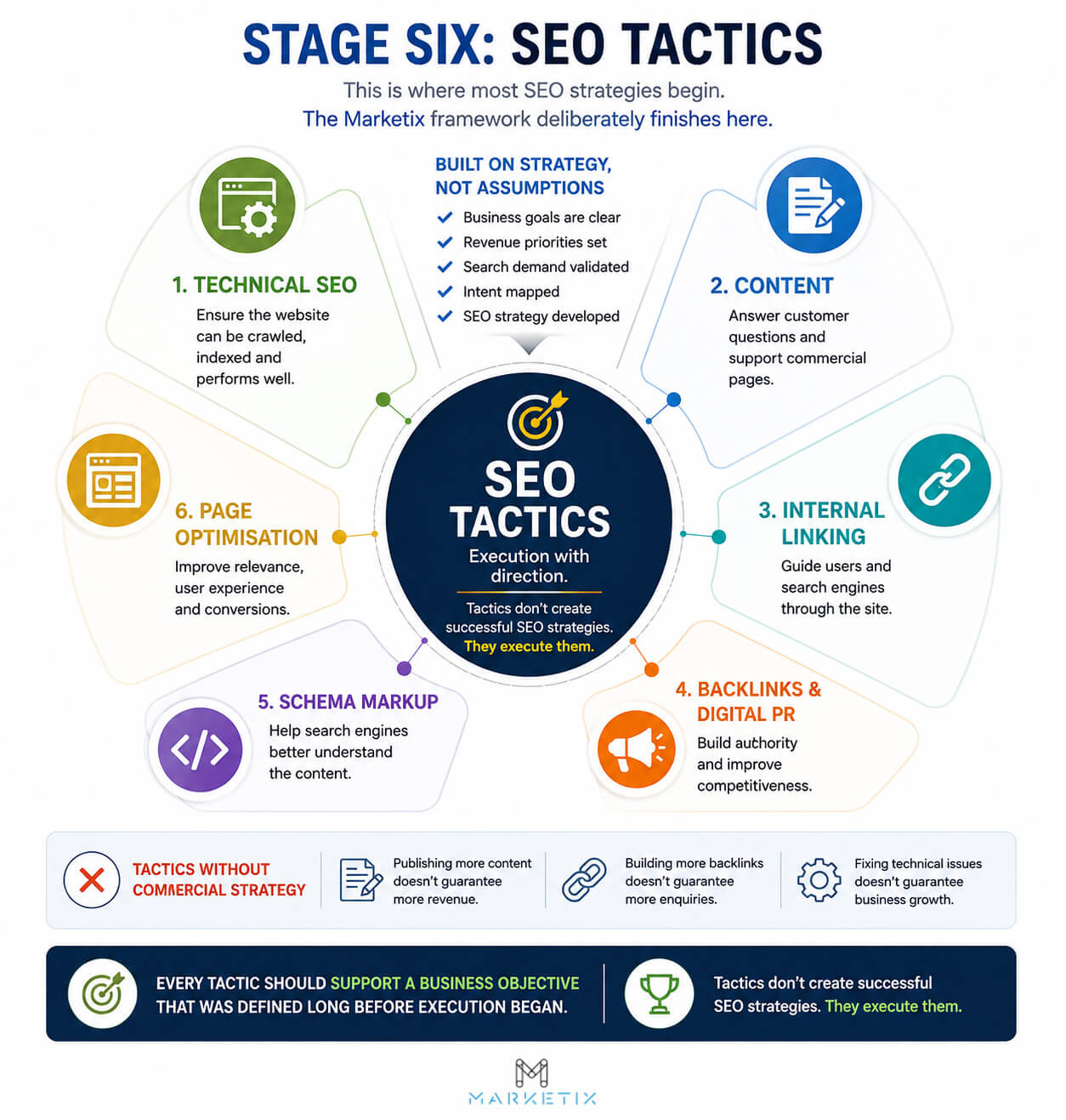
And for the last part, where most SEO strategies begin.
The Marketix framework deliberately finishes here.
By the time tactics are considered, every major strategic decision has already been made.
The business goals are clear.
Revenue priorities have been established.
Search demand has been validated.
Customer intent has been mapped.
The SEO strategy has been developed.
Execution now has direction.
Technical SEO, content creation, internal linking, backlink acquisition, digital PR, schema markup and on-page optimisation are all essential.
They remain the activities that improve visibility, strengthen authority and help pages perform in search.
But they should never determine the strategy.
SEO Tactic | Purpose |
Technical SEO | Ensure the website can be crawled, indexed and performs well. |
Content | Answer customer questions and support commercial pages. |
Internal linking | Guide users and search engines through the site. |
Backlinks & Digital PR | Build authority and improve competitiveness. |
Schema markup | Help search engines better understand the content. |
Page optimisation | Improve relevance, user experience and conversions. |
None of these tactics is inherently valuable on their own.
Their value comes from supporting a commercially driven strategy.
Publishing more content doesn't guarantee more revenue.
Building more backlinks doesn't guarantee more enquiries.
Fixing technical issues doesn't guarantee business growth.
Without a clear commercial objective, SEO tactics become activity for the sake of activity.
The Marketix framework takes the opposite approach.
Every technical improvement, every piece of content and every backlink should support a business objective that was defined long before execution began.
Because tactics don't create successful SEO strategies.
They execute them.
The framework remains the same for every business. What changes are the decisions made at each stage.
Business Goals: Increase revenue from emergency plumbing services.
Revenue: Emergency call-outs generate the highest commercial return.
Search Demand: Validate demand for emergency plumbing searches across target service areas.
Intent: Searchers need immediate assistance and want to contact a plumber.
SEO Strategy: Prioritise emergency service pages, suburb landing pages and local authority.
SEO Tactics: Optimise commercial pages, strengthen local SEO, build citations and earn relevant backlinks.
Outcome: SEO investment is directed towards generating more emergency call-outs rather than simply increasing traffic.
Business Goals: Increase online sales.
Revenue: Protein powder is the highest commercial priority.
Search Demand: Validate demand for protein powder and related searches.
Intent: Customers are researching, comparing and purchasing products.
SEO Strategy: Build topical authority around protein powder with commercial and supporting content.
SEO Tactics: Optimise category pages, buying guides, internal linking and structured data.
Outcome: SEO focuses on the product category that delivers the greatest commercial return rather than treating every product equally.
Business Goals: Generate more enquiries for large retail fit-out projects.
Revenue: Gondola shelving delivers the highest commercial value.
Search Demand: Validate demand across product, industry and location-based searches.
Intent: Buyers are evaluating suppliers and requesting quotations.
SEO Strategy: Position gondola shelving as the cornerstone category supported by industry-specific content.
SEO Tactics: Strengthen commercial pages, supporting content, internal linking and authority building.
Outcome: SEO attracts more qualified B2B enquiries instead of maximising rankings across every product category.
Although these businesses operate in different industries, the framework doesn't change.
Business goals shape revenue priorities. Revenue determines what deserves investment. Search demand validates the opportunity. Intent shapes the strategy. SEO tactics execute the plan.
That's why no two SEO strategies should ever look the same, even when they're built using the same framework.
Most SEO campaigns don't fail because of poor execution.
They fail because the wrong decisions are made before the work even begins.
Almost every common SEO mistake can be traced back to skipping one or more stages of the framework.
Common Mistake | What Was Skipped? |
Starting with keyword research | Business Goals & Revenue |
Measuring rankings instead of revenue | Business Goals |
Chasing traffic for its own sake | Revenue |
Treating every service or product equally | Revenue |
Copying competitors' SEO strategy | Business Goals & Revenue |
Building topic clusters without commercial purpose | Intent & SEO Strategy |
Treating all keywords equally | Intent |
Creating content because "SEO says we should" | SEO Strategy |
Consider a business that builds fifty blog articles because a competitor has done the same.
The content may generate traffic.
It may even improve rankings.
But if those articles don't support the services, products or customer journeys that drive the business, they've become an SEO activity rather than a commercial investment.
The same applies to keyword research.
A keyword with 20,000 monthly searches isn't automatically more valuable than one with 500.
If the smaller keyword consistently attracts qualified buyers while the larger one attracts casual researchers, the commercial decision is obvious.
That's why the Marketix framework doesn't ask: "What should we optimise?"
It asks: "What should the business achieve, and how can SEO help get us there?"
The difference may appear subtle.
In practice, it changes almost every decision that follows.
Rankings and traffic are important, but they're not the reason businesses invest in SEO. They are leading indicators, not business outcomes.
A #1 ranking for a keyword that never generates enquiries has little commercial value, just as a page attracting thousands of visitors means very little if those visitors never become customers.
Google's guidance consistently emphasises creating helpful, people-first content that satisfies user needs rather than optimising for search engines alone. Rankings are earned by delivering value to users, not by treating rankings as the end goal.
At Marketix, we measure SEO against commercial outcomes first. Rankings help us understand visibility. Traffic helps us understand reach.
But revenue, qualified enquiries and business growth determine whether an SEO strategy is actually successful.
When business goals drive the strategy from the outset, higher rankings become the result of making better commercial decisions, not the objective itself.
Why Are We So Confident This Framework Works?
Because each stage answers the question before it.
Business goals define the direction, revenue sets the priorities, search demand validates the opportunity, intent shapes the strategy, and tactics execute the plan.
Business Goals → Revenue → Search Demand → Intent → SEO Strategy → Tactics
The sequence removes guesswork and ensures every SEO decision has a commercial purpose.
The best SEO strategies don't start with search. They start with the business.
If you're looking for an SEO strategy built around commercial outcomes rather than vanity metrics, explore how Marketix approaches SEO.
Explore our SEO services or get in touch to start the conversation.
Recent Posts
Download our 24-page SEO book to learn:
You have successfully joined our subscriber list.
Recent Posts