There is no universally correct SEO budget for an industrial business.
For one company, a substantial monthly investment may be excessive. For another, it may be conservative.
The right number depends on the commercial opportunity.
The real question is not: “How much does SEO cost?”
It is: “Is search a commercially valuable market for this business, and what level of investment would that opportunity justify?”
That requires looking beyond rankings, traffic and deliverables.
For established industrial businesses, serious search investment can be entirely rational when a relatively small number of additional customers can create significant revenue and gross profit.
It can also be a poor investment when the economics do not support it.
The objective is not to find a budget for SEO. It is to determine whether search represents an opportunity worth investing in.
Most SEO pricing discussions start in the wrong place.
They begin with retainers, deliverables, content volumes, keyword counts or link quotas.
For an industrial business, those are execution questions. They do not tell management whether the investment itself makes commercial sense.
A more useful starting point is the revenue opportunity.
Two companies with similar turnover can rationally make very different decisions.
A larger company selling relatively low-value products into a limited search market may struggle to justify substantial investment.
A smaller specialist manufacturer selling high-value engineered systems into an active national market may justify it easily.
The difference is not simply company size.
It is the economics of the opportunity.
Before committing capital, management needs confidence that:
meaningful commercial demand exists
the business has a credible opportunity to compete
additional customers would be commercially valuable
the potential return is sufficient to justify the investment
Investment should follow opportunity, not the other way around.
There is no minimum project value that automatically makes SEO commercially viable.
A $30,000 project could support meaningful investment if search can generate enough additional projects.
A $300,000 project may justify the same investment with only a small number of additional wins.
What matters is the relationship between customer value, margin, achievable sales volume and the scale of the available market.
A high-value project means little if additional customers are unlikely to be acquired through search.
Equally, lower-value transactions can support substantial investment when demand, margins and volume are sufficiently strong.
The important question is not how valuable one customer is. It is how much incremental commercial value the search market could realistically create.
There is no useful universal benchmark.
For established industrial businesses, serious search investment may run into six figures annually when the potential commercial opportunity is substantially larger.
That does not mean every business should invest at that level.
The investment should reflect:
the size of the opportunity
the strength of existing competition
the commercial value of winning additional customers
the difficulty of establishing a meaningful market position
the expected return relative to competing uses of capital
Marketix does not begin with a predetermined retainer and then find enough work to fill it.
The commercial case comes first.
Assume:
Average project value: $75,000
Gross margin: 40%
Gross profit per project: $30,000
Search investment: $12,000 per month
Annual investment: $144,000
At these economics, approximately five additional projects per year would recover the annual investment at gross-profit level.
If search generated ten additional projects, the business would produce:
| Incremental revenue | $750,000 |
| Incremental gross profit | $300,000 |
| Annual search investment | $144,000 |
| Gross profit less investment | $156,000 |
These figures are illustrative rather than a universal ROI benchmark.
The point is not that every industrial business should invest $144,000.
The point is that once the value of an additional customer is understood, what initially looks like a large marketing expense can become a very different commercial decision.
At that point, the discussion is no longer about rankings, articles or backlinks.
It is about whether committing $144,000 to pursue a credible opportunity to generate $300,000 in incremental gross profit represents a sound allocation of capital.
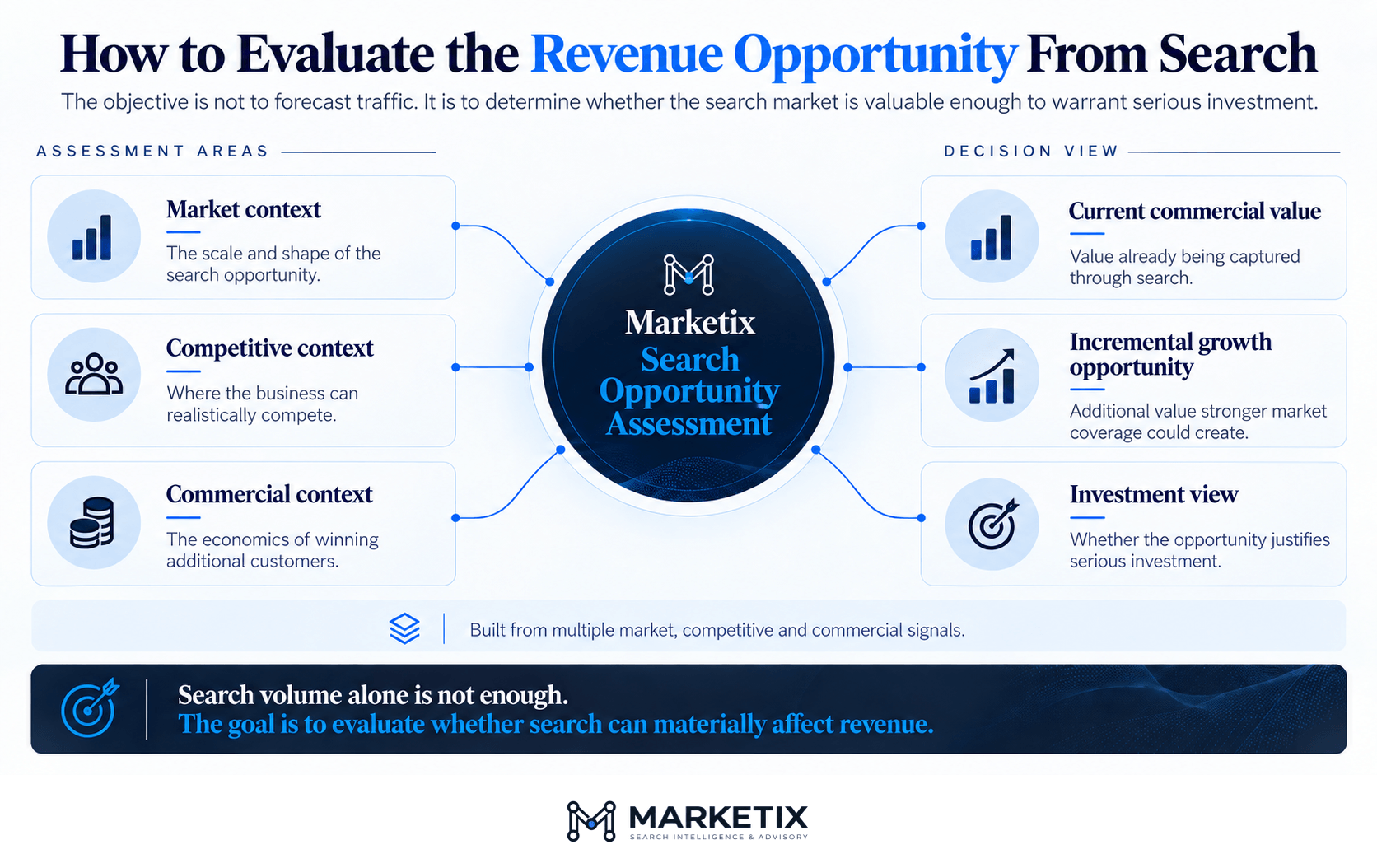
Before committing substantial investment, an industrial business needs to establish whether search represents a commercially significant market.
This requires more than keyword volumes or traffic forecasts.
Marketix combines multiple market, competitive and commercial signals to estimate the scale of the opportunity and whether stronger search coverage could create meaningful incremental value.
The assessment separates apparent search opportunity from the commercially meaningful opportunity available to the business.
The underlying assessment goes substantially deeper than a search-volume forecast.
The objective is not to predict traffic. It is to determine whether the search market is valuable enough to warrant serious investment.
Before committing substantial investment, an industrial business needs to establish whether search represents a commercially significant market.
This requires more than keyword volumes or traffic forecasts.
Marketix combines multiple market, competitive and commercial signals to estimate the scale of the opportunity and whether stronger search coverage could create meaningful incremental value.
The assessment separates apparent search opportunity from the commercially meaningful opportunity available to the business.
The underlying assessment goes substantially deeper than a search-volume forecast.
The objective is not to predict traffic. It is to determine whether the search market is valuable enough to warrant serious investment.
Industrial search markets can appear smaller than they really are.
That is because buyers rarely use one consistent phrase throughout a purchasing process.
They may search differently depending on what they are buying, the problem they are trying to solve, their technical requirements, location, stage of research or familiarity with the available solutions.
As a result, an individual keyword showing modest monthly volume may represent only a small part of the commercial market.
This is particularly important in industrial sectors where buying journeys are technical, fragmented and highly specific.
A management team should therefore be cautious about concluding that search is “too small” based on a handful of headline keywords.
Keyword volume is not the same as market size.
The relevant question is whether the broader search environment contains enough commercially valuable demand to influence meaningful revenue.
What Type of Industrial Business Can Justify Serious SEO Investment?
Serious search investment tends to make more commercial sense for established businesses where additional customer acquisition can materially affect revenue.
That often includes companies with:
valuable projects, contracts or customer relationships
healthy unit economics
an established sales operation
meaningful growth capacity
clear evidence that buyers use search when evaluating suppliers
sufficient market opportunity to justify long-term investment
This can include businesses supplying warehouse infrastructure, industrial equipment, pumps and fluid handling systems, automation, water treatment, manufacturing equipment and other technical B2B solutions.
For established companies in these markets, industrial SEO services should be scoped around the commercial opportunity rather than a standardised package.
However, operating in an industrial market does not automatically make SEO a worthwhile investment.
The commercial opportunity still has to justify the capital required to compete for it.
Not every industrial business should invest heavily in SEO.
Even where search demand exists, the opportunity may be too small, too difficult to capture or insufficiently profitable.
SEO may not make commercial sense where:
additional customers have limited economic value
the addressable search market is very small
buyers are acquired predominantly through closed procurement channels
the business has limited capacity to fulfil additional demand
sales conversion is weak
the commercial proposition is not competitive
management requires returns on a timeframe the market is unlikely to support
In those circumstances, strengthening the sales proposition, improving conversion capability or investing in another acquisition channel may be a better use of capital.
Marketix would rather identify that search does not make commercial sense than recommend an investment the economics cannot support.
There is no minimum turnover or employee count that automatically makes a company suitable for serious search investment.
Commercial opportunity matters more than size.
A specialist industrial company selling high-value engineered systems can have stronger search economics than a much larger company operating in a low-value or limited-demand market.
What matters is whether the organisation is established enough to convert additional demand and whether the potential commercial upside is materially larger than the investment required to pursue it.
The relevant question is not whether the business can afford SEO. It is whether the opportunity is valuable enough to justify it.
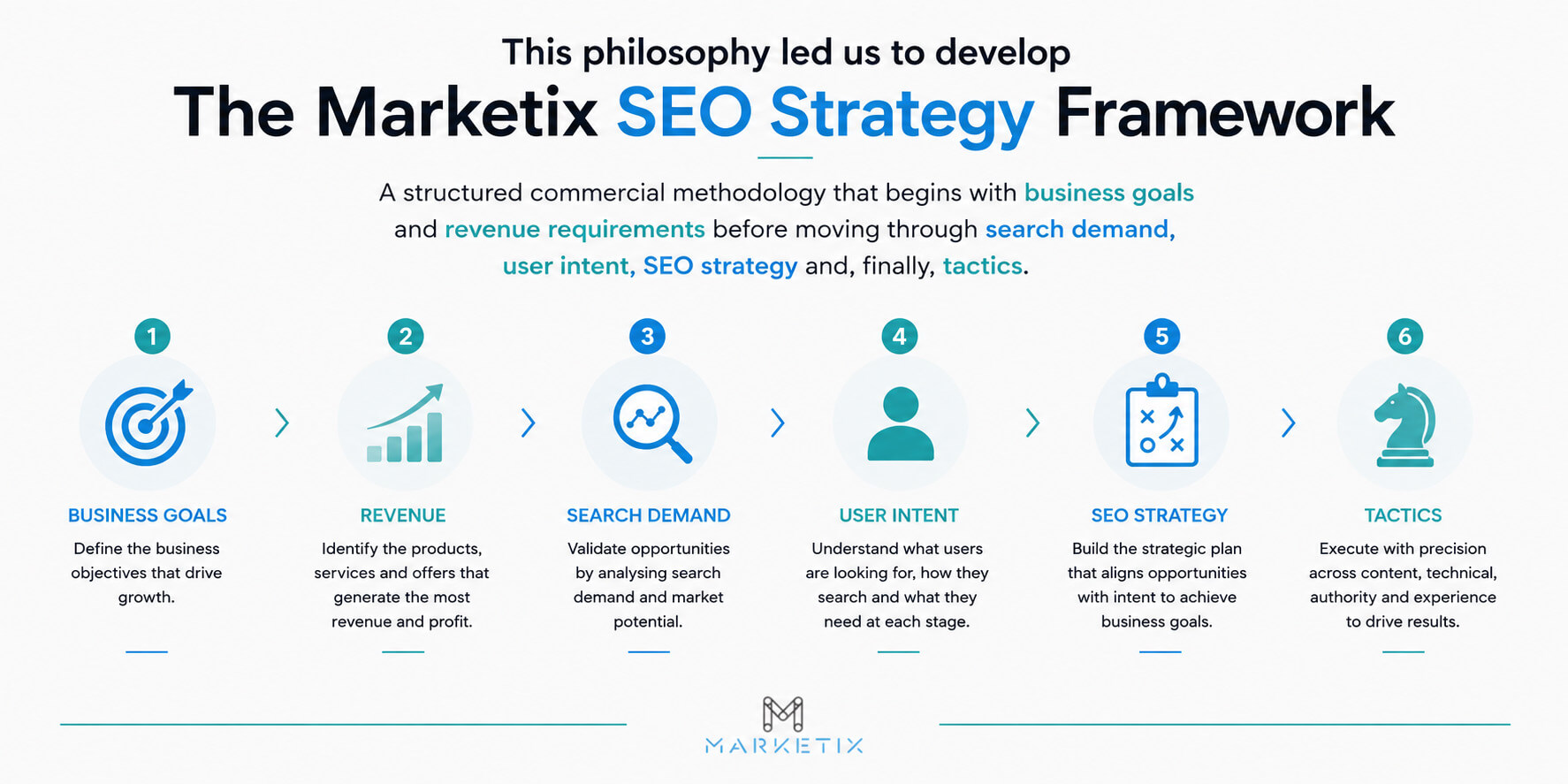
Most SEO agencies begin with execution.
Marketix starts earlier.
Our approach follows a simple sequence:
Business Goals → Revenue → Search Demand → Intent → Strategy → Tactics
The purpose of that sequence is not to create more SEO activity.
It is to determine where search can materially contribute to the commercial objectives of the business before deciding what execution is required.
Only after the commercial case is clear do tactics enter the conversation.
Strategy should be built around opportunity, not around filling a predetermined SEO package.
The decision is not simply whether SEO can generate more traffic.
Management needs to determine whether search represents a commercial market worth competing for.
That means understanding whether:
meaningful demand exists
the business has a credible opportunity to improve its position
additional customers would create significant commercial value
the likely return warrants the cost, time and competitive effort required
search represents a better use of capital than alternative growth opportunities
For some industrial businesses, search may represent a significant untapped route to market.
For others, the opportunity may be commercially inferior to alternative investments.
The role of Search Intelligence is to make that distinction before substantial capital is committed.
Marketix helps established industrial businesses determine whether search represents a commercially meaningful growth opportunity before recommending investment.
If the economics do not support serious investment in search, we will tell you.
Recent Posts
Download our 24-page SEO book to learn:
You have successfully joined our subscriber list.
Recent Posts