AI Overview (AIO) Statistics 2026: Key Data, Trends, and Insights

AI Overview (AIO) Statistics Key Data, Trends, and Insights


Search no longer behaves the way it did even two years ago.


Users are still typing queries into Google, but what happens next is different. Instead of scanning ten blue links, they are often met with an AI-generated summary that answers the question immediately. In many cases, that is where the journey ends.


The numbers already confirm it.


When an AI Overview appears, only 8% of users click a traditional result, compared to 15% on standard search pages. That gap is not small. It represents a near halving of click behaviour in real-world conditions.


Sessions are also ending earlier. Around 26% of searches stop completely after viewing an AI summary, with no further interaction.


That changes the entire premise of SEO. Visibility no longer guarantees traffic. Ranking alone is no longer the objective, which is why Generative Engine Optimisation is becoming central to how businesses approach search.


The Scale of AI Search Adoption


AI search is not emerging. It is already established.


Globally, AI-powered search platforms now account for 12–15% of total search activity, with projections suggesting this could exceed 28% by 2027. That level of share has been achieved in a short timeframe, which indicates how quickly behaviour is shifting.


Within Google itself, the integration is already deep. Around 47% of searches now include AI Overviews, meaning nearly half of all queries are influenced by AI-generated responses.


Adoption is not limited to global trends. The Australian market is moving in the same direction.


These are not early adopters. This is mainstream usage.


From a Marketix perspective, this is where most businesses underestimate the shift. They treat AI search as an add-on channel, when in reality, it is becoming a core layer of how search works. Waiting for it to stabilise is not a strategy. It is a delay.


The Shift in User Behaviour


Zero-click searches were already dominant before AI Overviews. In the United States, 58.5% of Google searches ended without a click, with similar figures of 59.7% across Europe, based on large-scale clickstream data.


AI has accelerated that trend.


After the rollout of AI Overviews, zero-click behaviour increased to nearly 69% in some verticals, meaning more than two-thirds of searches now result in no website visit at all.


The implication is direct. Traffic is not just declining, it is being intercepted, which is reshaping how businesses approach AI search and SEO strategies moving forward.


User trust patterns reinforce this shift. Only 18.6% of users typically click through to cited sources, while a large portion rarely engage beyond the summary itself.


In practical terms:


  • Users get an answer
  • They accept it
  • They move on


No comparison. No browsing. No website visit.


That compresses the decision-making process. It also reduces the number of opportunities a business has to influence the user.


How AI Overviews Are Reshaping the SERP


AI Overviews are not appearing occasionally. They are becoming a standard component of search results.


How AI Overviews Are Reshaping the SERP


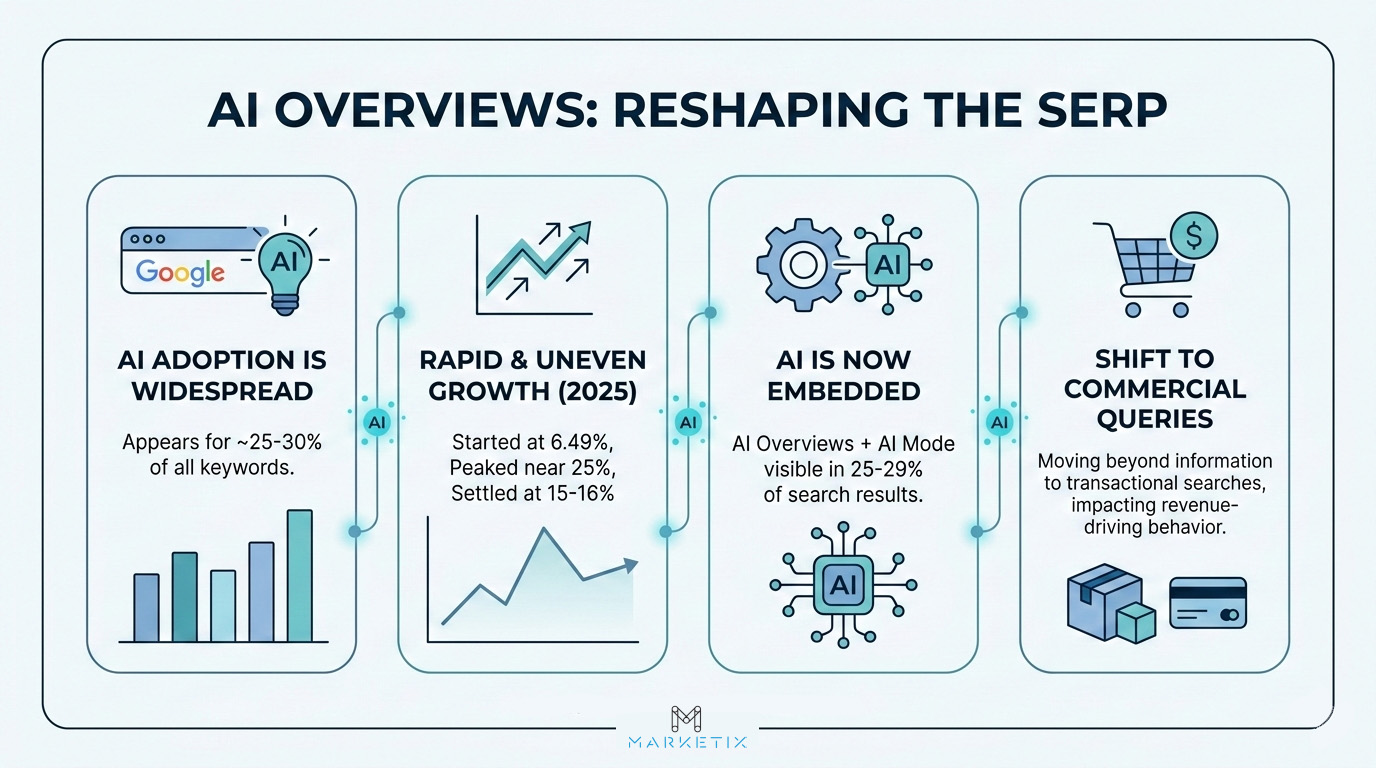
Across large datasets, they now trigger for roughly 25% to 30% of keywords, depending on the industry and query type.


The growth has been rapid and uneven. Tracking across 2025 shows AI Overview presence rising from 6.49% of queries to peaks near 25%, before settling around 15–16%.


That volatility matters. It shows Google is still actively testing and expanding coverage.


When combined with other AI-driven elements, such as AI Mode, these features now appear across 25–29% of keywords, indicating that AI is no longer a layer on top of search. It is embedded in it.


The nature of queries is also changing.


AI Overviews were initially dominant in informational searches. That is shifting. Commercial and transactional queries are now increasing their share, which means AI is moving closer to revenue-driving search behaviour.


That is where the real impact begins.


The Measurable Impact on Click-Through Rates


The most immediate consequence of AI Overviews is a drop in click-through rates across organic listings.
Large-scale analysis shows that
when AI Overviews are present, the CTR of the top-ranking result drops by around 34.5%, with newer comparisons showing declines as high as 58%.


That is a structural change. Position one is no longer protected.


Other datasets confirm the pattern at scale. Across hundreds of thousands of keywords, average CTR declines of 15.49% have been observed, with non-branded queries taking the largest hit.


The gap widens further depending on visibility within the AI result itself.


When a brand is not cited in the AI Overview, CTR can drop by up to 65.2%, effectively removing it from the user’s decision set.


Even ranking position no longer behaves predictably. Data shows CTR declines across all positions, with mid-ranking pages often experiencing the steepest losses.


There is also a misleading upside.


Impressions are increasing. In some cases, by as much as 49%. Yet at the same time, CTR is falling by nearly 30%, meaning visibility is growing while actual traffic declines.


That disconnect is one of the biggest risks in modern SEO. Surface-level metrics look positive. Outcomes are not.


Where the Traffic Is Going


Traffic is not disappearing. It is being redirected.


AI platforms are now generating measurable referral volume, with 1.13 billion monthly visits and 357% year-on-year growth.


That growth is significant, but the distribution is uneven.


Around 87.4% of AI-driven referral traffic comes from ChatGPT alone, showing how concentrated the ecosystem currently is.


Despite the rapid growth, AI traffic still represents a small portion of total sessions. In many datasets, it accounts for around 0.13% of overall traffic, although it is heavily skewed towards high-intent pages such as pricing, product, and tool pages.


That detail matters.


AI traffic is not evenly distributed across content. It favours decision-stage pages. Users arriving from AI platforms are often further along in the buying process, with recent studies showing that AI search visitors can convert significantly better than traditional organic traffic.


At the same time, referral patterns show strong concentration. A small number of domains capture a disproportionate share of clicks, meaning most websites see little benefit unless they are consistently cited.


Industry-Level Impact and Vertical Differences
 

AI Overviews Industry-Level Impact and Vertical Differences

The effect of AI Overviews is not evenly distributed. Some industries are absorbing the impact more aggressively than others.


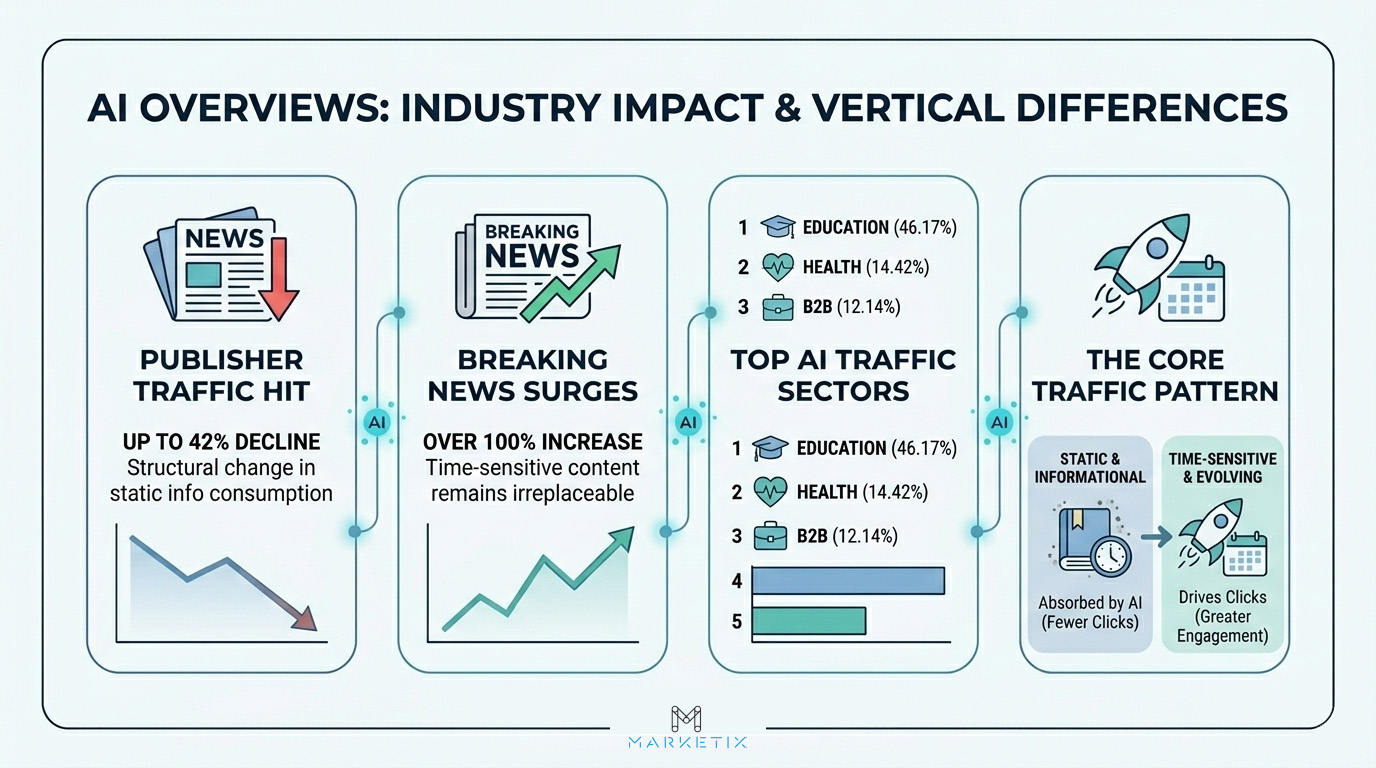
Publishing and content-heavy websites have been hit first. Data shows that organic search traffic for publishers has declined by up to 42% following the expansion of AI Overviews. That level of drop is not seasonal or cyclical. It reflects a structural shift in how information is consumed.


At the same time, not all content types are losing.


Breaking news has moved in the opposite direction. Traffic in this category has increased by over 100%, largely because time-sensitive information cannot be fully replaced by static summaries.


That contrast highlights a clear pattern:


  • Static, informational content is being absorbed by AI
  • Time-sensitive or evolving content is still driving clicks


The same applies across AI-driven traffic distribution.


Education accounts for over 46.17% of AI search traffic, followed by health (14.42%) and B2B sectors (12.14%). These are industries where users are actively seeking explanations, comparisons, and structured knowledge, which aligns closely with how AI generates responses.


For businesses, this means exposure is no longer based purely on rankings. It depends on how well the content fits into AI-generated answers within specific verticals.


Monetisation and the Next Phase of AI Search


Google is not only changing how search works. It is also building a monetisation layer inside AI results.


AI-driven ads are still limited, appearing in only around 0.76% of queries, but their presence has already grown by 58% in a short period.


That growth signals intent. Monetisation is coming, and it will expand.


Visibility within these placements is also uneven. Around 86.3% of products in AI-driven carousels sit below the fold, meaning most listings receive minimal exposure.


This creates a new competitive dynamic.


It is no longer enough to be present. You need to be positioned correctly within a much tighter visibility window.


From a strategy standpoint, this mirrors what happened with traditional paid search. Early adopters benefit from lower competition. As adoption grows, cost and complexity increase.


The New Reality: Visibility Does Not Equal Clicks


The traditional SEO model was simple. Rank higher, get more traffic.


That model is no longer reliable.


Even when links are present inside AI Overviews, user interaction remains low. Only a small percentage of users click cited sources, despite those links often being positioned prominently.


Some data suggests that links within AI Overviews can perform similarly to top organic positions in terms of visibility. The issue is that fewer users are clicking anything at all.


That distinction is critical.


Visibility is still achievable. Traffic is no longer guaranteed.


In practical terms, a page can:


  • Rank on page one
  • Appear in an AI Overview
  • Gain impressions


…and still lose traffic.


This is where many businesses misread performance. Metrics such as impressions and rankings can improve while leads and conversions decline.


What This Means for Businesses and SEO Strategy


The implications are direct. SEO is shifting from a ranking-based model to a visibility-and-inclusion model.


Being present in search results is no longer enough. The priority is being included in the answer itself.


If a brand is not cited inside an AI Overview, it is often excluded from the user’s decision process entirely. The earlier data already showed CTR dropping by up to 65% in those cases. That is not a marginal loss. It is a removal from consideration.


This changes how SEO needs to be approached.


Content must now:


  • Be structured in a way that AI systems can interpret and extract
  • Demonstrate clear authority and accuracy
  • Align closely with user intent, especially for high-intent queries


From what we are seeing across Marketix campaigns, businesses that adapt early tend to capture disproportionate visibility. Not because they rank higher, but because they are selected as a source.


That requires a different level of execution.


For companies navigating this shift, working with a specialised provider such as an AI SEO agency becomes increasingly relevant. The focus moves beyond keyword targeting into entity positioning, structured content, and AI retrieval optimisation.


Investment is also evolving.


AI search optimisation is more complex than traditional SEO. It involves content strategy, technical structuring, and authority building across multiple touchpoints. For a breakdown of how this is being priced and implemented locally, refer to AI SEO pricing in Australia, which outlines how businesses are allocating budgets in response to these changes.

 

A Structural Shift, Not a Temporary Trend


AI Overviews are not a feature update. They represent a change in how search works at a fundamental level.


The data is consistent across multiple sources:


  • Click-through rates are declining
  • Zero-click behaviour is increasing
  • Traffic is being redistributed across AI platforms
  • Visibility no longer guarantees engagement


Search is becoming an answer engine, not a discovery engine.


Businesses that recognise this shift early can adapt their strategy, reposition their content, and maintain visibility within AI-driven results.


Those that continue to rely on traditional SEO assumptions will still rank, still appear, and still gain impressions.


They will just receive less traffic from it.