For years, digital marketing has largely been a game of visibility.
Rank higher in Google, attract more visitors, generate more leads, and convert more customers.
That formula is now facing a significant challenge.
A growing body of research suggests that visitors arriving from AI search platforms such as ChatGPT, Perplexity, Gemini, and other large language models may be substantially more valuable than traditional organic search traffic.
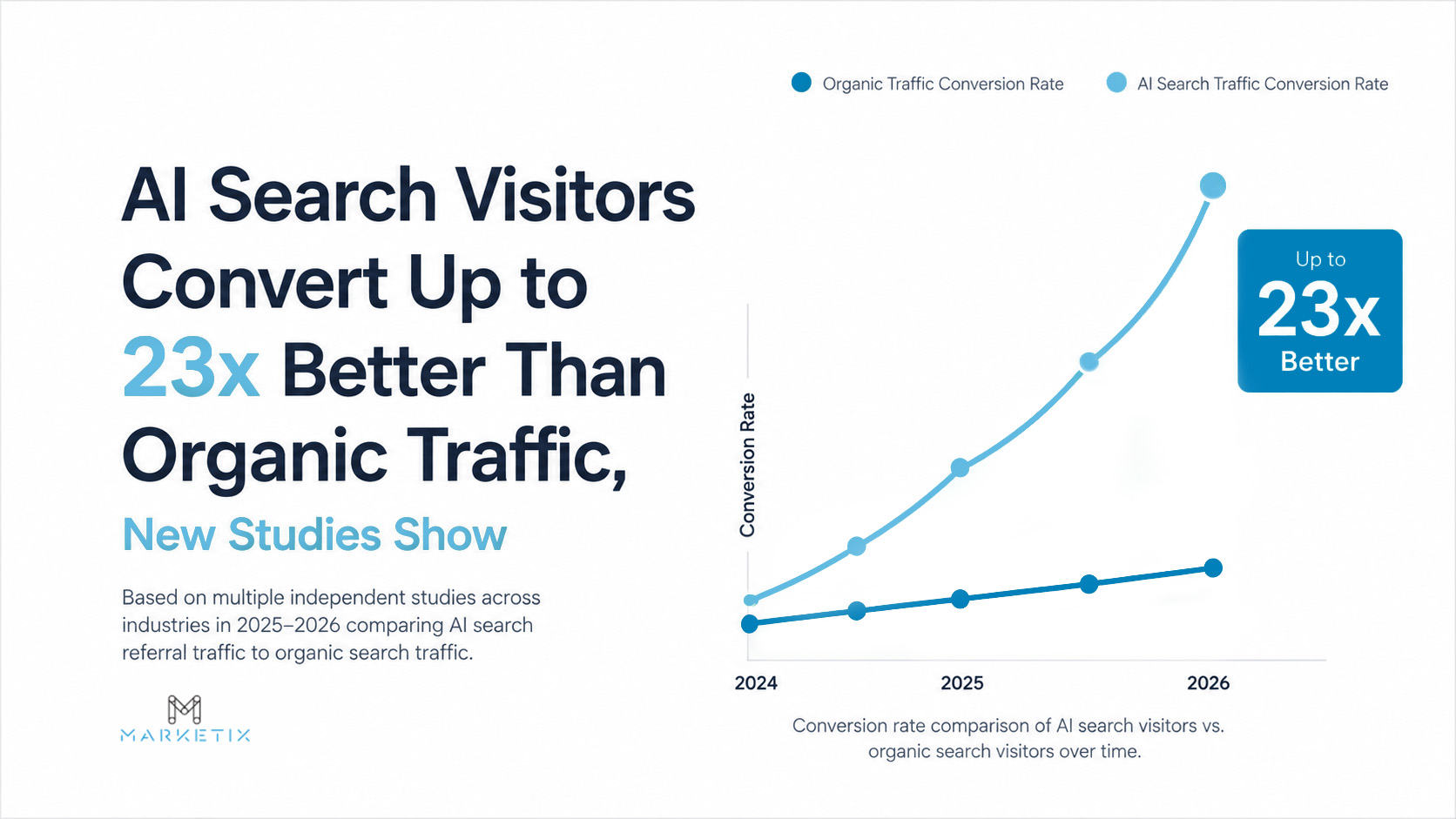
Multiple studies published throughout 2025 and 2026 have found that AI-referred visitors convert at significantly higher rates than visitors arriving through conventional search engines. Depending on the industry and study analysed, the reported uplift ranges from 42% to as much as 23 times higher conversion rates.
While AI traffic still represents a relatively small percentage of total website visits, the quality of that traffic is becoming increasingly difficult for marketers to ignore.
Several independent studies have reached similar conclusions.
A study reported by Search Engine Land found that AI search visitors were 4.4 times more likely to convert than traditional organic search visitors.
The Opollo AI Search Benchmark Report analysed data from 312 B2B technology companies and found that AI-referred visitors converted at 14.2%, compared to 2.8% from Google organic traffic, representing roughly a fivefold increase.
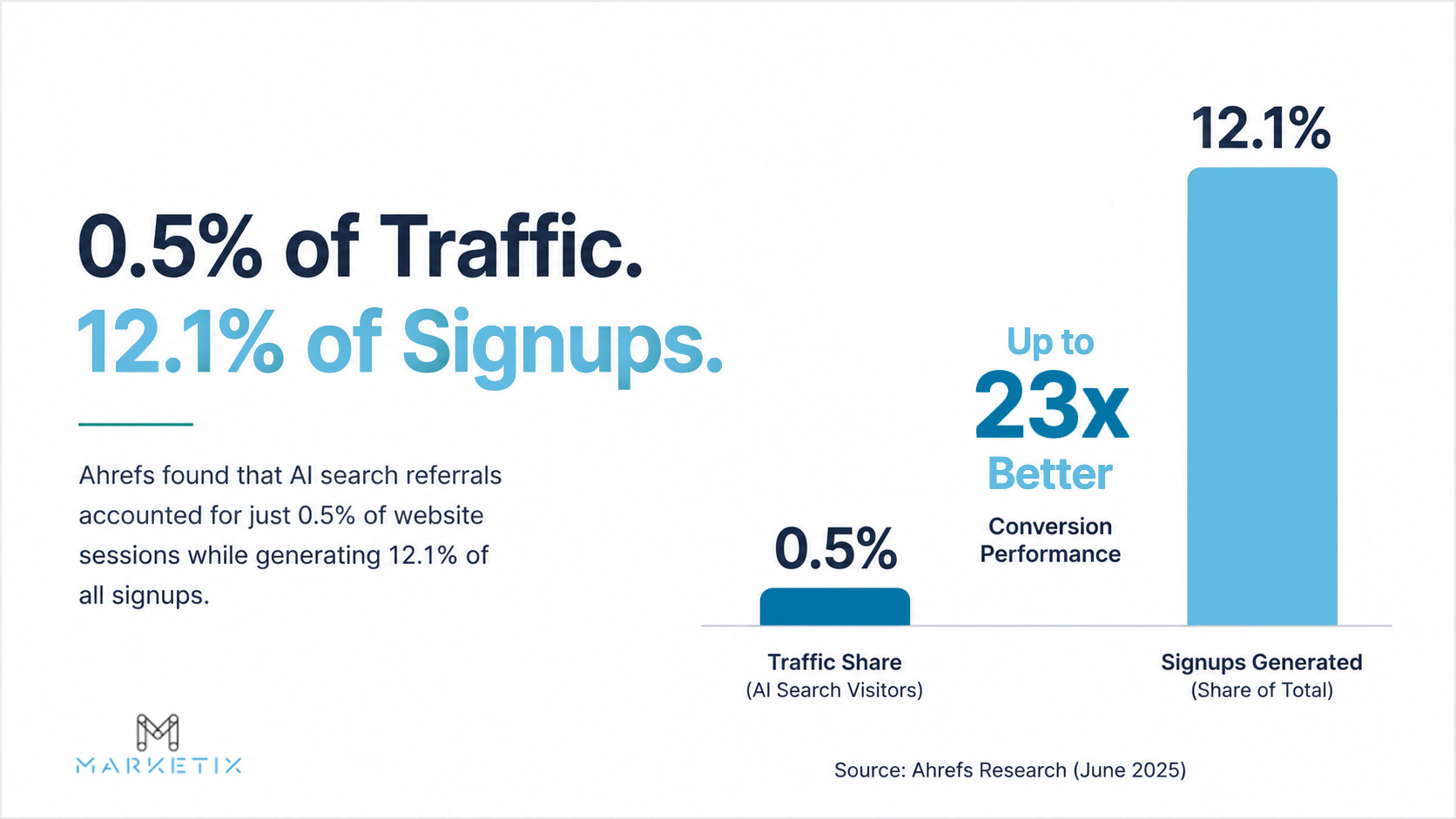
The most widely discussed figure comes from Ahrefs. The company reported that AI search referrals accounted for just 0.5% of total website sessions while generating 12.1% of all sign-ups. Based on the data published by Ahrefs, AI visitors converted up to 23 times better than traditional search visitors.
Additional evidence is emerging from the retail sector.
Adobe analysed more than one trillion visits to US retail websites and found that AI-driven traffic converted 42% better than non-AI traffic in March 2026. Visitors arriving through AI platforms also spent more time on websites, viewed more pages, and demonstrated higher engagement rates.
While the exact uplift varies across industries and business models, the direction of the findings is remarkably consistent. Businesses receiving traffic from AI search platforms are often seeing stronger engagement, higher conversion rates, and visitors who arrive closer to making a decision.
Taken together, the studies point to a clear trend: AI search visitors appear to arrive with stronger intent and a greater likelihood of taking action.
This flows better and keeps the momentum building toward the 23x finding rather than interrupting it with a much smaller statistic.
The explanation is surprisingly simple.
Traditional search often represents the beginning of the research process.
A user searches for a topic, opens several websites, compares information, returns to Google, performs additional searches, reads reviews, and gradually narrows down their options.
AI search changes that behaviour.
Instead of visiting multiple websites to gather information, users increasingly conduct much of their research directly within ChatGPT, Perplexity, Gemini, Claude, and similar platforms.
Questions are refined through conversation.
Options are compared instantly.
Pros and cons are summarised.
Recommendations are generated.
By the time a user clicks through to a website, much of the research process has already been completed.
In many cases, the visitor is no longer asking, "What are my options?"
They are asking, "Is this the provider I want to choose?"
That shift has major implications for conversion rates.
The visitor arriving on the website is often further along in the buying journey than someone performing a traditional Google search.

Despite the headlines, AI traffic is not replacing Google.
At least not yet.
Most businesses still receive the overwhelming majority of their organic traffic from traditional search engines.
Even some of the strongest AI conversion studies show that AI referrals currently account for less than 1% of total website sessions.
The volume simply is not there yet.
What makes the trend noteworthy is not the amount of traffic being generated today.
It is the combination of growing adoption and unusually strong conversion performance.
ChatGPT alone has grown from approximately 400 million weekly active users in early 2025 to hundreds of millions more users throughout the following year. AI search usage continues to accelerate across consumers, professionals, and businesses.
If that growth continues, even a modest increase in AI-referred traffic could have a meaningful impact on lead generation and revenue.
The rise of AI search does not mean SEO is becoming less important.
In many ways, the opposite is true.
AI platforms rely heavily on existing web content, trusted sources, strong brands, and authoritative information when generating answers. Recent AI Overview statistics also suggest that AI-generated search experiences are becoming increasingly visible across the search journey, creating new opportunities and challenges for businesses.
Businesses that already invest in technical SEO, high-quality content, digital PR, authority building, and brand visibility may be better positioned to appear within AI-generated responses. As a result, more organisations are beginning to evaluate their AI SEO strategy and how much investment may be required to improve visibility across AI-powered search platforms.
At the same time, conversion optimisation is becoming more important.
Higher-intent visitors create greater opportunities, but only if websites are capable of converting them.
Clear messaging, strong trust signals, effective calls to action, and frictionless user experiences remain critical.
Visibility still matters.
What is changing is the pathway people take before arriving on a website.
The most important takeaway is not that AI traffic converts better.
It is why it converts better.
The studies suggest that AI platforms are increasingly acting as a filtering mechanism. Users are completing more of their research before they ever visit a business website.
That creates a different type of visitor.
Potentially fewer visits. Potentially higher intent. Potentially greater value.
For businesses, the opportunity is not simply chasing AI traffic.
It is building enough authority, trust, and visibility to be part of the conversation when AI platforms recommend products, services, and brands.
The businesses that adapt early may benefit from a channel that is still small today but is showing clear signs of becoming a meaningful source of future growth.
AI search is still in its early stages, but the businesses building authority, trust, and visibility today may be best positioned to benefit as adoption continues to grow.
If you're looking to improve your AI SEO strategy, increase your visibility across platforms like ChatGPT, Gemini, and Perplexity, or convert more high-intent visitors into customers, speak with the Marketix team about your growth strategy.
Recent Posts
Download our 24-page SEO book to learn:
You have successfully joined our subscriber list.
Recent Posts