Text...
Most agencies focus on rankings and clicks, but this doesn't translate into business results and revenue.
Choosing a Shopify SEO agency isn't about finding the company with the biggest promises or the longest list of deliverables. It's about finding a partner that understands how ecommerce businesses actually grow.
At Marketix Digital, we believe SEO should start with your business, not your keywords. Before discussing rankings or content, we want to understand what success looks like for your store.
Those commercial goals should shape every SEO decision that follows.
Shopify has become far more competitive, making the right SEO partner more important than ever.
This guide explains what to look for in a Shopify SEO agency, the questions to ask before signing, and the qualities that contribute to long-term business growth.
Australian ecommerce continues to expand, but so does competition.
According to Australia Post's latest eCommerce Report, Australians spent more than $82 billion online during 2025, with online shopping now representing almost a quarter of total retail spending.
Millions of Australians purchase online regularly, and Shopify continues to be one of the country's most popular ecommerce platforms.
The opportunity is significant, but so is the competition.
More businesses are investing in SEO, more retailers are competing for the same searches, and Google continues evolving how products are discovered through traditional search, shopping experiences and AI-powered search features.
For Shopify store owners, this creates a simple reality:
Choosing the right SEO agency has become a commercial decision rather than just a marketing one.
The right partner can help you identify where organic search can genuinely contribute to revenue growth. The wrong one may spend months chasing rankings that never generate meaningful sales.
If you're still evaluating Shopify as a platform or want to understand its continued growth in Australia, our Shopify Statistics report explores the latest adoption trends, market share and industry data.
This is where we believe many SEO campaigns go wrong.
Most agencies begin with keyword research.
They identify search volumes, group keywords together and recommend a list of pages to optimise. While keyword research is important, it shouldn't be the starting point.
Instead, we believe the process should begin with your business.
Before developing an SEO strategy, we ask questions like:
Only after understanding those commercial priorities do we begin mapping search demand and identifying SEO opportunities.
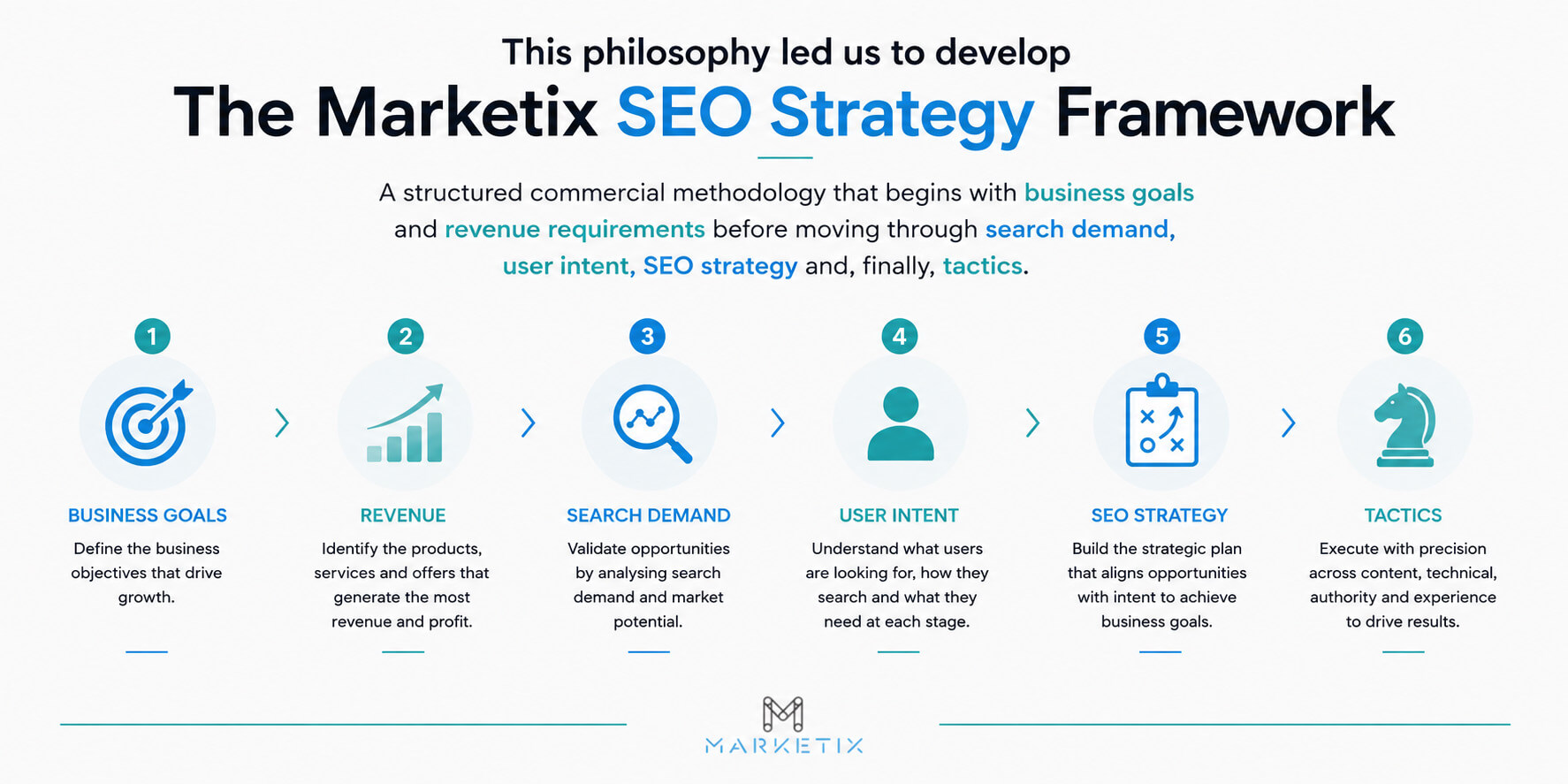
Our process typically follows this order:
Business First | SEO Second |
Business goals | Search demand |
Revenue targets | Keyword opportunities |
Commercial priorities | Technical improvements |
Product profitability | Content strategy |
Growth opportunities | Authority building |
This approach helps ensure SEO supports the business rather than becoming a disconnected marketing activity.
For example, a category with lower search volume but significantly higher profit margins may deserve more attention than a category attracting thousands of visitors who rarely convert.
Similarly, improving visibility for an existing best-selling collection may produce a stronger commercial outcome than publishing dozens of informational blog articles.
"SEO should support business growth, not become the goal itself. Rankings only matter when they contribute to qualified traffic, customers and revenue.”
Shoaib Mughal, Founder, Marketix Digital
When evaluating agencies, ask how they determine campaign priorities.
If the conversation starts and ends with rankings, it's worth asking how those rankings translate into revenue.
A Shopify SEO agency should do far more than optimise metadata or publish blog content every month.
Its role is to improve how your entire store performs in organic search while supporting the commercial objectives of the business.
That usually involves improving several interconnected areas rather than focusing on a single tactic.
Shopify takes care of many SEO fundamentals, but every store still has technical issues that can limit organic growth.
A good Shopify SEO agency should identify and prioritise the technical improvements that will have the biggest impact on your store, rather than treating every issue as equally important.
For example, at Marketix Digital, we use our proprietary CRICS Framework to prioritise technical SEO opportunities based on their likely impact on search performance and business growth.
This may include areas such as:
The goal isn't to fix every technical issue. It's to fix the issues that are most likely to improve your store's performance.
For most Shopify stores, collection pages represent some of the highest commercial opportunities.
A specialist agency should understand how to improve:
Rather than trying to rank every page for every keyword, the objective is to ensure each important page has a clear purpose within the overall store structure.
Not every Shopify store needs hundreds of blog posts.
Content should exist because it helps customers make purchasing decisions, not because an SEO checklist says another article needs to be published.
Depending on the business, valuable content might include:
The best content supports customers before, during and after the purchase journey.
Google increasingly rewards businesses that demonstrate expertise and authority within their industry.
That means SEO isn't only about what's happening on your own website.
A good agency should also help strengthen your broader online presence through activities such as:
The emphasis should always be on building genuine authority rather than accumulating large numbers of low-quality backlinks.
Finally, your reporting should answer the questions that matter to business owners.
Instead of focusing exclusively on rankings or traffic, ask whether the agency measures outcomes such as:
These metrics provide a much clearer picture of whether SEO is contributing to business growth.

Not all Shopify SEO agencies work the same way. Use the checklist below to compare providers beyond price and marketing claims.
What to Look For | Why It Matters |
Shopify-specific experience | Shopify has unique SEO considerations such as collection pages, product variants, themes, apps and Merchant Center. Platform experience reduces costly mistakes. |
A business-first strategy | The agency should start by understanding your revenue goals, products and commercial priorities before discussing keywords or rankings. |
Technical Shopify expertise | They should be able to identify and implement improvements relating to site architecture, crawlability, structured data, Core Web Vitals and Shopify-specific technical issues. |
Proven ecommerce results | Ask for examples showing growth in revenue, transactions and organic sales, not just rankings or traffic increases. |
Senior strategist involvement | Find out who develops the strategy, performs the work and provides ongoing advice after the campaign begins. |
Transparent reporting | Reports should focus on business performance, completed work, upcoming priorities and ROI rather than vanity metrics. |
Content that supports sales | Content should help customers make purchasing decisions through buying guides, category pages and product resources, not simply increase page count. |
Sustainable authority building | Look for agencies using digital PR, editorial links and genuine brand building instead of large volumes of low-quality backlinks. |
Clear communication | You should know who your contact is, how often you'll receive updates and how recommendations are prioritised. |
Honest expectations | Be cautious of guaranteed rankings or unrealistic promises. Good agencies explain what's achievable, how long it may take and why. |
Knowing what to avoid is just as important as knowing what to look for.
While no agency is perfect, the following warning signs should encourage you to ask more questions before committing.
Red Flag | Why It Matters |
Guaranteed #1 rankings | No agency controls Google's rankings. |
Extremely cheap monthly packages | Often rely on automated or low-value work. |
Selling thousands of backlinks | Quantity rarely equals quality. |
AI-generated content published at scale | Generic content rarely supports long-term growth. |
Reporting only rankings and traffic | These don't automatically translate into revenue. |
Identical SEO packages for every client | Every Shopify business has different priorities. |
No Shopify examples or case studies | Platform experience matters. |
Long lock-in contracts with little transparency | Results should earn ongoing business. |
A good agency should welcome difficult questions and explain its methodology clearly. If the answers feel vague or overly sales-focused, continue your search.
There isn't a standard price for Shopify SEO because every store has different requirements.
A small catalogue selling niche products has very different needs from a national retailer managing thousands of SKUs across multiple categories.
As a general guide, Australian Shopify SEO campaigns often fall into these ranges:
Store Size | Typical Monthly Investment |
Small or early-stage stores | $2,000–$3,500 |
Growing ecommerce brands | $3,500–$8,000 |
Large national or enterprise stores | $8,000+ |
These figures are indicative only. The right investment depends on factors such as competition, catalogue size, technical complexity and growth objectives.
Rather than asking, "Which agency is the cheapest?", a better question is: "Which agency is most likely to generate a positive return on our investment?" If you'd like a more detailed breakdown of Shopify SEO costs, pricing models and the factors that influence investment, read our guide on how much does Shopify SEO cost in Australia.
A lower monthly fee isn't necessarily a better value if very little meaningful work is completed.
SEO should be viewed as an investment rather than an expense.
Instead of comparing agencies solely on monthly retainers, compare them on their ability to create commercial value.
For example, consider:
These conversations shift the focus away from rankings and towards measurable business outcomes.
If you'd like to estimate the potential commercial return of an SEO campaign, try our Shopify SEO ROI Calculator to explore different growth scenarios before making a decision.
Every agency has its own process.
At Marketix, ours begins with understanding the business before developing the SEO strategy.
Rather than starting with keywords or predetermined deliverables, we first look at how your store generates revenue, where the strongest commercial opportunities exist, and which SEO activities are most likely to support long-term growth.
That strategy is then supported by four connected disciplines:
Because these areas work together, decisions are made within the context of the wider business rather than as isolated SEO tasks.
Our campaigns are also led by senior specialists, providing clients with direct access to experienced strategists throughout the engagement.
"Every Shopify store is different. That's why we never begin with a standard SEO package. We start by understanding how your business grows, then build an SEO strategy around the opportunities that will have the biggest commercial impact."
Shoaib Mughal, Founder, Marketix Digital
Choosing a Shopify SEO agency isn't about finding the company with the biggest promises or the longest list of deliverables.
It's about finding a partner that understands your business, develops strategies around commercial goals, and measures success by the outcomes that matter most.
When comparing agencies, ask how they prioritise opportunities, how they'll support your long-term growth, and how they'll measure success beyond rankings and traffic.
If you're looking for a Shopify SEO agency that starts with business goals, revenue opportunities and sustainable growth rather than rankings alone, learn more about our Shopify SEO Agency and discover how we help Australian ecommerce businesses grow through organic search.
Recent Posts
Download our 24-page SEO book to learn:
You have successfully joined our subscriber list.
Recent Posts