Shopify is no longer just a website builder for small retailers. It operates as core infrastructure for modern commerce.
The scale tells the story. Shopify total GMV has now surpassed US$1.6 trillion in cumulative gross merchandise value across the platform. That number matters because GMV reflects real transaction volume, not vanity metrics. It signals how much economic activity Shopify facilitates globally.
Recent performance reinforces that trajectory. In 2025 alone, Shopify processed US$378.4 billion in GMV, alongside US$11.56 billion in revenue, both up significantly from the previous year. Growth at that scale is difficult to sustain, yet Shopify continues to expand.
Adoption is just as strong. Shopify market share now sits at 29.8% of all eCommerce websites globally, placing it ahead of most competing platforms. That places it ahead of most competitors combined. At the same time, there are approximately 2.92 million live Shopify stores as of 2026, with store count growing 11% year-on-year.
What this means in practical terms is simple. Shopify is not saturated. It is still expanding, still attracting merchants, and still increasing transaction volume.
From a Marketix perspective, this is where many businesses misread the opportunity. Growth at the platform level does not automatically translate into growth at the store level. The gap between average and top-performing stores is where most of the opportunity sits.
Once you move past platform growth, the conversation shifts to performance. This is where most stores fall short.
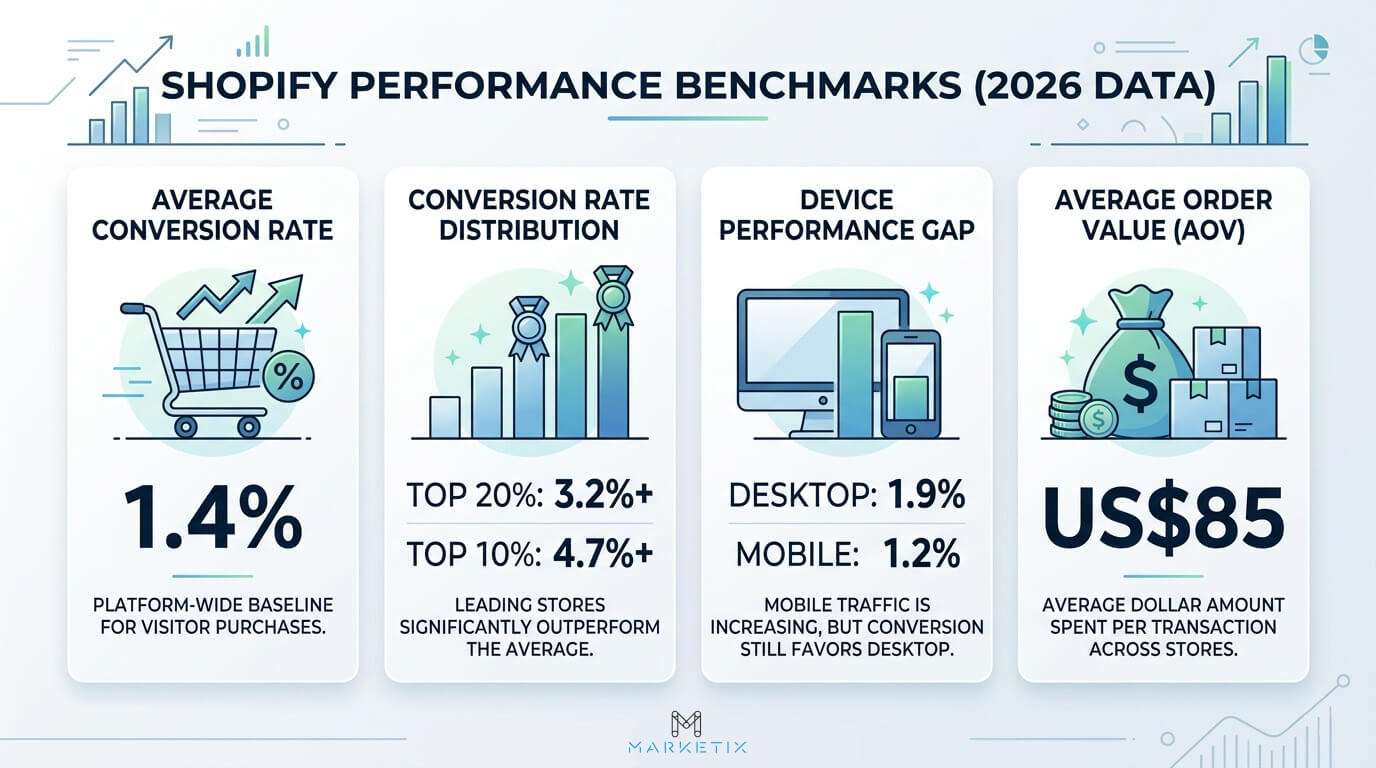
The Shopify average conversion rate currently sits at 1.4%, although top-performing stores significantly outperform that benchmark. That figure is often quoted without context. What matters more is the distribution. Stores in the top 20% convert at 3.2% or higher, while the top 10% exceed 4.7%.
That gap is not marginal. It is the difference between a struggling store and a highly profitable one.
Device performance highlights another layer of inefficiency:
Traffic is increasingly mobile, yet conversion still favours desktop. That imbalance is one of the biggest revenue leaks in Shopify stores.
Revenue efficiency is equally important. The average order value across Shopify stores sits at US$85, with a 45% checkout completion rate and a 4.6% add-to-cart rate. These numbers define the core funnel:
Each stage introduces drop-off. Small improvements at each point compound into meaningful revenue growth.
To put this into perspective, the global eCommerce conversion rate averages 2.76%. Many Shopify stores sit well below that benchmark. The issue is rarely demanded. It is execution.
This is where structured optimisation becomes critical. Strong SEO, conversion-focused design, and clear user journeys all influence these metrics. Businesses investing in eCommerce SEO strategies tend to see compounding gains because traffic quality improves alongside conversion efficiency.
Performance metrics only tell part of the story. User behaviour explains why those numbers look the way they do.
Cart abandonment remains the single largest issue in eCommerce. The average abandonment rate sits at around 70%. That means seven out of ten users who show purchase intent never complete the transaction.
This is not just a UX issue. It is a revenue issue at scale.
Shopify estimates that up to US$260 billion in lost orders across the US and EU could be recovered through better checkout design and optimisation. That figure highlights how much revenue is already within reach.
The reasons are predictable:
These are not complex problems. They are execution problems.
Mobile behaviour amplifies the issue. Cart abandonment on mobile reaches 85.65%, compared to significantly lower rates on desktop. At the same time, 72% of all eCommerce sales now come from mobile devices.
This creates a clear contradiction. Most users browse and buy on mobile, yet mobile delivers the worst conversion performance.
From a growth perspective, this is one of the highest-impact areas to address. Improving mobile UX does not just increase conversion rates. It unlocks revenue from traffic that already exists.
Traffic acquisition and device behaviour sit at the centre of Shopify performance.
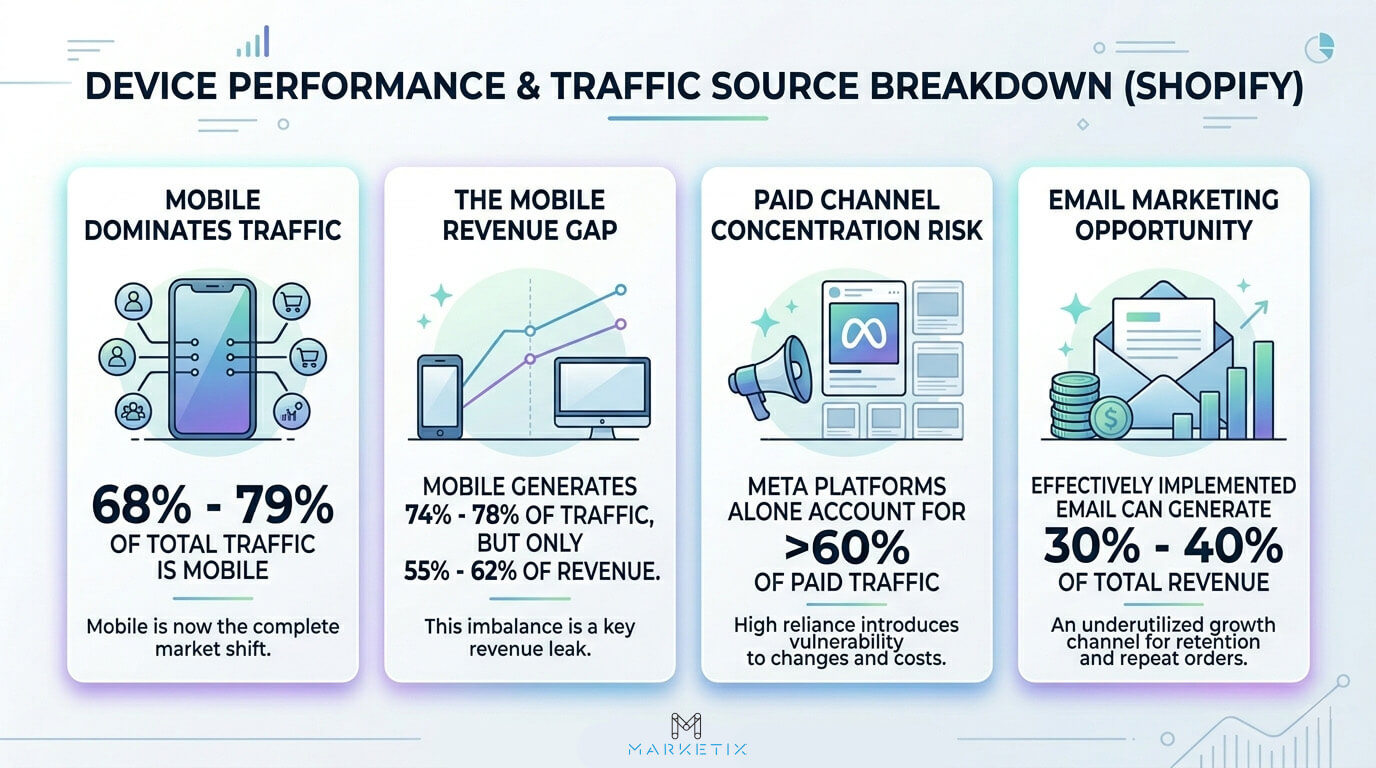
Mobile dominates. Between 68% and 79% of Shopify traffic comes from mobile devices, with up to 79% of purchases completed on mobile. The shift is no longer emerging. It is already complete.
Yet revenue distribution tells a different story. Mobile generates 74% to 78% of traffic, but only 55% to 62% of total revenue.
That gap is where most stores lose money.
Traffic source breakdown adds another layer. Organic search typically drives 20% to 30% of total traffic for well-optimised Shopify stores. Unlike paid channels, this traffic compounds over time and does not rely on ongoing spend.
For businesses focused on long-term growth, investing in a dedicated Shopify SEO service becomes a key lever. It improves both traffic volume and intent, which directly impacts conversion.
Paid channels still play a major role. Meta platforms alone account for over 60% of paid traffic to Shopify stores. That concentration introduces risk. When acquisition depends heavily on one channel, performance becomes vulnerable to rising costs and platform changes.
Email marketing, on the other hand, remains underutilised. When implemented properly, it can generate 30% to 40% of total revenue. The gap here is not awareness. It is execution.
From a Marketix perspective, the strongest-performing stores typically follow a balanced model:
Each channel plays a role. The challenge is aligning them into a cohesive system rather than treating them as isolated tactics.
Shopify’s core platform is only part of the equation. Performance is heavily influenced by how merchants use its ecosystem.
Most stores rely on apps to extend functionality. Around 75% of Shopify merchants use apps, with an average of six apps installed per store. That level of adoption highlights a key reality. Out-of-the-box Shopify is rarely enough to compete at scale.
Apps typically cover:
Conversion optimisation, such as upsells and bundling
Email and retention tools
Reviews and social proof
Analytics and tracking
The challenge is not access to tools. It is how those tools are implemented.
At the higher end of the market, Shopify Plus adoption continues to grow, with 76,607 live Plus stores recorded in 2025. These businesses operate with larger catalogues, higher traffic volumes, and more complex customer journeys. Their advantage often comes from structured optimisation rather than just budget.
Checkout is one of the clearest examples of where optimisation drives measurable impact.
Shopify’s own data shows that Shop Pay can increase conversion rates by up to 50% compared to standard guest checkout. Even its presence alone improves lower-funnel performance, reducing friction at the point of purchase.
That improvement is not marginal. It directly affects revenue.
Site performance is another critical lever. A 0.1-second improvement in load speed can increase conversion rates by around 8%, based on Deloitte-backed research. Small technical gains compound quickly when applied across thousands of sessions.
There is also a growing gap between stores that optimise continuously and those that do not. Many businesses install apps but fail to integrate them properly into the customer journey. Others focus on acquisition without improving conversion, which leads to diminishing returns.
From a Marketix standpoint, the strongest results come from aligning three areas:
Without that alignment, even high traffic volumes struggle to convert into sustainable revenue.
Once performance is understood at the store level, the focus shifts to return on investment and long-term growth.
The broader payments ecosystem is evolving rapidly. Global payments revenue is expected to reach US$3 trillion by 2029, with digital wallets accounting for around 30% of point-of-sale transactions.
This shift reinforces the importance of frictionless checkout experiences. As user expectations rise, slower or more complex payment processes will continue to underperform.
Looking ahead, several major Shopify eCommerce trends are reshaping how merchants acquire customers, optimise conversion, and scale revenue.
Emerging models such as agentic commerce are projected to reach US$5 trillion globally by 2030. This represents a move towards AI-assisted purchasing, where discovery, comparison, and even transactions are increasingly automated.
For Shopify merchants, this introduces both opportunity and pressure. Stores will need to adapt not only to user behaviour, but also to how platforms and algorithms mediate purchasing decisions.
In practical terms, this means:
ROI becomes the central metric that ties everything together. Traffic alone is no longer a reliable indicator of success. What matters is how efficiently that traffic converts into revenue.
For businesses evaluating performance, tools like an eCommerce SEO ROI calculator help quantify the impact of improvements across traffic, conversion, and average order value. These models make it easier to prioritise high-impact changes rather than guessing.
Growth also requires realistic expectations. SEO, in particular, is a long-term channel. Results compound over time rather than appearing immediately. Understanding how long SEO takes to deliver results helps align strategy with actual timelines and prevents premature decision-making.

Shopify’s growth at a platform level is clear. The scale, adoption, and transaction volume all point in the same direction. What matters more for individual businesses sits beneath that surface.
Performance across Shopify stores is not consistent.
Conversion rates remain relatively low on average. Mobile continues to underperform despite driving the majority of traffic. Checkout friction still accounts for a significant share of lost revenue. These are not isolated issues. They are patterns seen across the platform.
The key takeaway is straightforward. Most stores already have access to the same tools, traffic sources, and technology. The difference comes down to how effectively those elements are used.
Businesses that treat these benchmarks as performance indicators rather than reference points tend to see better outcomes. Improvements in conversion rate, order value, and traffic quality do not happen in isolation. They build on each other.
Viewed this way, the data becomes more than a collection of statistics. It provides a clear framework for identifying where performance gaps exist and where optimisation efforts should be focused.
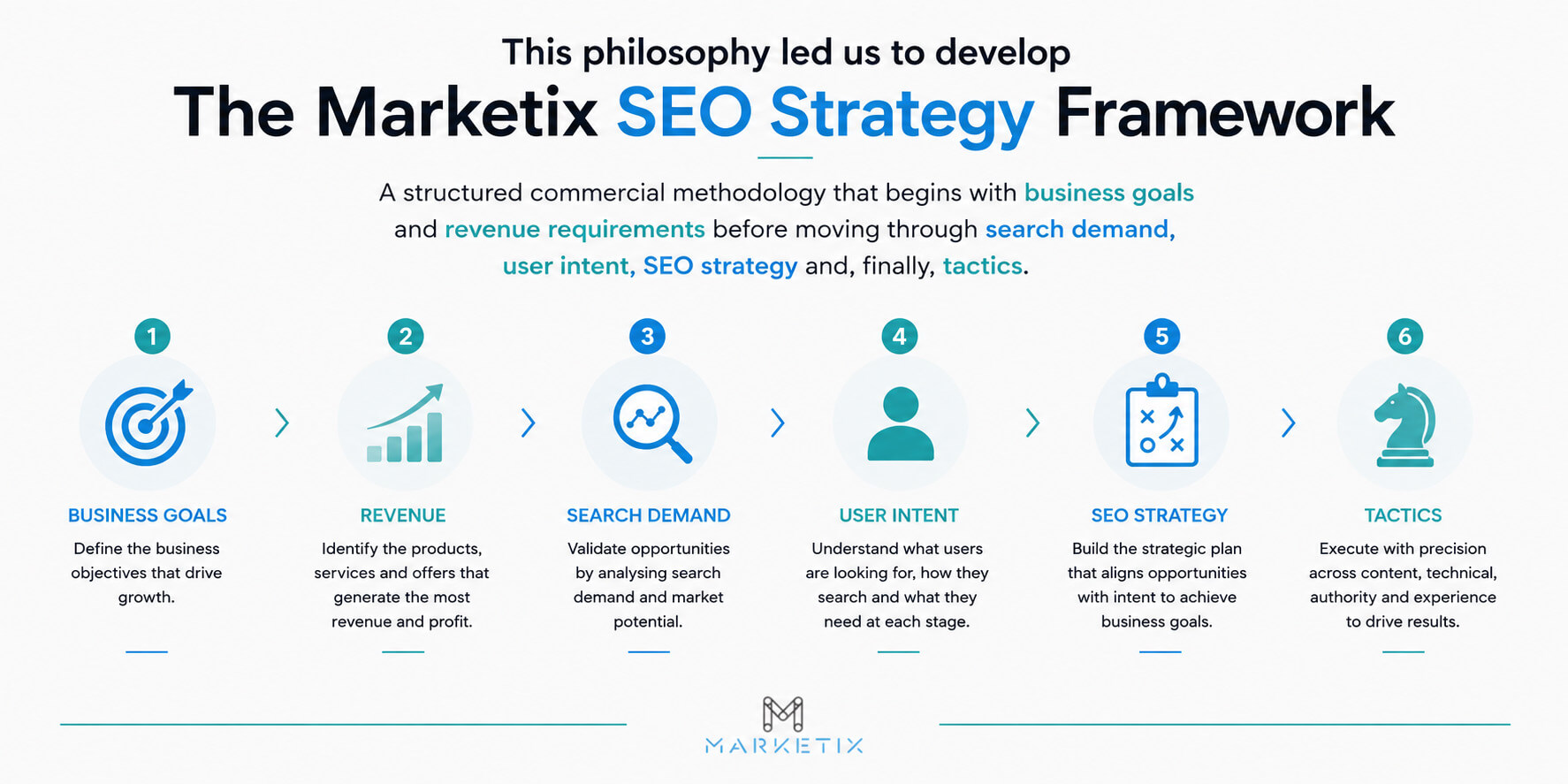
Shopify performance rarely improves through isolated changes. Growth comes from aligning acquisition, conversion, and technical execution into a single system.
That is where Marketix focuses its approach, combining SEO, CRO, and revenue modelling to identify where stores are underperforming and how to close the gap. Rather than chasing vanity traffic, the focus stays on measurable outcomes such as higher conversion rates, stronger revenue per visitor, and scalable organic growth.
For Shopify businesses looking to move beyond baseline performance, working with a dedicated provider provides a structured path forward. This includes identifying high-intent keywords, improving on-site conversion elements, and building a long-term organic channel that compounds over time.
The result is not just more traffic, but a more efficient and predictable revenue engine.
Recent Posts
Download our 24-page SEO book to learn:
You have successfully joined our subscriber list.
Recent Posts