Australian eCommerce traffic is no longer growing because consumers are simply “moving online”. That shift already happened years ago.
Growth in 2026 is being driven by something more complex: changing search behaviour, mobile-first browsing, marketplace dominance, rising acquisition costs, fragmented discovery channels, and stronger competition for commercial-intent traffic.
The businesses gaining market share are not necessarily the ones generating the most visits. They are the ones attracting higher-intent users, retaining customers longer, improving conversion efficiency, and reducing dependence on expensive paid channels.
That distinction matters now more than ever.
Australian online spend reached $82.6 billion in 2025, increasing 14% year on year, according to recent Australian eCommerce revenue statistics.
At the same time, 82% of Australian households shopped online during the year, equivalent to 9.8 million households.
The Australia e-commerce market is no longer a high-growth niche category. Online retail has become embedded consumer behaviour across almost every demographic, category, and purchasing cycle.
The challenge for retailers has shifted.
Traffic acquisition is harder. Competition is higher. Paid media costs continue rising. Organic visibility is increasingly competitive. Consumers browse across multiple devices and platforms before converting.
Simple “more traffic” strategies are becoming less effective.
Businesses now need stronger acquisition efficiency, better retention, higher conversion performance, and more durable traffic channels.

Despite broader economic pressure across retail, ecommerce growth in Australia continues to expand at a significant pace.
Online retail sales reached $4.7 billion in June 2025 alone, increasing 13% year on year.
Importantly, growth is no longer concentrated only in major metro areas or younger demographics.
Australia Post’s latest eCommerce report shows online shopping behaviour has spread deeply into mainstream Australian households, regional consumers, and older age groups. Millennials still drive a major share of online spending, but weekly online purchasing habits are now common across multiple demographics.
That maturity changes how traffic behaves.
Earlier growth phases were heavily driven by first-time digital adoption. The current phase is driven more by:
As markets mature, traffic becomes more commercially competitive.
Clicks become more expensive. Organic rankings become harder to win. Returning customer retention becomes more valuable than raw acquisition volume.
That is one reason many Australian eCommerce brands are investing more heavily into long-term acquisition channels like SEO, retention marketing, and owned audiences rather than relying purely on paid acquisition.
We’ve seen this shift accelerate over the past 18–24 months, particularly among mid-sized eCommerce brands experiencing rising Google Ads CPAs and declining efficiency from purely paid-led acquisition strategies.
The businesses scaling more sustainably tend to prioritise:
That becomes increasingly important as consumer journeys become more fragmented.
The modern Australian eCommerce journey is rarely linear.
Consumers do not simply click an ad and purchase immediately. Most move between search engines, marketplaces, social platforms, reviews, emails, YouTube, and retailer websites before converting.
Australian shoppers now use an average of 4.8 touchpoints before making a purchase.
That single statistic explains why attribution modelling has become increasingly difficult across eCommerce.
Traffic sources no longer operate independently.
Organic search may initiate discovery. Instagram may reinforce trust. Amazon may influence pricing comparisons. Email may drive the final purchase.
Many businesses still measure channels in isolation, even though consumers behave across ecosystems.
The fragmentation becomes even clearer when looking at search behaviour.
Google remains the primary product discovery channel, with 54% of consumers beginning product research through search engines.
Search still dominates because commercial-intent queries remain one of the strongest indicators of purchasing behaviour.
Users searching terms like:
They are already far deeper in the buying cycle than passive social media users.
That is why SEO continues to outperform many channels in long-term revenue efficiency, particularly for businesses competing in established categories.
Strong organic visibility captures intent at the exact moment consumers are actively evaluating products.
For businesses looking to improve long-term traffic acquisition efficiency, investing in structured eCommerce SEO strategies becomes increasingly important.
Social media increasingly influences what consumers buy, even when transactions happen elsewhere.
30% of Australians now purchase products through social commerce channels.
NielsenIQ also found that one in three global consumers is willing to purchase directly through social commerce environments.
TikTok’s influence is particularly important.
NielsenIQ reported that TikTok (Douyin) commerce sales in China increased 54.8% year on year, reinforcing how rapidly social commerce ecosystems can scale once consumer behaviour shifts.
Australia is following similar behavioural patterns, particularly across:
Social platforms increasingly shape discovery before users transition into Google searches, marketplaces, or direct website visits.
That distinction matters strategically.
Many businesses incorrectly view social commerce only as a direct conversion channel. In reality, social platforms often operate as awareness and consideration accelerators within broader buying journeys.
Traffic attribution frequently underreports its influence.
Mobile browsing is no longer an “optimisation layer”. It is the primary environment consumers use to discover products online.
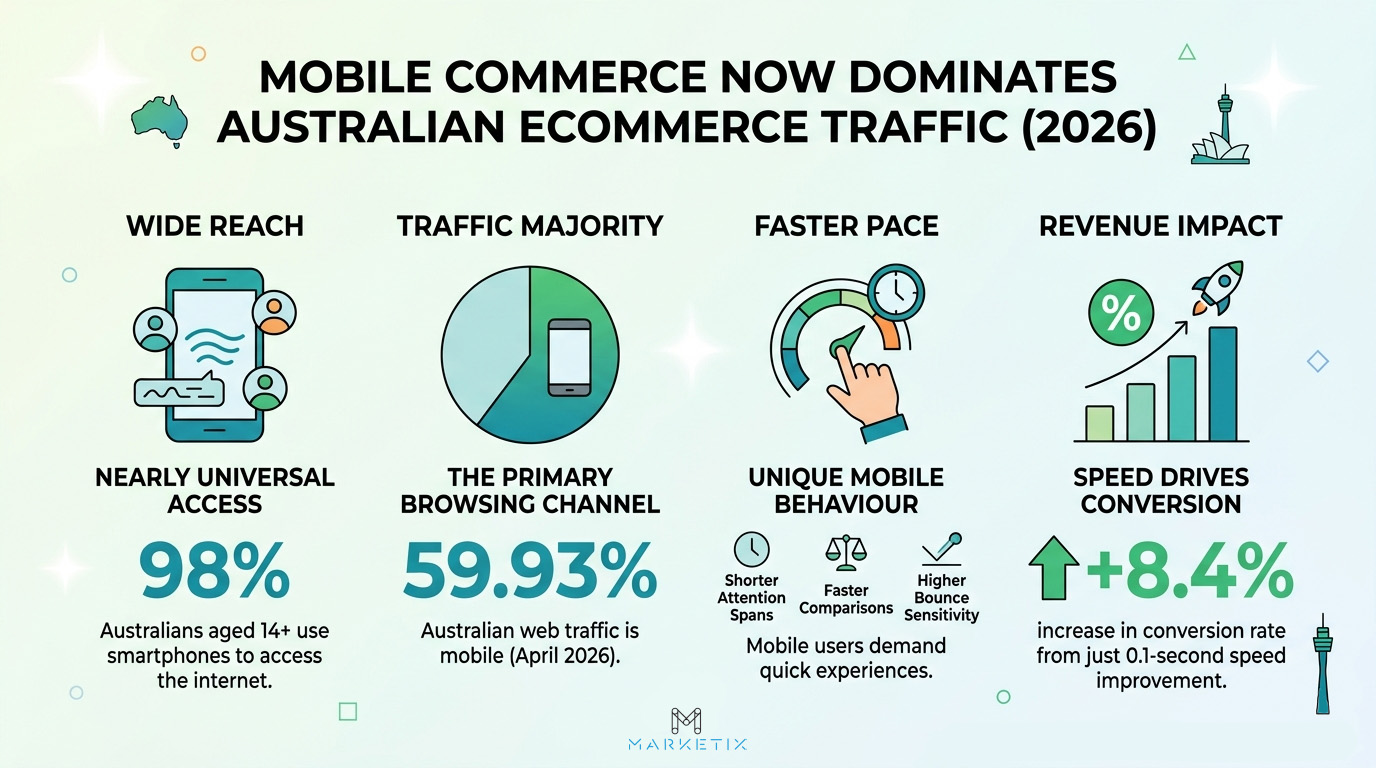
98% of Australians aged 14+ now use smartphones to access the internet.
Mobile traffic also accounted for 59.93% of Australian web traffic in April 2026.
That shift fundamentally changes how eCommerce websites need to perform.
Mobile users behave differently from desktop users:
Many Australian eCommerce stores still underperform badly on mobile, despite mobile dominating acquisition traffic.
The conversion impact is significant.
A 0.1-second improvement in mobile site speed increased retail conversion rates by 8.4%.
That is not a minor UX improvement. It is a direct revenue lever.
Mobile friction compounds quickly:
All reduce conversion efficiency.
The gap between traffic acquisition and traffic monetisation becomes particularly visible on mobile.
Many brands generate substantial mobile traffic volumes but fail to convert efficiently because the browsing experience does not match consumer behaviour patterns.
Consumer payment behaviour is evolving alongside mobile browsing behaviour.
Australians made more than 500 million mobile wallet payments worth over $20 billion in October 2024.
47% of Australians now prefer smartphones for online shopping and payments.
The commercial implication is straightforward.
Consumers increasingly expect:
Poor checkout UX destroys conversion performance, especially on mobile traffic. Recent eCommerce checkout and cart abandonment statistics show that even small amounts of friction during the purchase process can lead to significant revenue loss.
Many businesses focus heavily on traffic acquisition while underinvesting in checkout optimisation, despite checkout friction directly impacting revenue efficiency across all channels.
Traffic quality means very little if users cannot convert smoothly.
Australian consumers increasingly begin and finish their shopping journeys inside marketplaces.
93% of Australian consumers purchased from marketplaces within the past 12 months.
Amazon now reaches 60% of Australian shoppers, while eBay usage declined to 51%.
Marketplace dominance creates both opportunity and risk.
They offer massive traffic exposure and purchasing intent, but they also increase:
Many businesses become reliant on marketplaces because they struggle to generate profitable owned traffic channels independently.
That is where long-term SEO and owned acquisition strategies become commercially important.
Brands that build sustainable organic traffic can reduce reliance on marketplace ecosystems over time while improving customer ownership and retention economics.
For businesses evaluating the long-term financial value of SEO-driven acquisition, tools like an eCommerce SEO ROI calculator can help model revenue impact more realistically.
Australian eCommerce traffic remains heavily influenced by major retail periods.
Black Friday, Cyber Monday, EOFY sales, Boxing Day, and Christmas continue driving massive spikes in browsing and purchasing activity.
Consumers now plan purchases around promotional periods more strategically than in previous years.
Marketplace comparison behaviour also increases significantly during major retail events, with users actively comparing:
Traffic quality during these periods varies substantially.
Large traffic spikes do not automatically translate into stronger profitability, which is why many retailers now use an eCommerce profit margin calculator to better understand how acquisition costs, fulfilment expenses, and conversion rates impact actual profit.
Brands with weak conversion infrastructure often experience:
Meanwhile, businesses with stronger retention systems, email databases, and organic visibility often outperform because they rely less heavily on aggressive paid acquisition during peak competition periods.
That distinction increasingly separates sustainable eCommerce growth from purely seasonal revenue spikes.
One of the biggest shifts happening across Australian eCommerce is the growing gap between traffic quantity and traffic value.
A business generating 500,000 monthly visits is not necessarily outperforming a competitor generating 120,000 visits.
The real differentiator is increasingly:
That becomes particularly important as acquisition costs continue increasing across Google Ads, Meta, TikTok, and marketplaces.
Paid traffic still plays an important role in Australian eCommerce growth, especially for:
But relying entirely on paid traffic creates structural risk.
As competition rises, marginal acquisition costs increase. Brands eventually reach a point where scaling traffic becomes less profitable.
Organic acquisition behaves differently.
Strong SEO performance compounds over time. Rankings improve. Brand searches increase. Returning users grow. Non-branded search visibility expands.
The long-term economics become significantly more favourable.
That is one reason many established Australian eCommerce brands are increasing investment into technical SEO, category page optimisation, internal linking, content depth, and commercial search intent targeting.
Unlike short-term paid traffic spikes, SEO compounds.
For businesses evaluating how organic acquisition contributes to long-term revenue growth, we previously analysed broader retail and online shopping trends.
While newer acquisition channels attract most attention, owned traffic sources continue producing some of the strongest long-term returns in eCommerce.
Email remains one of the highest-performing retention channels available.
Campaigns sent in Australia achieved the highest regional open rate globally at 47.69%.
Even broader eCommerce email campaigns achieved a benchmark open rate of 32.67%.
Those numbers matter because retention traffic behaves differently from cold acquisition traffic.
Returning users generally:
Brands relying entirely on cold paid traffic often struggle with margin compression over time.
Businesses with strong owned audiences tend to scale more sustainably because they reduce dependence on external platforms.
That applies not only to email marketing, but also:
Owned traffic sources create stability.
That becomes increasingly valuable during algorithm changes, rising ad costs, or major marketplace competition shifts.
The gap between average eCommerce stores and high-performing stores continues widening.
Average Shopify conversion rates sit around 1.4%, while top-performing stores exceed 4.7%.
That difference is massive commercially.
At scale, moving from a 1.4% conversion rate to 3–4% fundamentally changes:
The stores outperforming are rarely succeeding because of a single tactic.
Most combine:
Traffic quality and conversion optimisation are becoming inseparable.
There is very little value in generating large volumes of low-intent traffic that cannot be monetised effectively.
That becomes especially important for SEO.
Many businesses still pursue informational traffic without a clear commercial strategy attached to it.
Traffic growth alone does not guarantee revenue growth.
The highest-performing eCommerce SEO strategies usually focus heavily on:
The objective is not simply “more rankings”. The objective is profitable traffic growth.
AI-driven search behaviour is now beginning to influence how consumers research products online.
The impact is still early, but the direction is clear.
AI search traffic remains relatively small today, accounting for less than 1% of referral traffic overall.
Yet behaviour is shifting quickly.
BCG reported that traffic to retail websites from GenAI browsers and AI chat platforms increased 4,700% year over year in July 2025.
BCG also found that AI search visits in Europe increased from 4% of organic visits in early 2024 to 8% in early 2025 and could reach 25% by the end of 2026.
That does not mean traditional SEO is disappearing.
In reality, organic search still remains the dominant conversion channel across most eCommerce categories.
What is changing is how product discovery happens before users reach retailer websites.
Consumers increasingly expect:
That creates major implications for:
Many eCommerce businesses are still underprepared for this shift.
The brands likely to benefit most are those already investing in:
AI discovery increasingly favours clarity, structure, authority, and relevance.
Weak, thin, or templated eCommerce content becomes increasingly vulnerable.
One of the clearest patterns across Australian eCommerce is the growing commercial value of owned organic traffic.
Organic search remains one of the few acquisition channels that compound over time.
Strong SEO performance can continue generating:
Paid traffic usually stops the moment spend stops.
Organic visibility behaves differently.
Well-optimised category pages, collection pages, buying guides, and commercial content assets can continue generating revenue long after publication.
That long-term compounding effect becomes increasingly important as paid acquisition costs continue rising.
For many eCommerce brands, SEO is no longer just a “traffic channel”.
It is becoming a core profitability lever.
Businesses improving:
often improve both traffic acquisition and conversion performance simultaneously.
That combination creates a stronger long-term ROI than purely scaling paid traffic alone.
As the Australia ecommerce market size continues growing, Australian eCommerce traffic is becoming more competitive, fragmented, and expensive to acquire.
Easy growth from simply increasing traffic volume is becoming less common.
From what we are seeing across Australian eCommerce, the businesses performing best are focusing on:
Consumers now move across Google, marketplaces, social platforms, email, and AI tools before purchasing.
That means acquisition strategies need to be broader, more efficient, and more conversion-focused than they were a few years ago.
At Marketix, we are seeing more brands shift investment towards SEO, technical optimisation, CRO, and retention because long-term owned traffic is becoming more valuable as paid acquisition costs continue rising.
Organic search, mobile UX, and conversion-focused acquisition strategies continue delivering some of the strongest long-term ROI across Australian eCommerce.
Traffic growth still matters. Profitable traffic growth matters more.
Recent Posts
Download our 24-page SEO book to learn:
You have successfully joined our subscriber list.
Recent Posts