eCommerce Checkout & Cart Abandonment Statistics 2026

A customer finding a product is only part of the sale.


The more difficult challenge begins once they reach the cart.


Every year, online retailers spend billions acquiring visitors through SEO, Google Ads, social media advertising, email marketing, marketplaces, influencers, and affiliate partnerships. Yet a significant percentage of those potential customers leave without completing their purchase.


The gap between adding a product to a cart and completing a transaction remains one of the largest sources of lost revenue in eCommerce.


For many online stores, improving checkout performance can generate more revenue than increasing traffic. A business that converts more of its existing visitors often grows faster than one focused solely on acquiring additional traffic.


The latest checkout and cart abandonment data reveals where retailers continue to lose customers, what shoppers expect during checkout, and which factors have the greatest influence on conversion rates.


eCommerce Cart Abandonment Remains One of the Industry’s Biggest Revenue Challenges


Cart abandonment is not a new problem.


Despite major advances in payments, fulfilment, website technology, and mobile commerce, most online shopping journeys still fail to result in a completed purchase.


Baymard Institute's analysis of 50 separate studies found that the average documented cart abandonment rate is 70.22%.


Put simply, roughly seven out of every ten shoppers who place an item in their cart never complete checkout.


Dynamic Yield reports an even higher global cart abandonment rate of 77.68%.


Although methodologies vary between studies, the conclusion remains consistent. Most potential revenue entering the checkout process never reaches the final transaction stage.


Cart Abandonment Benchmark

Rate

Baymard Institute Average

70.22%

Dynamic Yield Global Average

77.68%

The financial impact is substantial.


Forrester estimates that cart abandonment costs eCommerce businesses approximately $18 billion in lost revenue every year.


Those losses extend beyond missed sales.


Every abandoned cart also reduces the return on marketing investment. The cost of acquiring the visitor has already been incurred. The opportunity to convert that visitor into revenue is what disappears.


At Marketix, we often see retailers focus heavily on traffic acquisition while overlooking checkout performance. Traffic growth remains important, but conversion efficiency often produces faster revenue gains because it improves the value of every visitor already reaching the website.


This becomes particularly important as customer acquisition costs continue to increase across both organic and paid channels.


For broader context around the growth of online retail and consumer purchasing behaviour, many of these trends align closely with the findings covered in our Australian eCommerce statistics analysis.


Why Shoppers Abandon Their Carts Before Completing a Purchase


Most customers do not abandon because they suddenly decide they no longer want the product.


In many cases, abandonment occurs because something during checkout creates doubt, frustration, inconvenience, or unexpected cost.


Baymard Institute found that extra costs remain the leading reason shoppers abandon carts. Shipping fees, taxes, and other charges introduced late in the checkout process continue to create friction that pushes customers away.


The same research identified several additional contributors, including:


  • Slow delivery
  • Lack of payment trust
  • Forced account creation
  • Complex checkout processes


Each of these issues introduces uncertainty at the exact point where retailers need confidence and momentum.


McKinsey's research highlights the importance of delivery costs even further.


The firm found that 90% of consumers are likely to abandon an online purchase when they encounter high shipping costs during checkout.


Few statistics demonstrate the importance of shipping transparency more clearly.


Consumers increasingly evaluate the total delivered cost rather than the product price alone. A competitively priced product can quickly become uncompetitive once shipping fees are revealed.


Delivery Expectations Continue to Influence Conversion Rates


Delivery is no longer viewed as a post-purchase experience.


For many shoppers, delivery forms part of the purchase decision itself.


Australia Post found that 69% of Australian shoppers want delivery options available during checkout.


Customers increasingly expect flexibility. They want to choose delivery methods, delivery speeds, collection options, and fulfilment preferences before committing to a purchase.


Australia Post also found that 73% of shoppers say a positive delivery experience makes them more likely to shop online rather than visit physical stores.


The delivery experience has effectively become a competitive advantage.


Retailers competing purely on product or price are increasingly competing against businesses that offer superior convenience.


Further evidence comes from CommBank's summary of the Australia Post eCommerce Report, which found that 85% of shoppers view reliable delivery as the most important trust factor when purchasing online.


Trust begins long before the parcel arrives.


Consumers want confidence that products will arrive when promised, without surprises.


Free Shipping Continues to Shape Purchase Decisions


The appeal of free shipping has not diminished.


According to CommBank's analysis, more than half of Australian shoppers rank free delivery as their preferred delivery option.


McKinsey reached a similar conclusion, finding that more than 95% of consumers prefer free standard shipping over paying for faster delivery.


The implication is straightforward.


Many shoppers would rather wait longer and pay less than receive products faster at an additional cost.


This has important implications for checkout design, shipping thresholds, promotional offers, and free shipping incentives.


Many successful retailers use minimum order value thresholds to encourage larger basket sizes while offsetting fulfilment costs. When executed correctly, these offers can simultaneously improve conversion rates and average order values.


Returns Policies Also Affect Checkout Completion


Consumers increasingly evaluate what happens if something goes wrong.


According to CommBank's summary of the Australia Post eCommerce Report, 65% of shoppers say friction-free returns contribute to a positive online shopping experience.


A difficult returns process introduces risk into every purchase decision.


When customers are uncertain about sizing, quality, compatibility, or suitability, a clear returns policy reduces perceived risk and increases purchase confidence.


Many retailers still hide returns information deep within policy pages.


The strongest performers typically surface return information throughout the shopping journey, including category pages, product pages, cart pages, and checkout screens.


This is one reason product page optimisation plays a significant role in conversion performance. Clear shipping information, delivery estimates, returns policies, reviews, FAQs, and trust signals all help reduce uncertainty before customers reach checkout. Many of these conversion-focused elements are discussed in our guide to SEO strategies for eCommerce product pages.


Payment Preferences Are Reshaping Checkout Behaviour


Payment Preferences Are Reshaping Checkout Behaviour


Payment options have become a major conversion factor.


Consumers increasingly expect retailers to support their preferred payment methods rather than forcing them into a single checkout pathway.


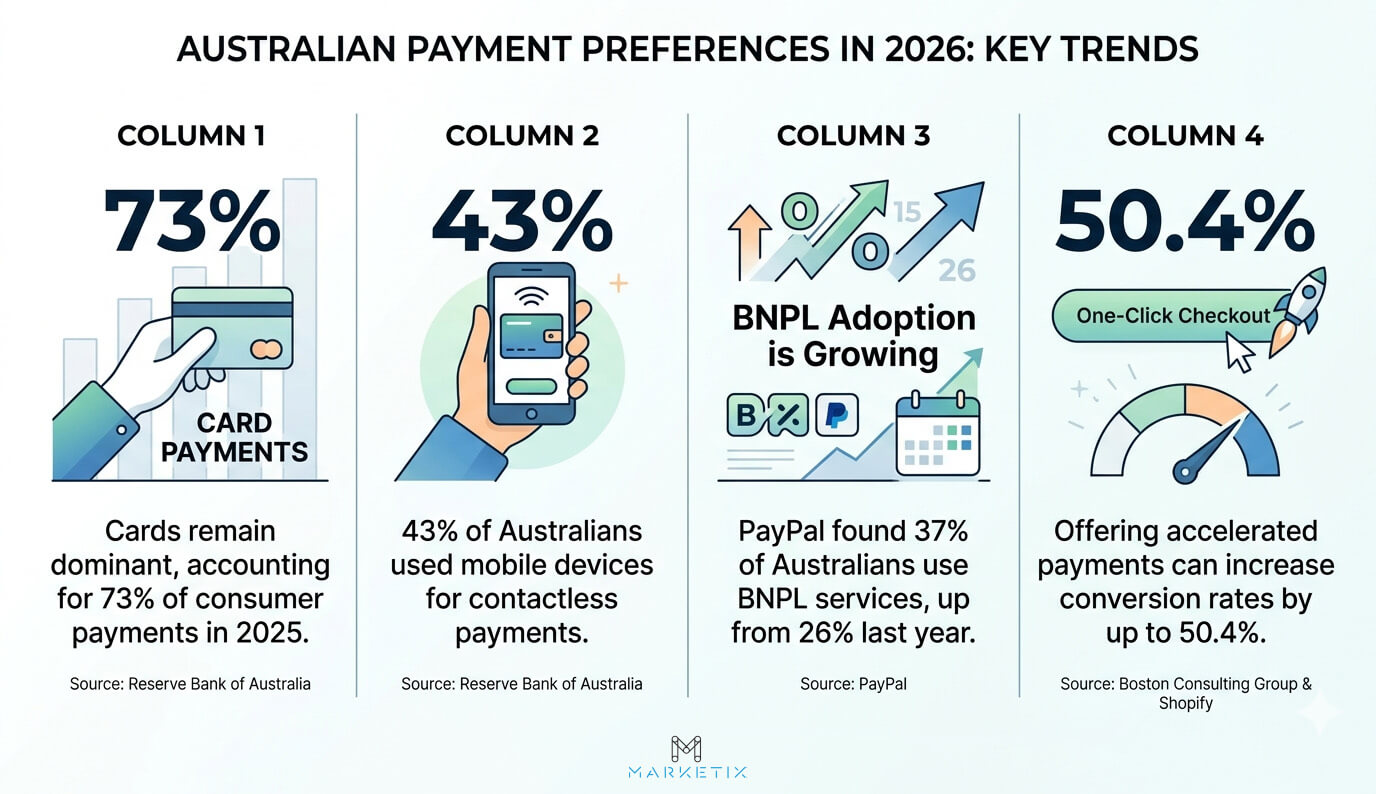
According to the Reserve Bank of Australia, cards accounted for 73% of consumer payments in 2025, making them the dominant payment method across the country.


While traditional card payments remain dominant, consumer behaviour continues to shift toward faster and more convenient alternatives.


The Reserve Bank also found that 43% of Australians used a mobile device to make contactless payments during the survey period.


That figure reflects the broader adoption of digital wallets such as Apple Pay and Google Pay.


Consumers have become increasingly comfortable with biometric authentication, one-click purchasing, and mobile-first payment experiences.


Buy Now Pay Later continues to influence online purchasing behaviour as well.


PayPal found that 37% of Australians now use BNPL services, up from 26% the previous year.


The growth of BNPL highlights how payment flexibility can influence purchase decisions, particularly for larger discretionary purchases.


Payment choice is no longer simply a convenience feature.


For many customers, it determines whether a purchase happens at all.


Boston Consulting Group and Shopify found that offering accelerated payment methods can increase conversion rates by up to 50.4%.


That finding reinforces a broader trend emerging across eCommerce.


Reducing effort during checkout frequently produces stronger conversion gains than adding additional marketing channels.


The easier it becomes to pay, the more likely customers are to complete their purchase.

 

Mobile Commerce Continues to Create Checkout Challenges


Mobile commerce is no longer an emerging trend.


For many retailers, mobile devices now account for the majority of website traffic, product discovery, and shopping activity.


PayPal found that 47% of Australians prefer using smartphones for online purchases and payments.


Consumers increasingly browse, compare products, read reviews, and complete purchases from their phones. Yet despite this shift, mobile conversion rates continue to lag behind desktop performance.


Dynamic Yield reports that mobile cart abandonment rates reach 80.39%, making mobile the weakest-performing device category for checkout completion.


That figure should concern any retailer relying heavily on mobile traffic.


An abandonment rate above 80% means most purchase journeys are still failing before a transaction occurs.


Boston Consulting Group and Shopify found that desktop shoppers convert 23% better than mobile shoppers on average.


The difference highlights a challenge facing much of the eCommerce industry.


Consumers increasingly prefer mobile devices, but many mobile checkout experiences still introduce unnecessary friction.


Smaller screens, slower page speeds, form completion difficulties, payment interruptions, and poor usability continue to create barriers that are less common on desktops.


In our experience, Mobile conversion gaps are one of the most common issues we encounter during eCommerce audits. Many retailers focus heavily on traffic acquisition while overlooking the mobile checkout experience, where a large percentage of their revenue is either won or lost.


Checkout UX Friction Continues to Reduce Conversion Rates


Many cart abandonment issues are caused by avoidable checkout friction rather than a lack of purchase intent.


Baymard Institute found that the average checkout contains 5.1 steps and 11.3 form fields. Every additional step increases the effort required to complete a purchase and creates another opportunity for shoppers to leave.


Baymard's research also identifies checkout complexity and forced account creation as significant abandonment drivers. Shoppers generally want the fastest path to payment possible. Long forms, unnecessary account requirements, and poor usability often interrupt that journey.


The highest-converting checkouts tend to share several common characteristics:


Check out Best Practice

Why It Matters

Guest checkout

Removes unnecessary barriers to purchase

Fewer form fields

Reduces effort and completion time

Clear progress indicators

Helps shoppers understand where they are in the process

Autofill functionality

Speeds up form completion

Multiple payment methods

Supports different payment preferences

Mobile-first design

Improves usability for mobile shoppers

Small improvements often deliver disproportionate gains because they affect customers who have already demonstrated strong purchase intent and are close to completing a purchase.


Trust Signals Have Become Critical Conversion Drivers


Trust has become one of the most important factors influencing checkout completion.


Consumers are increasingly aware of online fraud, payment scams, data breaches, and fulfilment issues.


As a result, many shoppers actively look for reassurance before completing a purchase.


PayPal found that 79% of Australian consumers are more concerned about data security than they were 12 months earlier.


That statistic reflects a broader shift in consumer behaviour.


Shoppers are no longer evaluating products alone.


They are evaluating retailers.


Questions running through a customer's mind often include:


  • Can I trust this website?
  • Will my payment information be safe?
  • Will the product arrive?
  • Can I return it if needed?
  • Is this retailer legitimate?


CommBank's summary of the Australia Post eCommerce Report found that 85% of shoppers consider reliable delivery the most important trust factor when purchasing online.


Trust extends well beyond payment security.


Reliable fulfilment, transparent delivery information, visible returns policies, customer reviews, ratings, FAQs, contact information, and recognised payment providers all contribute to purchase confidence.


Many of the strongest trust-building elements are introduced long before checkout begins.


This is why product page optimisation often has a direct impact on checkout performance. Well-structured product pages reduce uncertainty before customers reach the cart, creating smoother purchase journeys and stronger conversion rates.


Cart Recovery Strategies Continue to Deliver Significant Revenue Opportunities


An abandoned cart does not necessarily represent a lost customer.


Many shoppers leave for reasons unrelated to purchase intent.


They may become distracted. They may want additional time to compare options. They may be waiting for payday. They may simply forget.


This creates an opportunity for recovery.


Klaviyo found that abandoned cart email flows generate an average open rate of 50.5%, a click rate of 6.25%, and a placed order rate of 3.33%.


Those numbers help explain why abandoned cart automation remains one of the highest-return activities in eCommerce marketing.


The customer has already shown strong intent.


The recovery campaign simply brings them back to complete the purchase.


SMS marketing can be even more immediate.


Omnisend reports SMS open rates between 90% and 98%, with 90% of messages being read within three minutes.


The speed of engagement is particularly valuable for retailers selling impulse purchases, promotional products, limited stock items, or seasonal offers.


Effective recovery programmes typically combine multiple channels, including:


  • Abandoned cart emails
  • SMS reminders
  • Dynamic retargeting campaigns
  • Personalised offers
  • Product recommendation emails


The goal is not simply to remind customers.


It is to remove whatever barrier prevented them from completing the purchase initially.


Checkout Performance Has Become a Core Driver of eCommerce Profitability


Checkout performance affects far more than conversion rates. It directly influences revenue, customer acquisition costs, return on ad spend, and overall profitability.


Website speed remains a major factor. Google's research found that a 0.1-second improvement in mobile page speed can increase retail conversion rates by 8%. Even small improvements can generate significant revenue gains for high-traffic online stores.


Every abandoned cart increases the cost of acquiring customers because more traffic is required to generate the same number of sales. Improving checkout completion allows retailers to generate more revenue from their existing visitors without increasing marketing spend.


This is why leading eCommerce businesses treat checkout optimisation as a growth strategy rather than a simple UX improvement. Traffic drives opportunity, but conversion turns that opportunity into revenue.


For businesses focused on long-term growth, this also highlights the importance of choosing the right eCommerce SEO partner. Generating qualified traffic is only part of the equation. Sustainable growth comes from combining SEO, user experience, and conversion optimisation to maximise the value of every visitor.


Why Checkout Optimisation Matters More Than Ever


Cart abandonment continues to be one of the biggest revenue challenges in eCommerce. The data shows that most lost sales stem from predictable issues such as unexpected costs, checkout friction, delivery concerns, limited payment options, and a lack of trust.


We've found that some of the largest revenue gains often come from improving what happens after a visitor arrives. While attracting qualified traffic through eCommerce SEO services remains important, increasing the percentage of visitors who complete checkout often delivers the fastest path to revenue growth.


Retailers that streamline checkout, improve the customer experience, and remove friction throughout the purchase journey are better positioned to convert more traffic into revenue.


As competition and customer acquisition costs continue to rise, checkout optimisation is no longer just a CRO tactic. It has become a critical driver of profitable eCommerce growth.