Australian eCommerce Revenue Statistics 2026: Key Market Data, Growth Trends and Online Sales Insights

Australian eCommerce Revenue Statistics


Australian eCommerce revenue continues climbing, but the dynamics behind that growth are changing.


Revenue expansion is no longer driven purely by more people shopping online. Australian consumers already buy online at scale. Growth now comes from higher purchase frequency, marketplace expansion, mobile commerce adoption, improved conversion efficiency, stronger retention systems, and increasingly sophisticated acquisition strategies.


Competition has intensified at nearly every level of online retail.


Customer acquisition costs continue rising. Organic visibility has become more valuable. Large marketplaces are absorbing more consumer spending. Conversion rate optimisation is having a greater influence on profitability. Mobile purchasing behaviour is reshaping checkout expectations.


The businesses winning market share in 2026 are usually the ones building efficient revenue systems rather than simply chasing traffic growth.


Australian eCommerce Market Revenue Continues to Expand


Australian consumers spent AU$82.6 billion online during 2025, representing 13.9% year-on-year growth. Nearly 9.8 million Australian households purchased online during the year, while average basket sizes reached AU$96.


That level of growth matters for two reasons.


First, Australian online retail is still expanding despite inflation pressure, higher living costs, and increasing competition. Second, eCommerce is continuing to capture a larger percentage of total retail spending nationally.


NAB estimated Australians spent AU$66.23 billion online over the 12 months to September 2025, equivalent to approximately 14.9% of all retail trade.


A decade ago, online retail represented a relatively small portion of Australian commerce. That has changed substantially.


Australia Post previously reported that online retail already accounted for approximately 18.1% of total retail spending by 2022.


The shift is structural rather than temporary.


Consumers now move fluidly between physical stores, marketplaces, social platforms, mobile apps, search engines, and direct brand websites before purchasing. Online retail is no longer treated as a separate channel. It has become embedded in broader Australian eCommerce customer behaviour trends.


That behavioural shift is one reason organic acquisition channels and broader ecommerce customer acquisition Australia strategies continue becoming more commercially valuable for retailers. Businesses investing in long-term visibility through strategies such as eCommerce SEO are increasingly less dependent on volatile paid acquisition costs compared with brands relying heavily on advertising alone.


Monthly Online Retail Sales Continue Rising


Monthly spending data reinforces the broader annual growth trend.


ABS reported AU$4.7 billion in online retail sales during June 2025 alone, representing 13% annual growth.


That figure highlights how large the Australian online retail economy has become on a recurring monthly basis.


More importantly, growth is occurring across multiple retail sectors simultaneously rather than being isolated to a single category. Fashion, electronics, marketplaces, homewares, food delivery, beauty, and specialty retail all continue contributing to broader digital revenue expansion.


Global forecasts suggest the long-term trajectory remains strong.


Deloitte projected global eCommerce sales would reach US$6.09 trillion during 2024, reflecting continued worldwide digital commerce expansion.


Meanwhile, BCG forecasts the global eCommerce market could grow from roughly US$25 trillion in 2024 to more than US$80 trillion by 2030 as AI-driven commerce, embedded purchasing experiences, and omnichannel retail mature further.


Australia is following many of the same patterns seen globally:


  • Increasing mobile-first purchasing
  • Higher online purchase frequency
  • Faster delivery expectations
  • Marketplace dominance
  • Rising social commerce influence
  • Stronger omnichannel integration
  • Greater reliance on digital product discovery


These changes are reshaping how online revenue is generated.


Online Marketplaces Are Capturing More Revenue


One of the biggest shifts in Australian eCommerce revenue is the growing dominance of marketplaces.


Online marketplaces became Australia’s largest eCommerce category during 2025, generating AU$18.9 billion in online spending.


That number alone demonstrates how much consumer purchasing behaviour has shifted towards consolidated retail platforms.


Amazon, Temu, and Shein are now absorbing enormous amounts of Australian consumer spending.


That level of marketplace concentration creates both opportunities and risks for eCommerce businesses.


Marketplaces provide access to enormous consumer demand and built-in traffic. At the same time, they compress margins, increase competition, reduce brand ownership, and make long-term customer retention more difficult.


Many Australian retailers are now trying to balance marketplace exposure with direct-to-consumer growth strategies.


That shift is increasing demand for owned acquisition channels such as SEO, email marketing, retention campaigns, and direct brand search visibility. Businesses increasingly want to reduce reliance on platforms they do not control.


For brands evaluating long-term acquisition strategies, understanding how to select the right SEO partner has become increasingly important as competition intensifies. Marketix previously explored this in detail within our guide on choosing the right eCommerce SEO agency.


Fashion, Electronics and Apparel Continue Driving Online Revenue


Fashion, Electronics and Apparel Continue Driving Online Revenue


Several retail categories continue dominating Australian online spending.


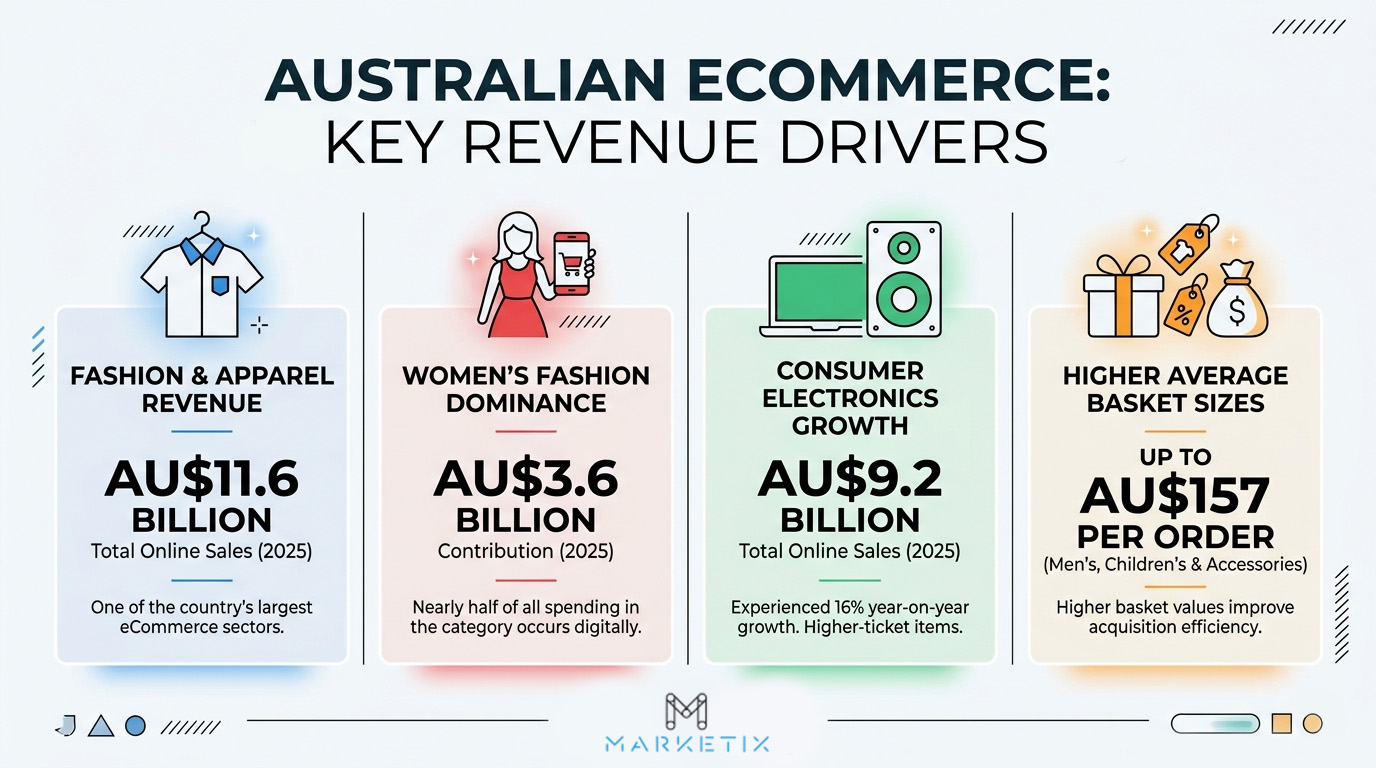
Fashion and apparel generated AU$11.6 billion in Australian online sales during 2025, making it one of the country’s largest eCommerce sectors.


Women’s fashion alone contributed AU$3.6 billion online during the year, with almost half of all category spending now occurring digitally.


That figure highlights how deeply online purchasing has penetrated the fashion industry, specifically.


Fashion eCommerce continues benefiting from:


  • High purchase frequency
  • Strong mobile usage
  • Social discovery behaviour
  • Influencer-driven demand
  • Fast checkout expectations
  • Aggressive promotional cycles


Consumer electronics also remain one of Australia’s strongest online revenue categories.


Australians spent AU$9.2 billion online on consumer electronics during 2025, while the category grew 16% year-on-year.


Electronics growth is commercially important because higher-ticket categories tend to produce larger average order values and stronger revenue concentration per transaction.


The same report found average basket sizes for electronics reached AU$106.77.


Men’s, children’s, and accessories categories generated even larger average basket sizes, reaching approximately AU$157 per order.


Higher basket values can significantly improve acquisition efficiency and improve overall profitability when paired with stronger margins, lower fulfilment costs, and better operational control, something many brands now model using an eCommerce profit margin calculator.


An online store converting the same amount of traffic at a higher AOV generally creates stronger margins, better advertising efficiency, and greater profitability potential.


That relationship between traffic, conversion rates, and revenue efficiency is one reason more Australian retailers are focusing heavily on analytics and forecasting tools, such as an eCommerce SEO ROI calculator, to better model long-term acquisition profitability.


Consumer Purchase Behaviour Is Becoming More Intentional


Australian consumers are not simply buying more online.


They are shopping differently.


KPMG’s Australian Retail Outlook found more than 80% of consumers now shop across both online and physical retail channels.


That level of omnichannel behaviour changes how revenue attribution works across the customer journey.


Consumers increasingly:


  • Discover products through social platforms
  • Compare pricing through Google
  • Read reviews on marketplaces
  • Visit physical stores
  • Return to purchase later on mobile devices
  • Use email offers or promotions before converting


The path to purchase has become significantly more fragmented.


KPMG also found 66% of Australians actively seek promotions and discounts before purchasing online.


That trend is increasing pressure on retailers to compete aggressively on pricing, offers, shipping speed, loyalty programs, and checkout experience.


McKinsey research further found that consumer intent to purchase goods online increased between 40–60% compared with pre-pandemic behaviour across multiple retail sectors.


The long-term implication is clear.


Online purchasing behaviour is now deeply embedded into mainstream retail consumption patterns rather than functioning as an alternative purchasing channel.


Retailers that fail to adapt to those expectations increasingly struggle to maintain revenue growth as customer expectations continue rising.


Mobile Commerce Is Reshaping Revenue Growth


Mobile commerce continues to influence nearly every part of Australian eCommerce performance.


Purchasing journeys are becoming faster, more fragmented, and increasingly mobile-first.


Australians made 520 million mobile wallet transactions worth AU$24.3 billion during a single month in 2025.


The Reserve Bank of Australia reported mobile wallets accounted for 43% of card transactions by late 2025, compared with only 10% in 2020.


That level of adoption changes consumer checkout expectations significantly.


Faster payment experiences reduce friction during checkout. Reduced friction generally improves mobile conversion rates, particularly for repeat customers and impulse-driven purchases.


This is one reason conversion optimisation and mobile UX improvements continue to become more commercially important for Australian retailers.


It also connects directly to broader Australian traffic trends, particularly the growing dominance of mobile discovery behaviour across search, social media, and marketplaces, which we explored further in our breakdown of Australian eCommerce traffic statistics.


Seasonal Revenue Peaks Continue Growing


Seasonal sales events continue generating enormous revenue spikes across Australian eCommerce.


Roy Morgan forecast Australians would spend AU$6.8 billion during the Black Friday–Cyber Monday sales period in 2025 alone.


That scale of spending shows how heavily annual revenue is increasingly concentrated into short promotional windows.


The broader Christmas retail period remains even larger.


Overall pre-Christmas retail spending during the 2025 festive season was forecast to reach AU$72.4 billion nationally.


For many eCommerce brands, a disproportionate percentage of annual revenue now occurs during:


  • Black Friday
  • Cyber Monday
  • EOFY sales
  • Christmas
  • Boxing Day
  • Major marketplace events


That creates both opportunity and operational pressure.


Inventory management, shipping capacity, conversion optimisation, remarketing, email automation, and search visibility all become significantly more important during compressed revenue periods where competition intensifies sharply.


Conversion Rates and Checkout Performance Are Becoming Major Revenue Drivers


Traffic growth alone is no longer enough to sustain profitable eCommerce growth.


As acquisition costs rise, conversion efficiency is becoming one of the biggest revenue levers available to online retailers.


Baymard Institute’s large-scale checkout research found the average global cart abandonment rate sits around 70%.


That statistic is commercially significant because it highlights how much revenue is still lost during the checkout process itself.


For many online stores, improving checkout completion rates by even a few percentage points can produce substantial revenue gains without increasing traffic spend.


Baymard research also found that checkout usability improvements can increase conversion rates by up to 35%.


In practical terms, that can influence:


  • Revenue per visitor
  • Customer acquisition efficiency
  • Profit margins
  • Advertising scalability
  • Repeat purchase behaviour
  • Long-term customer value


The relationship between conversion rates and profitability is becoming increasingly important as paid acquisition channels become more expensive and competitive.


Many Australian retailers are discovering that improving revenue efficiency often produces stronger returns than simply increasing traffic volume.


That shift is changing how growth-focused businesses evaluate SEO, CRO, analytics, UX, and retention investments.


Retail Media and Marketplace Advertising Are Reshaping Online Revenue Distribution


Retail media is becoming a major factor in how online revenue is distributed across Australian eCommerce platforms.


Large marketplaces and retailers are no longer functioning solely as transactional platforms. They are becoming advertising ecosystems built around first-party consumer data, sponsored product visibility, and algorithmic product discovery.


IAB Australia’s Retail Media State of the Nation 2025 report found that seven in ten Australian advertisers and agencies using retail media increased their investment over the previous 12 months, while 77% now work with three or more retail media networks.


That growth reflects how rapidly retailers and marketplaces are monetising product discovery environments.


Brands are now competing for visibility not only inside Google search results, but also across marketplace search placements, retailer-owned advertising networks, sponsored product listings, and recommendation algorithms.


Platforms such as Amazon, Woolworths Cartology, Coles 360, and major marketplaces increasingly influence which products consumers discover first.


This creates another layer of acquisition complexity for eCommerce businesses.


Organic visibility inside marketplaces is becoming harder to maintain without advertising support, while external paid acquisition costs continue rising simultaneously.


The result is growing pressure on margins and customer acquisition efficiency.


Many brands are now actively trying to diversify acquisition channels to reduce platform dependency and improve long-term revenue stability.


That is one reason owned acquisition strategies such as SEO, retention marketing, and direct brand search visibility continue becoming more commercially valuable for Australian eCommerce businesses.

 

Social Commerce Is Expanding Rapidly


Social commerce is becoming increasingly important within broader online retail growth.


Platforms are steadily moving from product discovery environments into transactional commerce ecosystems.


BCG stated social commerce is projected to exceed US$1 trillion globally as content, discovery, entertainment, and transactions continue merging together.


Growth is already accelerating heavily in parts of Asia.


NIQ reported TikTok (Douyin) eCommerce sales in China grew 54.8% year-on-year, highlighting how quickly social commerce ecosystems can scale once purchasing behaviour becomes embedded within platforms.


Australia is still earlier in the social commerce lifecycle compared with China, but the behavioural shift is already visible.


Consumers increasingly:


  • Discover products through short-form video
  • Purchase directly through creator recommendations
  • Interact with live shopping content
  • Use TikTok and Instagram for product research
  • Expect frictionless mobile purchasing journeys


That behavioural shift changes how brands think about attribution, traffic acquisition, and conversion paths.


The traditional linear customer journey is becoming less common.


Instead, online purchases increasingly happen across fragmented touchpoints involving search engines, marketplaces, creators, email campaigns, paid ads, organic social content, and mobile apps simultaneously.


SEO and Owned Channels Are Becoming More Valuable for Long-Term Revenue Growth


As acquisition channels become more fragmented and expensive, owned traffic sources are becoming more commercially valuable.


Many eCommerce businesses are now reassessing how sustainable their ecommerce sales acquisition Australia models actually are.


Heavy dependence on paid acquisition can become increasingly difficult to maintain when:


  • Advertising costs rise
  • Marketplace competition increases
  • Margins tighten
  • Conversion rates fluctuate
  • Platforms change algorithms
  • Consumer loyalty weakens


This is where long-term organic acquisition strategies become increasingly important.


Unlike paid campaigns that stop generating traffic once spending ends, SEO compounds over time.


Strong organic visibility can continue producing:


  • Revenue growth
  • Lower blended acquisition costs
  • Higher profitability
  • Greater brand authority
  • More stable traffic acquisition
  • Better long-term ROI


For many Australian retailers, SEO is no longer viewed purely as a traffic channel.


It is increasingly treated as a revenue infrastructure investment.


That distinction matters.


The businesses continuing to scale profitably are usually the ones combining:


  • Organic search visibility
  • Strong conversion systems
  • Email retention
  • Customer lifecycle marketing
  • Brand search growth
  • Efficient checkout experiences
  • Data-driven CRO


Those elements collectively create more durable revenue systems.


At Marketix, we increasingly see this shift across Australian eCommerce brands. Businesses are becoming less focused on vanity traffic metrics and more focused on revenue efficiency, customer acquisition sustainability, and profitability per visitor.


That shift is changing how SEO performance itself is measured.


Revenue contribution, customer lifetime value, assisted conversions, and blended acquisition costs are becoming more important than rankings alone.


AI, Automation and the Future of eCommerce Revenue Growth


Artificial intelligence is also beginning to reshape how online revenue is generated.


AI-driven product recommendations, predictive merchandising, personalised search experiences, automated customer support, dynamic pricing, and AI-assisted product discovery are all becoming more common across online retail environments.


Some of the largest marketplaces are already heavily integrating AI into product discovery and shopping behaviour.


Australia Post’s reporting also found increasing consumer adoption of AI-assisted shopping research, particularly within electronics and fashion categories.


The commercial implications are significant.


AI-driven discovery systems may increasingly influence:


  • Product visibility
  • Search behaviour
  • Customer journeys
  • Purchase decisions
  • Conversion rates
  • Revenue attribution


That will likely make brand authority, structured data, customer trust, and content quality even more important over time.


Businesses that rely purely on transactional advertising may struggle as discovery behaviour evolves further towards AI-assisted experiences.


Final Thoughts


The Australia e-commerce market continues growing, but the market is becoming more competitive, more expensive, and more operationally demanding.


Higher acquisition costs, stronger marketplace competition, rising consumer expectations, and tighter margins are forcing businesses to focus more heavily on conversion efficiency, retention, and long-term customer value rather than simply driving more traffic.


We see the strongest eCommerce brands investing in scalable acquisition systems that continue generating revenue over time. SEO, CRO, retention marketing, mobile UX, and revenue-focused analytics are becoming far more important as paid advertising costs continue rising.


The businesses that build stronger organic visibility, better conversion systems, and more efficient customer acquisition channels are usually the ones positioned for more sustainable long-term growth.