Google Ads Statistics Australia 2026: PPC Benchmarks, Trends & Data

Google Ads Statistics


Google Ads remains one of Australia's most widely used digital advertising platforms, helping businesses reach customers who are actively searching for their products and services.


This report brings together the latest Google Ads statistics, Australian digital advertising data and PPC benchmarks for 2026.


Where Australian benchmark data is unavailable, we've included reputable global studies alongside Google's own data to provide the most comprehensive picture of the current Google Ads landscape.


Australia's Digital Advertising Market Continues to Grow


Google Ads doesn't exist in isolation. Its growth mirrors the continued expansion of Australia's digital economy, where businesses are investing larger portions of their marketing budgets into measurable online advertising.


The latest Internet Advertising Revenue Report from IAB Australia found that Australian digital advertising expenditure reached $16.4 billion during the 2024–25 financial year, representing continued year-on-year growth across the industry.


Search advertising remained one of the country's largest advertising channels, reinforcing Google's central role within digital marketing strategies.


Quarterly reporting tells a similar story. IAB Australia's December 2025 report showed continued growth in internet advertising revenue, supported by sustained investment across search, video and retail media.


Search advertising consistently accounted for a significant share of total digital advertising spend, highlighting the ongoing importance of paid search for businesses seeking measurable returns.


Earlier reporting from September 2025 also demonstrated strong market momentum, indicating that advertiser confidence has remained resilient despite broader economic pressures.


Taken together, these reports point to a clear trend:


  • Australian businesses continue increasing investment in digital advertising.
  • Search advertising remains one of the most established acquisition channels.
  • Competition for high-intent search traffic is becoming more intense.


From our experience at Marketix Digital, this increased competition is one of the biggest reasons campaign quality now matters more than simply increasing budgets.


Well-structured campaigns, strong landing pages and accurate conversion tracking consistently outperform businesses that rely solely on higher ad spend.


Google Continues to Dominate Search Advertising in Australia


The value of Google Ads becomes much easier to understand when you consider Google's position within Australia's search market.


The Australian Competition and Consumer Commission (ACCC) concluded that Google's dominance in general search remains largely undisrupted, with few realistic alternatives capable of matching its scale or reach.


That dominance extends beyond search results alone.


The ACCC's Digital Platform Services Inquiry found that Google occupies influential positions across search, advertising technology and digital advertising services, allowing it to participate throughout much of the digital advertising supply chain.


Its earlier Digital Advertising Services Inquiry reached a similar conclusion, identifying Google's significant market power across advertiser tools, publisher services and advertising exchanges.


For Australian advertisers, this has practical implications.


When people say they're "running Google Ads", they're advertising on the platform that reaches the overwhelming majority of Australian search users.


Few other PPC platforms can consistently deliver the same volume of high-intent traffic.


That doesn't automatically make Google Ads easy.


Greater market share also means greater competition. More businesses bidding on the same commercial keywords naturally pushes up costs, making campaign optimisation increasingly important.


More Australian Businesses Are Investing in Google Ads


The number of businesses operating in Australia continues to grow, increasing competition across almost every industry.


According to the Australian Bureau of Statistics, Australia had more than 2.6 million actively trading businesses during 2024–25.


Every new business entering the market creates additional competition for visibility.


While not every business advertises on Google, many eventually turn to paid search as organic competition becomes more difficult. For highly commercial industries such as legal services, finance, healthcare, trades and ecommerce, Google Ads has become a standard component of customer acquisition.


Consumer demand is also supporting this investment.


ABS Retail Trade data continues to show substantial retail spending across Australia, reflecting ongoing consumer purchasing activity despite changing economic conditions.


For advertisers, this creates a straightforward equation:


  • Consumers continue searching.
  • Businesses continue competing.
  • Paid search remains one of the fastest ways to capture demand.


It's also why understanding campaign economics has become increasingly important. Businesses evaluating PPC should look beyond media spend alone and understand management costs, tracking, optimisation and reporting.


Our guide to Google Ads & PPC Management Pricing explores the different pricing models agencies use and what businesses should expect from a professional PPC management service.


Australian Consumers Continue to Rely on Google Throughout the Buying Journey


Google searches are no longer limited to finding information.


Consumers now use search throughout nearly every stage of the purchasing journey, moving between research, reviews, local searches, product comparisons and final purchasing decisions.


Google's own consumer research highlights how shoppers increasingly move between online and offline channels before making purchasing decisions, with search acting as a central touchpoint throughout that journey.


This behaviour explains why search advertising often delivers stronger intent than interruption-based advertising channels.


Rather than persuading someone who wasn't previously interested, Google Ads allows businesses to appear when consumers have already demonstrated intent through their search query.


Seasonal buying patterns reinforce this behaviour.


Google's retail insights show that consumers increasingly begin researching purchases well before peak shopping periods, using Google Search extensively to compare products, prices and retailers.


For advertisers, appearing during these research stages can significantly influence later purchasing decisions, even if the final conversion occurs days or weeks afterwards.


Google Ads Benchmarks: Cost Per Click (CPC)


Cost per click (CPC) is one of the most important Google Ads metrics because it directly affects how far your advertising budget will go.


Google Ads Benchmarks Cost Per Click


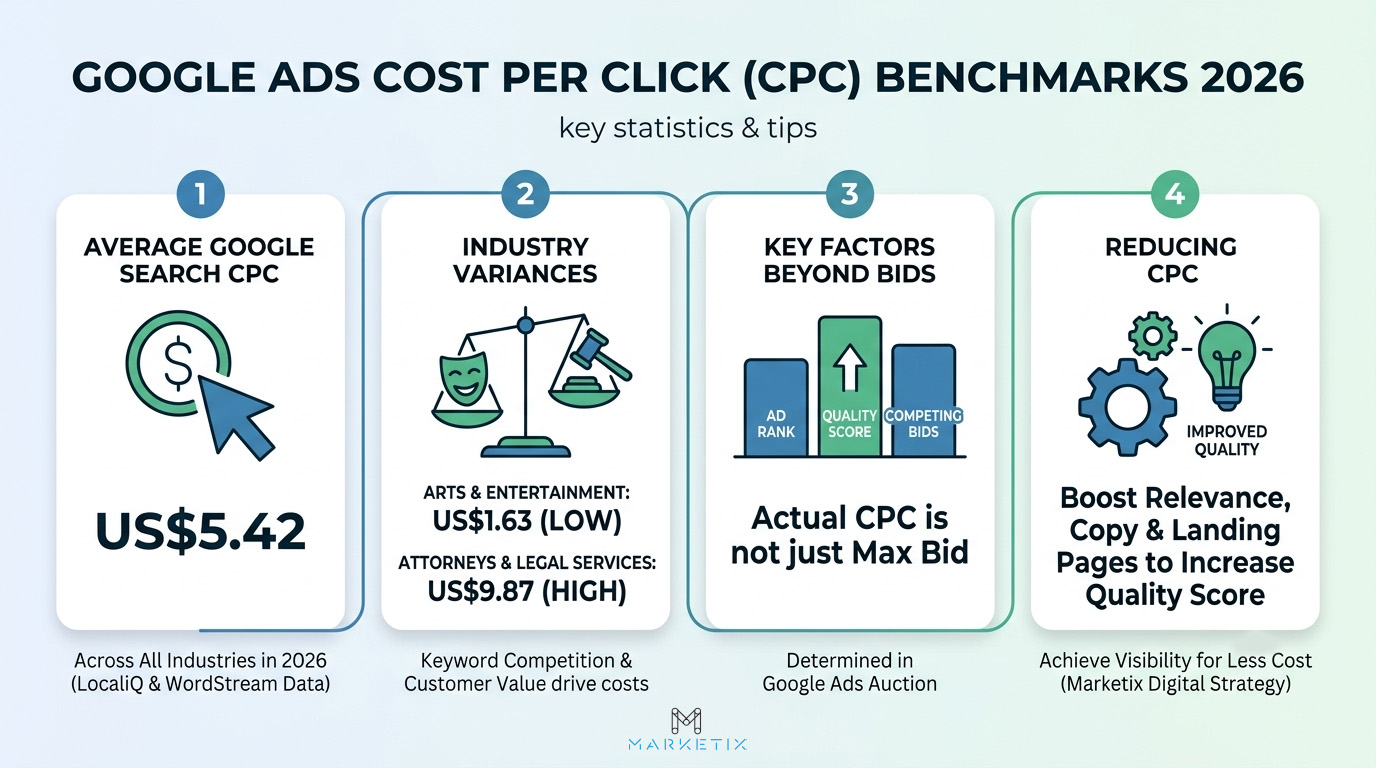
According to the latest Google Ads benchmark data from LocaliQ and WordStream, the average Google Search CPC across all industries in 2026 was US$5.42 per click.


That average only tells part of the story.


CPC varies significantly depending on industry and keyword competition. For example, Arts & Entertainment recorded one of the lowest average CPCs at US$1.63, while Attorneys & Legal Services averaged US$9.87 per click. Other highly competitive industries, including Dentists & Dental Services at US$8.00 and Home & Home Improvement at US$8.33.


These differences reflect the value of a customer. Businesses operating in industries with high customer lifetime values or expensive services are often willing to pay considerably more for a qualified click because a single conversion can generate thousands of dollars in revenue.


Google also explains that advertisers don't simply pay their maximum bid. Actual CPC is determined through the Google Ads auction, where Ad Rank, Quality Score and competing bids all influence the final amount paid.


For that reason, reducing CPC isn't just about lowering bids. Improving ad relevance, writing stronger ad copy and creating better landing page experiences can increase Quality Score, allowing advertisers to achieve similar visibility while paying less per click.


At Marketix Digital, this is one of the key areas we focus on within our Google Ads Management service. Improving campaign quality often delivers a greater reduction in acquisition costs than simply increasing advertising budgets.


Google Ads Benchmarks: Click-Through Rate (CTR)


Click-through rate (CTR) measures how often people click an ad after seeing it, making it one of the clearest indicators of ad relevance and search intent.


According to LocaliQ's latest benchmark report, the average Google Search Ads CTR across all industries is 6.64%.


Performance varies considerably by industry. Arts & Entertainment records one of the highest average CTRs at 13.10%, while Attorneys & Legal Services averages 5.09%. Industries such as Beauty & Personal Care (7.69%) and Shopping, Collectibles & Gifts (7.81%) also perform above the overall average, reflecting stronger consumer engagement in those sectors.


These differences highlight why CTR should always be compared against businesses in the same industry rather than against an overall platform average.


Google defines CTR as the number of clicks divided by the number of impressions, but its impact extends beyond measuring engagement. A stronger CTR can contribute to higher Quality Scores, which may improve Ad Rank and reduce cost per click over time.


If CTR begins to decline, it doesn't necessarily mean a campaign is underperforming. It can indicate several factors, including:


  • Increased competition

  • Less compelling ad copy

  • Poor keyword targeting

  • Ad fatigue

  • Changes in user search behaviour


At Marketix Digital, we regularly improve CTR through ongoing testing of headlines, descriptions, keyword groupings and ad assets.


Even relatively small improvements can lead to more qualified traffic without increasing advertising spend.


Google Ads Benchmarks: Conversion Rate


Conversion rate measures the percentage of ad clicks that result in a valuable action, such as a purchase, phone call or enquiry. It is one of the most important metrics for evaluating whether Google Ads traffic is generating real business outcomes.


According to LocaliQ's latest benchmark report, the average Google Search Ads conversion rate across all industries is 8.18%.


Performance differs significantly depending on industry and user intent. Automotive Repair, Service & Parts records one of the highest average conversion rates at 15.51%, while Physicians & Surgeons average 12.43%. In contrast, industries with longer buying cycles or more research-intensive purchasing decisions often record lower conversion rates.


These differences reinforce why businesses should benchmark against competitors within their own industry rather than comparing themselves with platform-wide averages.


Google also recommends tracking meaningful business outcomes, including purchases, lead form submissions and phone calls—so advertisers can optimise campaigns based on real conversions instead of clicks alone.


We often find that improving landing page experience, strengthening calls to action and refining audience targeting can increase conversion rates without requiring additional advertising spend.


Even small improvements can significantly reduce overall customer acquisition costs over time.


Google Ads Benchmarks: Cost Per Acquisition (CPA)


Cost per acquisition (CPA) tells advertisers how much they're paying, on average, to generate a conversion.


It is one of the most useful metrics for evaluating campaign efficiency because it combines advertising costs with actual business outcomes.


Industry benchmark studies continue to show considerable variation in average CPA across Google Ads campaigns. Highly competitive sectors such as legal services, finance and insurance generally experience much higher acquisition costs than industries with lower advertiser competition.


CPA should never be viewed in isolation.


A business paying £40 per lead isn't necessarily outperforming one paying £120. The more important question is what those customers are worth.


For businesses with high customer lifetime value, a relatively high CPA can still produce exceptional profitability.


This is why experienced PPC specialists optimise towards profitable customer acquisition rather than simply chasing the lowest possible cost.


Google Ads Benchmarks: Return on Ad Spend (ROAS)


Return on ad spend (ROAS) measures how much revenue is generated for every dollar invested in advertising.


It remains one of the clearest indicators of whether Google Ads is producing commercial value.


Benchmark research from Focus Digital shows that average ROAS varies significantly depending on the industry, product margins and campaign maturity, with profitable targets differing substantially between businesses.


Triple Whale's ecommerce benchmark research also demonstrates that ROAS expectations depend heavily on the sector, customer lifetime value and purchasing behaviour rather than a single universal benchmark.


A lower ROAS isn't always a problem.


Businesses entering new markets, launching products or pursuing aggressive growth often accept lower short-term returns while building market share. Others prioritise profitability and optimise campaigns accordingly.


The right target depends on commercial objectives, not industry averages alone.


Quality Score Remains One of Google's Most Important Performance Signals


Quality Score continues to play a significant role in campaign performance.


Google calculates Quality Score using factors such as expected click-through rate, ad relevance and landing page experience, providing advertisers with an indication of how well their ads meet user expectations.


Although Quality Score isn't used directly as a bidding mechanism, the underlying signals contribute to Ad Rank, which influences ad visibility and the amount advertisers ultimately pay per click.


Improving Quality Score often produces benefits across multiple areas, including:


  • Lower average CPC
  • Higher ad positions
  • Better click-through rates
  • More efficient use of advertising budgets


For many advertisers, improving relevance delivers stronger long-term gains than continually increasing bids.


Mobile Search Continues to Shape Google Ads Performance


Mobile devices now dominate much of the customer journey.


Consumers regularly move between smartphones, tablets and desktop devices before completing purchases, making cross-device optimisation increasingly important.


Google's research into omnichannel consumer behaviour shows that people frequently use Search throughout both online and in-store purchasing journeys, with mobile playing a central role in product discovery and decision-making.


At the same time, continued strength in Australian retail spending demonstrates that consumers remain actively engaged across digital channels.


For advertisers, this means campaign success increasingly depends on more than keyword selection.


Landing page speed, mobile usability, simplified enquiry forms and fast-loading websites all contribute to better conversion performance.


Automation and AI Are Changing Google Ads Faster Than Ever


Google Ads has changed dramatically over the past few years.


Machine learning and artificial intelligence now influence almost every aspect of campaign management, from bidding strategies to audience targeting and creative optimisation.


Google Marketing Live 2025 introduced a range of AI-powered capabilities designed to help advertisers generate creative assets, improve targeting and optimise campaigns with less manual intervention.


Google has also continued expanding AI within Search advertising, giving advertisers new tools to better match ads with user intent and emerging search behaviour.


This shift has been supported by Google's long-term investment in Smart Bidding and automated campaign optimisation.


Automation doesn't remove the need for expertise.


Instead, it changes where that expertise is applied.


Rather than manually adjusting bids throughout the day, experienced PPC specialists now spend more time refining campaign structure, improving creative assets, analysing first-party data and guiding AI towards stronger commercial outcomes.


Performance Max and AI Max Continue to Expand


Performance Max has quickly become one of Google's flagship campaign types.


Designed to run across Search, Display, YouTube, Discover, Gmail and Maps, Performance Max uses Google's machine learning systems to optimise placements and bidding automatically.


Google continues expanding the platform with additional reporting features, asset controls and optimisation capabilities aimed at giving advertisers greater visibility while maintaining automated bidding.


Alongside Performance Max, Google has introduced AI Max for Search campaigns, providing additional AI-powered capabilities that help advertisers discover new search opportunities and improve campaign performance.


Google has also announced the gradual transition from Dynamic Search Ads towards AI Max capabilities, signalling its long-term direction for automated Search advertising.


For businesses, the message is becoming increasingly clear.


AI is no longer an optional feature within Google Ads; it is becoming the default.


Alphabet's Financial Results Demonstrate Google's Advertising Strength


Google's continued investment in advertising technology is supported by strong financial performance.


Across recent quarterly earnings reports, Alphabet has reported ongoing growth in Google advertising revenue, demonstrating that businesses worldwide continue investing heavily in Google's advertising ecosystem.


These results are reinforced through Alphabet's official investor filings, which continue to show advertising as the company's primary revenue source.


Continued revenue growth allows Google to invest heavily in artificial intelligence, advertising infrastructure and campaign automation, shaping the future direction of Google Ads for advertisers worldwide.


What These Google Ads Statistics Mean for Australian Businesses


The statistics throughout this report point to several clear trends.


Digital advertising investment continues to grow. Google remains Australia's dominant search platform. Businesses are competing more aggressively for high-intent traffic, while automation and artificial intelligence continue to reshape how campaigns are managed.


That creates both opportunities and challenges.


Google Ads still offers one of the fastest ways to reach potential customers, but achieving consistent results now requires far more than simply increasing advertising budgets.


Strong account structure, accurate conversion tracking, compelling ad creative, relevant landing pages and ongoing optimisation all play a critical role in improving long-term performance and profitability.


"Google Ads has become significantly more sophisticated over the past few years. AI and automation have made campaign management more efficient, but they haven't replaced the need for strategic thinking. The businesses that consistently outperform their competitors are the ones that combine Google's automation with accurate data, strong creative and continuous optimisation."
Shoaib Mughal, Founder of Marketix Digital


At Marketix Digital, we provide professional Google Ads Management for businesses looking to generate more leads, increase online sales and maximise return on advertising spend.


Every campaign is built around clear commercial objectives, supported by robust conversion tracking, continuous optimisation and transparent reporting.


As a specialist PPC Agency in Sydney, we work with businesses across Australia to manage high-performing PPC campaigns, helping clients reduce wasted ad spend, improve campaign efficiency and scale sustainable growth through paid search.


As Google's advertising platform continues to evolve, one principle remains the same: businesses that combine accurate data, a well-defined strategy and ongoing optimisation are best positioned to achieve sustainable, long-term success with Google Ads.