Australian eCommerce has moved well beyond a “growth channel” phase.
Online retail is now deeply embedded into how Australians research products, compare brands, and purchase across nearly every major retail category. At the same time, competition for visibility inside Google has intensified dramatically. Organic search results now compete against marketplaces, AI-generated answers, Google Shopping listings, TikTok discovery, YouTube reviews, Reddit discussions, and increasingly aggressive paid advertising environments.
That shift has changed what successful eCommerce SEO actually looks like.
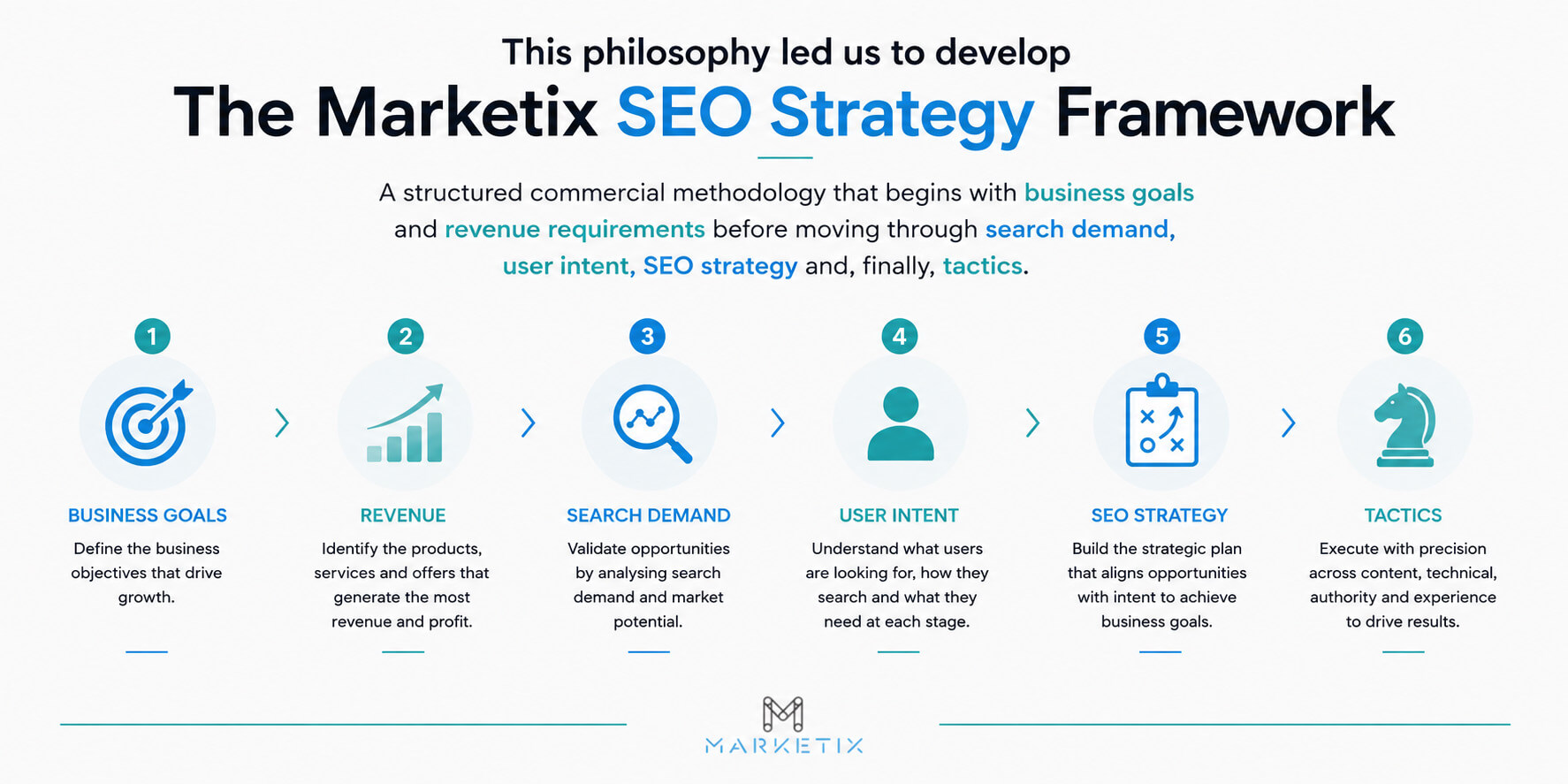
Ranking alone is no longer enough. The brands growing fastest through organic search are usually combining technical SEO, category architecture, CRO, brand trust, structured data, content depth, and authority signals into a single growth system.
The numbers increasingly support that direction.
Australian online retail sales reached $4.7 billion in June 2025 alone, increasing 13% year on year. Online sales also represented 12.7% of total Australian retail turnover during the same period.
Every increase in online retail penetration increases competition for organic visibility. More retailers entering digital commerce means more businesses targeting the same commercial keywords, category terms, and transactional search intent.
Australia Post’s latest eCommerce report reinforces the scale of this expansion. Australian online spending reached $82.6 billion in 2025, while 82% of Australian households shopped online.
That level of adoption changes how businesses think about customer acquisition. Organic search is no longer a secondary marketing channel for many retailers. It increasingly influences long-term revenue stability, customer acquisition efficiency, and profitability.
Many Australian brands are already adjusting toward broader, commercially focused eCommerce SEO strategies designed around revenue growth rather than rankings alone.
Despite the rise of marketplaces and social commerce, Google search remains deeply embedded within broader Australian eCommerce customer behaviour trends.
Australian shoppers now use an average of 4.8 touchpoints before purchasing online.
That means organic search rarely works as a standalone acquisition source anymore. Customers often move between Google, marketplaces, YouTube, TikTok, email, reviews, Reddit discussions, and social media before converting.
Importantly, search still remains the leading product discovery channel for Australian online shoppers.
Research also shows that 54% of shoppers continue starting product research directly on Google.
That behaviour matters heavily for eCommerce SEO because many of the highest-value searches happen before brand preference exists.
Searches involving:
…often happens before the customer knows where they intend to purchase.
Those non-branded commercial searches remain some of the largest organic revenue opportunities in eCommerce.
At the same time, search behaviour is becoming more fragmented.
Social media as a starting point for product research increased 67% year on year.
TikTok, YouTube, marketplaces, and AI-driven discovery engines are increasingly influencing how consumers discover products before returning to Google for validation and purchasing decisions.
That overlap between channels is becoming much more important from an SEO perspective.
Younger consumers increasingly use social platforms as search engines.
That does not necessarily reduce the importance of Google SEO. In many cases, it expands the overall discovery ecosystem surrounding products and brands.
Consumers may discover products through TikTok or Instagram before later searching:
…inside Google.
YouTube continues playing a major role in this process as well. It remains the second-largest search engine globally.
Video reviews, demonstrations, tutorials, and comparisons increasingly influence both rankings and conversions indirectly by shaping buyer trust before purchase decisions occur.
Marketplace behaviour is also reshaping organic product discovery.
Research found that 93% of Australians purchased from marketplaces within the past 12 months.
Amazon now reaches 60% of Australian shoppers, while eBay usage has declined to 51%.
This increasingly affects SEO competition inside Google itself.
Search results for commercial product terms now regularly include:
The modern SERP environment is significantly more competitive than it was several years ago.
Despite SERP fragmentation, ranking position still matters heavily.
The #1 organic Google result receives around 39.8% CTR on average.
The top three organic positions collectively capture roughly 68.7% of all clicks.
This concentration of click behaviour explains why relatively small ranking improvements can create substantial revenue growth for eCommerce businesses.
A movement from position 7 to position 3 for a high-intent keyword can dramatically alter:
At the same time, the click competition inside Google has become more difficult.
Nearly 60% of Google searches now end without a click.
This does not mean SEO is losing value. It means visibility itself is becoming more competitive.
Modern eCommerce SEO increasingly requires optimisation for:
Strong organic visibility today often depends on controlling multiple areas of the SERP simultaneously rather than relying on a single ranking alone.
Traffic quality matters more than raw traffic volume.
This becomes extremely obvious inside eCommerce analytics.
Research from First Page Sage found that SEO traffic converts at approximately 1.6% for eCommerce and retail businesses compared with 1.3% for PPC traffic.
The difference may appear relatively small initially, but across large traffic volumes, the revenue impact becomes substantial.
Organic traffic often converts more efficiently because users typically:
SEO also contributes heavily to assisted conversions rather than simply last-click attribution.
This becomes particularly important during major retail periods such as:
Many customers research products organically before later converting through branded searches, direct visits, email campaigns, or remarketing.
That often causes SEO’s real commercial contribution to be substantially underreported inside standard attribution models.
Customer acquisition costs continue increasing across most paid advertising environments.
Google Ads CPC inflation, Meta CPM increases, marketplace competition, and rising social advertising costs are placing growing pressure on eCommerce margins.
Research now suggests Australian eCommerce CAC sits approximately 20–35% higher than the US average.
This is one reason many retailers are shifting more heavily toward long-term organic acquisition strategies.
SEO economics increasingly look attractive in comparison.
eCommerce SEO now delivers an estimated 317% ROI and roughly 3.65 ROAS over time.
The major difference is compounding behaviour.
Unlike paid advertising:
This creates a fundamentally different acquisition model compared with paid channels.
Many businesses are now forecasting:
…before scaling SEO investment.
That shift is also why tools like an eCommerce SEO ROI calculator have become more useful for estimating the commercial impact of long-term organic growth strategies.
Mobile commerce now represents nearly 59% of global eCommerce sales.
For many Australian retailers, mobile devices already generate the majority of organic sessions.
The issue is that mobile conversion performance still lags behind desktop.
The average mobile eCommerce conversion rate sits around 2.85%, while desktop conversion rates reach approximately 3.85%.
That conversion gap represents one of the largest growth opportunities in modern eCommerce SEO.
Improving:
…can significantly improve organic revenue without requiring additional traffic growth. Studies on eCommerce checkout abandonment rates consistently show that even minor usability improvements can have a meaningful impact on completed purchases.
This is where technical SEO increasingly overlaps with CRO.
The businesses scaling organic revenue fastest are often improving the entire buying experience after the click, not simply rankings before the click.
Technical SEO problems rarely stay “technical”.
They usually become commercial problems very quickly.
Issues involving:
…can significantly reduce rankings, indexation efficiency, conversion rates, and long-term scalability.
This becomes particularly severe for larger eCommerce websites with extensive product catalogues.
Performance data continues to reinforce this relationship.
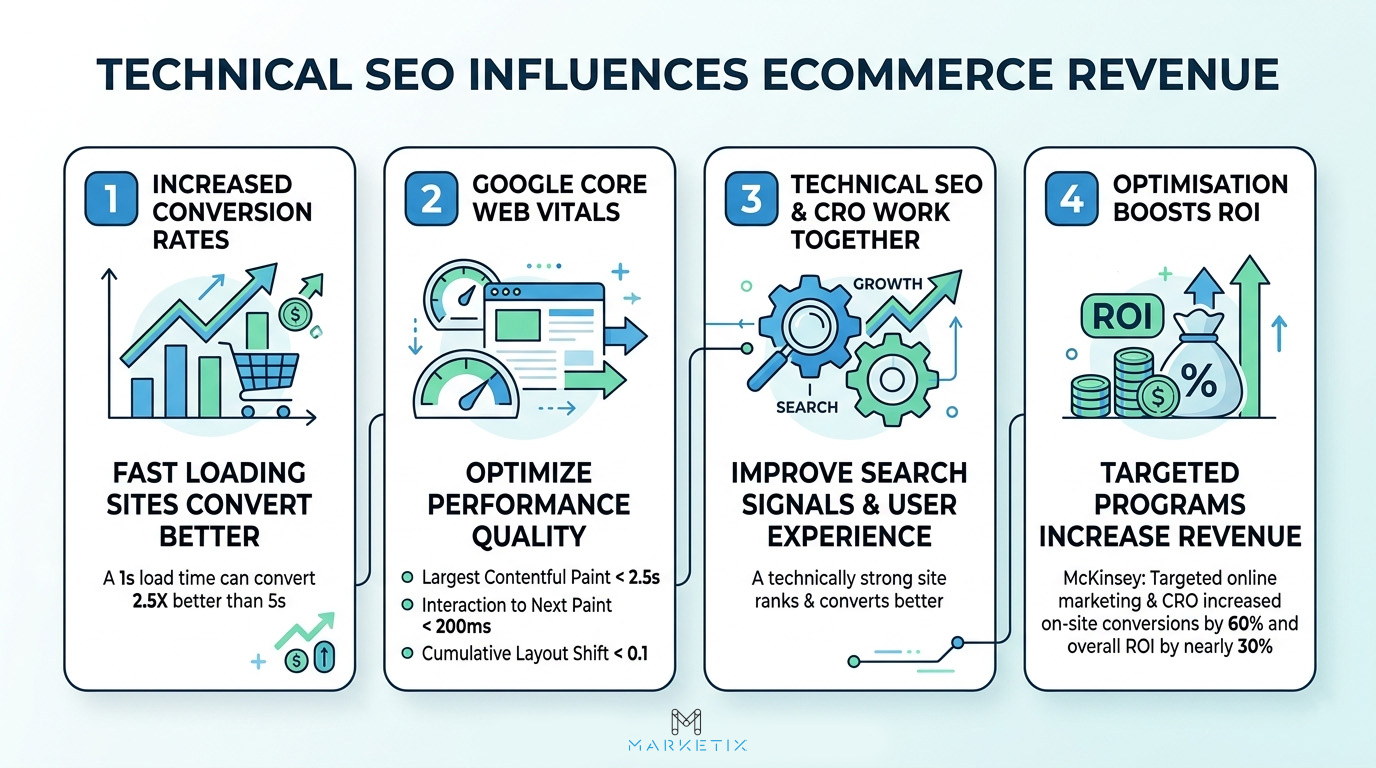
eCommerce websites loading in one second convert 2.5 times better than websites loading in five seconds.
Google’s Core Web Vitals guidance also continues reinforcing the importance of performance quality, recommending:
The important point is that technical SEO and CRO increasingly operate together.
A technically strong eCommerce website generally:
McKinsey research reinforces this overlap between optimisation and revenue growth. The company found that targeted online marketing and conversion optimisation programs increased on-site conversions by 60%, improved email conversions by 25%, and increased overall marketing ROI by nearly 30%.
The businesses performing best organically are usually improving the entire revenue system surrounding search visibility rather than treating SEO as a standalone activity.
The structure of Google search results is changing faster than most eCommerce businesses realise.
Traditional blue-link rankings still matter heavily, but AI-generated search experiences are increasingly affecting how users discover products, compare brands, and interact with search results before clicking through to websites.
Semrush’s analysis of 200,000 keywords found that AI Overviews appeared primarily for informational searches, with 80% of desktop and 76% of mobile AI Overviews targeting informational intent queries. The study also found that transactional keywords represented less than 3% of keywords triggering AI Overviews.
That number continues rising rapidly.
The commercial implication is important because AI-generated search results reduce the amount of visible organic real estate available for standard listings. Product searches that previously produced ten visible blue links may now contain:
…before traditional category pages even appear.
This is already changing click behaviour.
BrightEdge research found that AI Overview citation overlap with traditional organic rankings reached 54.5% overall, but only 22.9% within eCommerce search results.
That lower overlap in eCommerce matters.
It suggests that Google’s AI systems are pulling information from broader sources rather than simply rewarding traditional top-ranking commercial pages. Product comparisons, discussions, reviews, videos, forums, and marketplace signals increasingly influence visibility.
This creates a much broader SEO environment than many retailers are used to.
Consumer behaviour is shifting alongside Google’s AI rollout.
Deloitte research found that 40% of Australians have already used an AI agent, while 50% would trust AI systems to search, compare, and transact on their behalf.
That changes how eCommerce brands should think about discoverability.
Instead of optimising only for direct clicks from Google rankings, businesses increasingly need to optimise for:
AI systems rely heavily on confidence signals.
Brands with stronger digital authority across multiple platforms are far more likely to appear consistently inside AI-generated recommendations.
This does not mean SEO is disappearing.
It means SEO is expanding.
The businesses likely to perform strongest over the next few years will not simply focus on rankings alone. They will focus on becoming trusted, recognisable sources across the broader digital ecosystem.
Trust is becoming one of the biggest differentiators in eCommerce performance.
Consumers are now exposed to enormous amounts of product information before making decisions. Search results contain marketplaces, Reddit threads, AI summaries, influencer reviews, YouTube comparisons, and social discussions, all competing simultaneously.
That environment makes authority far more commercially valuable.
NielsenIQ found that consumers now move fluidly between search engines, social platforms, messaging apps, and stores, creating increasingly disconnected discovery journeys.
The same report noted that online shopping occasions increased 16% year over year, reinforcing the continued expansion of digital buying behaviour.
At the same time, consumers increasingly rely on AI-generated summaries during online research.
NielsenIQ reported that nearly six in ten consumers now rely on AI-generated summaries at least some of the time when searching online.
That trend further increases the importance of:
Strong SEO today increasingly overlaps with digital trust building.
This is one reason why many businesses now evaluate SEO agencies differently compared with several years ago. Rankings alone are rarely enough anymore. Businesses increasingly need partners who understand revenue attribution, technical scalability, UX, CRO, AI visibility, and broader acquisition economics together.
For businesses evaluating long-term SEO investment, understanding what separates strategic SEO from activity-based SEO becomes increasingly important, particularly as rankings, CRO, AI visibility, technical SEO, and revenue attribution become more interconnected. Businesses wanting to assess what strong commercial SEO actually looks like can explore this guide on how to choose the right eCommerce SEO agency.

Search results for commercial product terms now regularly include Amazon, Temu, Shein, eBay, Google Shopping listings, marketplace sellers, and AI-generated recommendations within the same SERP.
Large marketplaces hold major advantages through stronger authority, larger product inventories, higher crawl frequency, and extensive review ecosystems. That pressure makes category architecture, internal linking, technical SEO, product page quality, and overall shopping experience significantly more important for independent retailers.
Google increasingly rewards trusted, useful shopping experiences rather than keyword relevance alone.
One of the clearest trends across eCommerce growth is the convergence between SEO and CRO. Historically, many businesses treated them separately, where SEO focused on rankings and traffic while CRO focused on improving conversions after the click.
That separation is becoming increasingly outdated. Modern search systems heavily evaluate behavioural signals tied to usability, engagement, satisfaction, relevance, and overall page experience.
| Traditional Approach | Modern eCommerce SEO Approach |
| SEO focused mainly on rankings and traffic | SEO focuses on revenue, profitability, and customer acquisition efficiency |
| CRO focused mainly on checkout optimisation | CRO is integrated into the full organic search journey |
| Technical SEO handled separately from UX | Site speed, UX, and Core Web Vitals affect both rankings and conversions |
| Product pages targeted keywords only | Product pages are built around trust, usability, and purchasing intent |
| Category pages acted mainly as navigation | Category pages now operate as major commercial landing pages |
| Mobile optimisation treated as secondary | Mobile experience is now central to both SEO and revenue growth |
A website that ranks well but converts poorly often creates weak engagement signals over time. Meanwhile, websites with strong UX, fast loading speeds, clear navigation, high-quality product information, and low-friction checkout experiences tend to perform better both commercially and organically.
This is especially visible across category pages, collection pages, mobile product pages, faceted navigation systems, and internal search experiences. The strongest eCommerce SEO strategies increasingly operate as broader revenue optimisation systems rather than isolated ranking campaigns.
Paid acquisition costs will likely continue increasing across most digital channels.
Marketplace competition will continue to intensify.
AI search will continue reshaping SERPs.
Consumer discovery journeys will continue fragmenting across platforms.
Yet despite all of those changes, organic search still remains one of the few acquisition channels capable of compounding over time.
Strong SEO can continue generating:
…without requiring perpetual click-based spending.
That long-term compounding effect is what continues making SEO commercially attractive for Australian eCommerce businesses heading into 2026 and beyond.
The businesses likely to benefit most will usually be the ones investing early in:
The gap between strong and weak eCommerce SEO execution is likely to widen significantly over the next few years.
Australian eCommerce SEO is becoming significantly more sophisticated, and from what we are seeing across the industry, rankings alone are no longer enough to drive sustainable growth. Search visibility now overlaps with marketplaces, AI-generated discovery, technical UX, CRO, mobile performance, and broader digital trust signals.
Businesses relying purely on traditional keyword optimisation are likely to struggle as search behaviour continues evolving.
In fact, we increasingly see the strongest-performing eCommerce brands treating SEO as a long-term revenue growth system rather than simply a traffic channel. The businesses generating the best organic results are usually the ones investing in technical SEO, category architecture, conversion optimisation, authority building, and overall shopping experience together.
As paid acquisition costs continue rising and AI-driven search expands, our eCommerce SEO service focuses heavily on helping Australian eCommerce businesses improve visibility, profitability, and long-term revenue growth across both traditional search and emerging AI-driven search environments.
Recent Posts
Download our 24-page SEO book to learn:
You have successfully joined our subscriber list.
Recent Posts