Online shopping behaviour in Australia has changed significantly over the past few years.
Consumer expectations are higher. Buying journeys are longer and more fragmented. Product discovery increasingly happens across search engines, marketplaces, TikTok feeds, YouTube reviews, Reddit discussions, and AI-generated recommendations long before someone lands on a product page.
Australian eCommerce brands are now competing in a far more complex buying environment.
That shift matters because customer behaviour now directly influences:
The businesses adapting fastest are generally the ones aligning their websites, product discovery strategies, UX, and conversion flows with how consumers actually shop online today.
Australian eCommerce growth continues, reinforcing that trend.
Australia Post reported that 82% of Australian households shopped online in 2025, representing 9.8 million households across the country. Australian online shoppers also spent more than $69 billion online during 2024.
Online shopping is no longer a secondary purchasing channel. It has become standard consumer behaviour across most retail categories.
Monthly purchasing frequency reflects that shift clearly.
IAB Australia found that 83% of Australian online shoppers now shop online every month.
PayPal’s eCommerce Index reported even stronger behavioural consistency, showing that 96% of Australians shop online and 69% now shop online weekly.
That level of frequency changes how brands should think about customer acquisition.
Consumers are no longer simply making isolated online purchases. Many are now continuously browsing, comparing, researching, saving products, revisiting brands, and purchasing across multiple sessions and devices throughout the week.
The customer journey has become far less linear.
Google still plays a major role in eCommerce product discovery.
Search engines remain the most-used product discovery channel for Australian online shoppers.
That remains highly important for Australian retailers because high-intent search behaviour still often signals strong commercial intent.
Consumers actively search for:
At Marketix, we regularly see product and category pages generate stronger conversion intent when search visibility aligns closely with specific buying-stage queries rather than broad informational traffic. That becomes increasingly important as consumers spend longer researching before purchasing.
Search behaviour itself is also becoming more fragmented.
Social platforms are now heavily influencing buying intent before Google searches even occur.
IAB Australia found that social media influences 59% of Australian shoppers aged between 18 and 39.
Australia Post reported that 74% of Gen Z and Millennials browse or shop for products through social media platforms.
That behavioural shift has major implications for eCommerce SEO and content strategy.
Consumers increasingly discover products through:
The Google search often happens later in the journey rather than first.
That changes the role SEO plays within eCommerce acquisition.
Modern eCommerce SEO increasingly involves owning product comparison intent, category visibility, trust-based content, branded search visibility, and high-conversion informational searches rather than simply ranking for broad product keywords.
Brands investing in structured eCommerce SEO services are generally better positioned to capture those longer and more fragmented customer journeys.
Cost-of-living pressure continues to reshape online purchasing behaviour across Australia. IAB Australia reported that 62% of Australian shoppers switch products or brands to find cheaper alternatives, showing how price sensitivity is weakening loyalty across many retail categories.
Consumers are increasingly comparing multiple retailers before purchasing, delaying purchases until sale periods, switching brands more frequently, and using marketplaces to find lower pricing. The same IAB Australia report found that 38% of Australian shoppers actively use price-comparison websites and services before buying online.
Pricing transparency has effectively become unavoidable in eCommerce. Consumers can now compare prices, reviews, shipping speeds, return policies, and marketplace alternatives within seconds, making it harder for brands to compete purely on visibility alone.
Bazaarvoice research also found that 57% of Australian shoppers have permanently switched to store-brand products due to value considerations.
That trend places increasing pressure on independent eCommerce brands to compete through stronger positioning, better customer experience, faster delivery, clearer product education, and stronger trust signals. Price alone is often no longer enough to create long-term customer retention.
Marketplaces now sit at the centre of Australian online shopping behaviour.
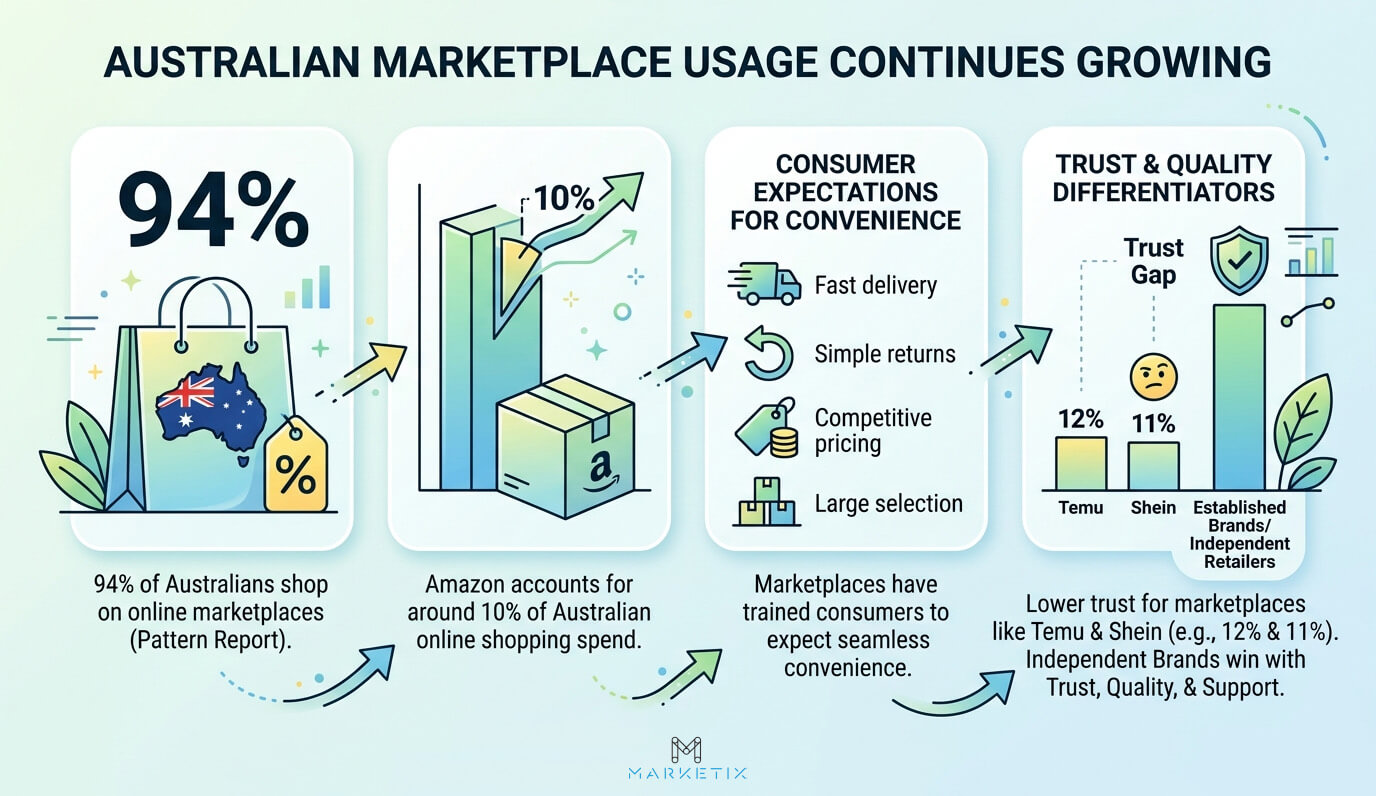
Pattern’s Marketplace Consumer Report found that 94% of Australians shop on online marketplaces.
Amazon alone now accounts for around 10% of Australian online shopping spend.
That level of marketplace penetration changes customer expectations significantly.
Consumers increasingly expect:
Marketplaces have effectively trained consumers to expect convenience at every stage of the buying journey.
At the same time, marketplace trust is becoming increasingly uneven.
Pattern’s research showed that only 12% of Australian shoppers trust Temu, while 11% trust Shein.
That gap creates opportunities for independent retailers.
Consumers may still purchase from marketplaces for pricing advantages, but trust, quality assurance, customer service, authenticity, and post-purchase support remain major differentiators for established brands.
Many consumers now behave differently depending on purchase risk.
Low-cost purchases may happen through marketplaces with lower trust levels. Higher-value purchases often involve more detailed research across branded websites, reviews, comparison content, YouTube demonstrations, and Reddit discussions before conversion occurs.
Mobile commerce continues dominating Australian eCommerce behaviour.
PayPal’s eCommerce Index found that smartphones are now the preferred shopping device for 47% of Australian online shoppers.
Mobile behaviour influences almost every part of the buying journey:
The distinction between mobile and desktop journeys also continues to blur.
Consumers frequently:
BCG highlighted that modern customer journeys are increasingly omnichannel, with many consumers researching online before purchasing either online or in-store.
That behavioural overlap means attribution is becoming harder for retailers to measure accurately.
A product discovery touchpoint on TikTok may eventually lead to:
Traditional last-click attribution models increasingly fail to reflect how consumers actually buy online.
Customer patience continues to shrink across Australian eCommerce.
Consumers increasingly expect fast-loading websites, responsive mobile experiences, simple navigation, and minimal checkout friction. Small UX issues now create measurable revenue impact, particularly on mobile devices, where hesitation and abandonment happen much faster.
Category pages now play a much larger role in helping consumers narrow purchase decisions quickly. Shoppers increasingly expect category pages to provide clear navigation, strong filtering systems, transparent pricing, review visibility, delivery messaging, and mobile-friendly browsing experiences.
| Category Page Expectation | Why It Matters |
| Filters and product sorting | Helps shoppers narrow decisions faster |
| Visible reviews and ratings | Builds confidence during browsing |
| Transparent pricing | Reduces comparison friction |
| Delivery messaging | Improves purchase clarity |
| Clear product imagery | Helps validate product quality |
| Mobile-friendly browsing | Supports faster mobile decision-making |
Product pages are also expected to remove hesitation immediately. Consumers increasingly want clear answers around shipping, returns, product dimensions, warranty details, payment options, and overall product trustworthiness before committing to purchase.
| Product Page Element | Influence on Consumer Behaviour |
| Delivery information | Reduces checkout uncertainty |
| Reviews and ratings | Builds buying confidence |
| Product dimensions and specifications | Helps validate suitability |
| Return policies | Lowers purchase hesitation |
| Warranty details | Improves trust for higher-value purchases |
| FAQs | Reduces friction during decision-making |
| Payment options | Supports conversion flexibility |
| Social proof | Reinforces legitimacy and trust |
Strong product page UX now directly affects conversion performance.
KPMG research found that 84% of Australian shoppers consider ratings and reviews important when making purchase decisions.
Trust signals increasingly influence conversion rates across both branded stores and marketplaces.
| Trust Signal | Why It Influences Purchases |
| Verified reviews | Improves credibility |
| Customer testimonials | Reinforces trust |
| User-generated content | Validates product quality |
| Secure payment icons | Reduces checkout anxiety |
| Delivery clarity | Increases purchase confidence |
| Return transparency | Reduces hesitation |
| Brand authority | Strengthens perceived reliability |
| Third-party mentions | Supports external validation |
For many eCommerce businesses, conversion rate optimisation is increasingly becoming a larger revenue lever than traffic growth alone.
Relatively small improvements in mobile usability, product page clarity, checkout simplicity, site speed, and trust positioning can materially improve profitability, particularly as customer acquisition costs continue rising across SEO, Google Ads, Meta Ads, and marketplaces.
This is where understanding margins and conversion efficiency becomes increasingly valuable for eCommerce operators using tools like the eCommerce profit margin calculator.

Checkout expectations have changed significantly over the past few years.
Consumers increasingly expect checkout experiences to feel almost invisible.
Australia Post found that free shipping remains one of the strongest conversion drivers, with 56% of Australian shoppers prioritising it during purchase decisions.
The same report found that 65% of shoppers believe friction-free returns contribute heavily to a positive shopping experience.
KPMG further reported that high shipping costs remain the single biggest obstacle to an ideal online shopping experience for 63% of shoppers.
Consumers now expect:
Any friction introduced during checkout can quickly reduce conversion rates.
BNPL growth reflects part of that behaviour shift.
PayPal reported that 37% of Australian online shoppers now use Buy Now Pay Later services.
Finder data showed that 41% of Australians used BNPL services during the previous six months as of March 2026.
Flexible payment options increasingly influence conversion behaviour, particularly for:
Digital wallet usage continues expanding alongside that trend. Apple Pay is now the most-used digital wallet in Australia.
Airwallex also reported that Australians made 520 million mobile wallet transactions worth $24.3 billion within a single month.
Fast checkout experiences increasingly affect both conversion rates and cart abandonment behaviour.
Major promotional periods now play a far larger role in Australian eCommerce revenue cycles than they did a decade ago.
Consumers increasingly delay purchases in anticipation of:
Australia Post reported that 24% more households shop during major online sale events compared with the rest of the year.
That statistic highlights how heavily promotional periods now influence buying intent.
Discount expectations are also becoming more aggressive among younger demographics.
Australia Post found that Gen Z and Millennials actively seek discounts of between 20% and 30% during major sale periods.
That behavioural pattern affects pricing strategy across the entire year.
Many consumers now:
Roy Morgan data further showed that Australians planned to spend $10.5 billion during EOFY sales in 2025 alone.
Seasonal events now shape acquisition strategy, inventory planning, paid advertising budgets, email marketing flows, and retention campaigns for many Australian eCommerce businesses.
The strongest-performing brands generally prepare for these events well before the promotional period itself begins.
That includes:
Many businesses still treat promotional events purely as short-term revenue opportunities.
The larger opportunity often comes afterwards through retention.
A customer acquired during Black Friday or EOFY can generate significantly more long-term value if the post-purchase experience, product quality, customer support, and retention systems are strong enough to encourage repeat purchasing.
Australian online shoppers increasingly expect shopping experiences to feel faster, more relevant, and easier to navigate. Consumers generally want better search functionality, clearer category sorting, relevant recommendations, simplified checkout flows, and tailored promotions rather than overly complex personalisation.
KPMG research found that 59% of shoppers value tangible loyalty rewards, while 51% prefer personalised offers and tailored promotions.
Convenience is also becoming a stronger conversion driver. Nielsen research found that 62% of consumers are willing to spend more on easier shopping experiences and more convenient product formats.
Consumers increasingly reward brands that reduce friction across navigation, checkout, delivery expectations, and product discovery. At Marketix, we regularly see relatively small UX improvements around mobile usability, product filtering, checkout simplicity, and trust positioning generate meaningful improvements in conversion performance.
Many eCommerce brands still focus heavily on traffic growth while underestimating how much revenue is lost through poor UX and conversion friction. In many cases, improving the buying experience itself can generate stronger ROI than increasing acquisition spend alone.
Online loyalty has become increasingly fragile across many Australian retail categories.
Consumers now have easier access to:
That creates more competition at every stage of the buying journey.
Many shoppers now behave opportunistically rather than loyally.
They may purchase from:
Retention, therefore, becomes critically important.
Acquiring new customers continues to become more expensive across:
That makes customer lifetime value increasingly important for long-term profitability.
Strong retention strategies now often include:
McKinsey research found that 60% of loyalty-program members changed their spending behaviour because of those programs, including purchasing more frequently or choosing premium options.
That matters because repeat customers generally:
The financial impact of retention is often underestimated.
Yotpo research highlighted that acquiring a new customer can cost 5–25 times more than retaining an existing one, while a 5% increase in retention can increase profits by 25–95%.
That changes how many eCommerce businesses should think about growth.
Retention is no longer simply an email marketing function.
It increasingly affects:
AI-driven product discovery is still early, but consumer behaviour is already beginning to shift. Australia Post reported that 32% of Australians now use AI for shopping advice.
Consumers are increasingly using tools like ChatGPT, Gemini, Perplexity, AI-powered search assistants, and marketplace recommendation engines to compare products, summarise reviews, discover alternatives, research categories, and validate purchasing decisions before buying online.
| How Consumers Are Using AI for Shopping | Consumer Behaviour Shift |
| Product comparison | Comparing products before purchase |
| Review summarisation | Condensing large volumes of reviews quickly |
| Alternative discovery | Finding cheaper or better alternatives |
| Category research | Understanding products before purchasing |
| Recommendation validation | Checking what products others recommend |
That behaviour has major implications for eCommerce visibility. Traditional SEO remains highly important, but product discovery is increasingly extending into AI-generated environments where recommendations are influenced by brand authority, reviews, mentions, structured content, product data, reputation, user-generated content, and external references.
| What Influences AI Product Recommendations | Why It Matters |
| Brand authority | Strong brands are more likely to surface |
| Reviews and mentions | Reinforces trust and credibility |
| Structured content | Helps AI systems interpret information |
| Product data | Improves recommendation accuracy |
| User-generated content | Supports product validation |
| External references | Strengthens authority signals |
The search journey itself is also becoming more conversational. Consumers increasingly search using prompts like “What’s the best…”, “Which product should I buy for…”, “Compare these products…”, and “What do people recommend…” rather than relying purely on short keywords.
That shift increases the importance of comparison-focused content, detailed product pages, strong review profiles, multi-platform visibility, and overall brand trust signals.
| Growing Importance of eCommerce Brands | Why It Matters |
| Product comparison content | Aligns with conversational search behaviour |
| Detailed product pages | Improves AI understanding and recommendations |
| Strong review profiles | Builds recommendation trust |
| Multi-platform visibility | Expands product discovery opportunities |
| Helpful UX | Supports stronger engagement signals |
| Clear category structures | Improves discoverability |
AI-assisted discovery will likely become increasingly important throughout 2026 and beyond. The brands most visible inside those environments will generally be the ones already building strong topical authority, trusted brand positioning, structured product content, helpful UX, clear category structures, and consistent customer experience.
Sustainability continues influencing purchasing behaviour across Australian retail categories, although cost sensitivity still affects how much consumers are willing to pay.
Monash University research found that 46% of Australian shoppers say sustainability matters when making retail purchases.
Consumers increasingly consider packaging waste, product durability, ethical sourcing, recycling, carbon impact, and product lifespan during purchase decisions.
Nielsen research found that 71% of consumers are willing to pay more for products that last longer before needing replacement.
That insight aligns closely with broader value-driven shopping behaviour.
Consumers increasingly want purchases to feel:
That affects how products should be positioned online.
For many brands, stronger product education and clearer value communication increasingly matter more than aggressive promotional messaging alone.
Australian eCommerce customer behaviour is becoming more fragmented, more research-driven, and far more experience-focused. Consumers now move between Google, marketplaces, social platforms, reviews, AI tools, and mobile devices before making a purchase decision.
In fact, we increasingly see that traffic acquisition alone is no longer enough. Brands that perform best are usually the ones investing in stronger SEO visibility, faster websites, better mobile UX, clearer product pages, stronger trust signals, and frictionless checkout experiences.
The gap between good and poor customer experience is becoming far more visible in revenue performance. Small improvements in conversion rate optimisation, UX, retention, and buying confidence can often produce stronger long-term profitability than simply increasing traffic alone.
As Australian eCommerce continues growing throughout 2026 and beyond, businesses that better understand evolving customer behaviour alongside broader Australian eCommerce market trends will generally be in a far stronger position to grow market share and long-term revenue.
Recent Posts
Download our 24-page SEO book to learn:
You have successfully joined our subscriber list.
Recent Posts