Conversion Rate Optimisation (CRO) Statistics 2026: Benchmarks, Trends, and ROI Insights


Conversion is where growth actually happens, and modern conversion rate optimisation statistics continue to show that even small improvements in user experience and funnel performance can produce substantial revenue growth.


Traffic is easy to talk about. Rankings, impressions, clicks, all visible, all measurable.


Conversion is different. It is where revenue is made or lost.


Conversion Rate Optimisation (CRO) Statistics


Across most industries, the gap between average and high-performing websites is not marginal. It is structural. Data shows that average eCommerce conversion rates sit around 2–3%, while top-performing websites reach 5–11% or higher. That gap is not explained by traffic quality alone. It is driven by experience, clarity, trust, and execution.


In practical terms, two businesses can generate the same traffic and see completely different outcomes. One converts at 2%, the other at 6%. The second business does not need more traffic. It is already extracting more value from what it has.


That is the role of CRO.


Conversion benchmarks: what performance actually looks like


Key Conversion Benchmarks


To understand optimisation, you need a clear baseline. Without it, improvements are difficult to quantify. Strong CRO benchmarks help businesses compare performance against industry averages and identify where the largest conversion gaps exist.


Across Australia, websites convert at roughly 1.78%, slightly below global averages but expected to move closer to 2–4% as conversion rate optimisation Australia maturity improves across businesses investing more heavily in UX, CRO testing, and funnel optimisation. That gap reflects a broader trend; many businesses still underinvest in conversion compared to acquisition.


Industry context matters as well.


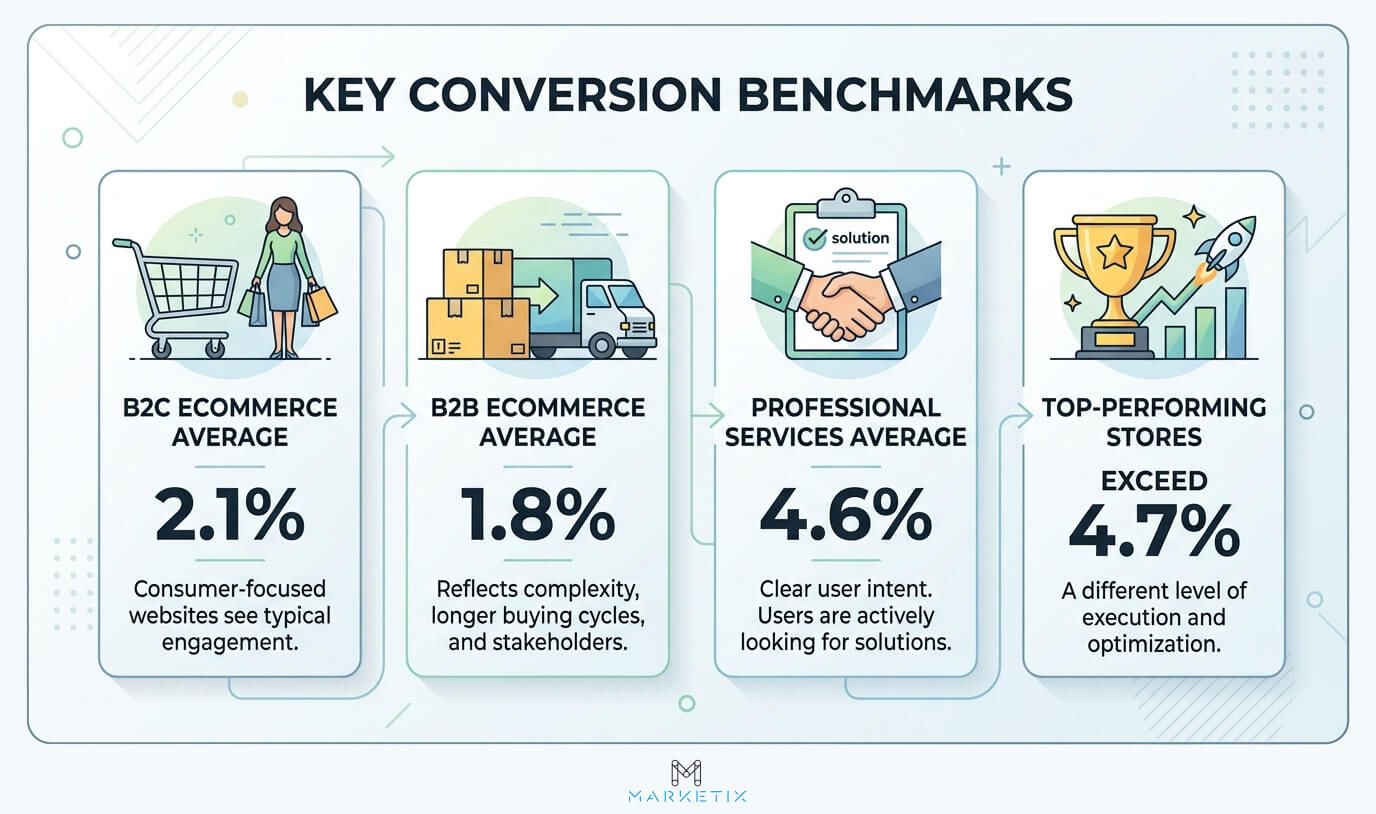
  • B2C websites convert at around 2.1% on average
  • B2B eCommerce sits closer to 1.8%


These figures reflect intent and complexity. B2B buyers take longer, require more information, and often involve multiple stakeholders. Conversion rates are lower, but deal value is higher.


Contrast that with service-based websites. Professional services convert at approximately 4.6%. The reason is simple: intent is clearer. Users are not browsing. They are looking for a solution.


From a broader perspective, Boston Consulting Group confirms that most industries operate within a 1–4% conversion range. That narrow band is where most businesses compete.


The difference is not where you sit in the range. It is how far you push beyond it.


Top-performing stores exceed 4.7% conversion rates. That is not incremental improvement. It is a different level of execution.


From a Marketix perspective, this is where most growth opportunities sit. Businesses often focus on scaling traffic through SEO or paid media, without understanding their organic conversion rate or fixing the conversion bottlenecks underneath. A stronger approach is to treat traffic and conversion as one system, the same thinking applied in high-performance SEO campaigns such as those delivered through a structured SEO agency Sydney strategy.


User behaviour: why visitors convert or drop off


Conversion does not fail randomly. It fails at predictable points.


The first is trust.


Around 95% of users read reviews before making a purchase. This is not a minor influence. It is a core decision driver. Without visible proof, testimonials, ratings, or case studies, hesitation increases immediately.


The second is friction.


Almost half of users abandon the process if checkout takes longer than 90 seconds. That is a direct reflection of modern expectations. Users expect speed, clarity, and minimal effort.


Then there is abandonment at scale.


The average cart abandonment rate sits at approximately 70.22% globally, one of the most widely referenced CRO statistics when analysing checkout friction and lost revenue opportunities. That means most users who show purchase intent never complete it.


The reasons are consistent:


Unexpected costs (48–55% of cases)
Forced account creation
Complicated checkout flows


These are not design issues. They are decision barriers.


There is also a broader behavioural layer that often gets overlooked, the relationship between brand and conversion.


Nielsen data shows that brands lose around 2% of future revenue for every quarter they stop advertising. That loss is not immediate. It compounds over time.


At the same time, a one-point increase in brand awareness or consideration drives a 1% increase in sales.


The implication is clear: conversion is not only influenced by the page the user lands on. It is shaped by everything that happens before that moment.


Device and channel performance: where conversions actually happen


Device and channel performance


The modern conversion landscape is fragmented across devices and channels. Performance varies significantly depending on where users come from and how they interact.


Start with device behaviour.


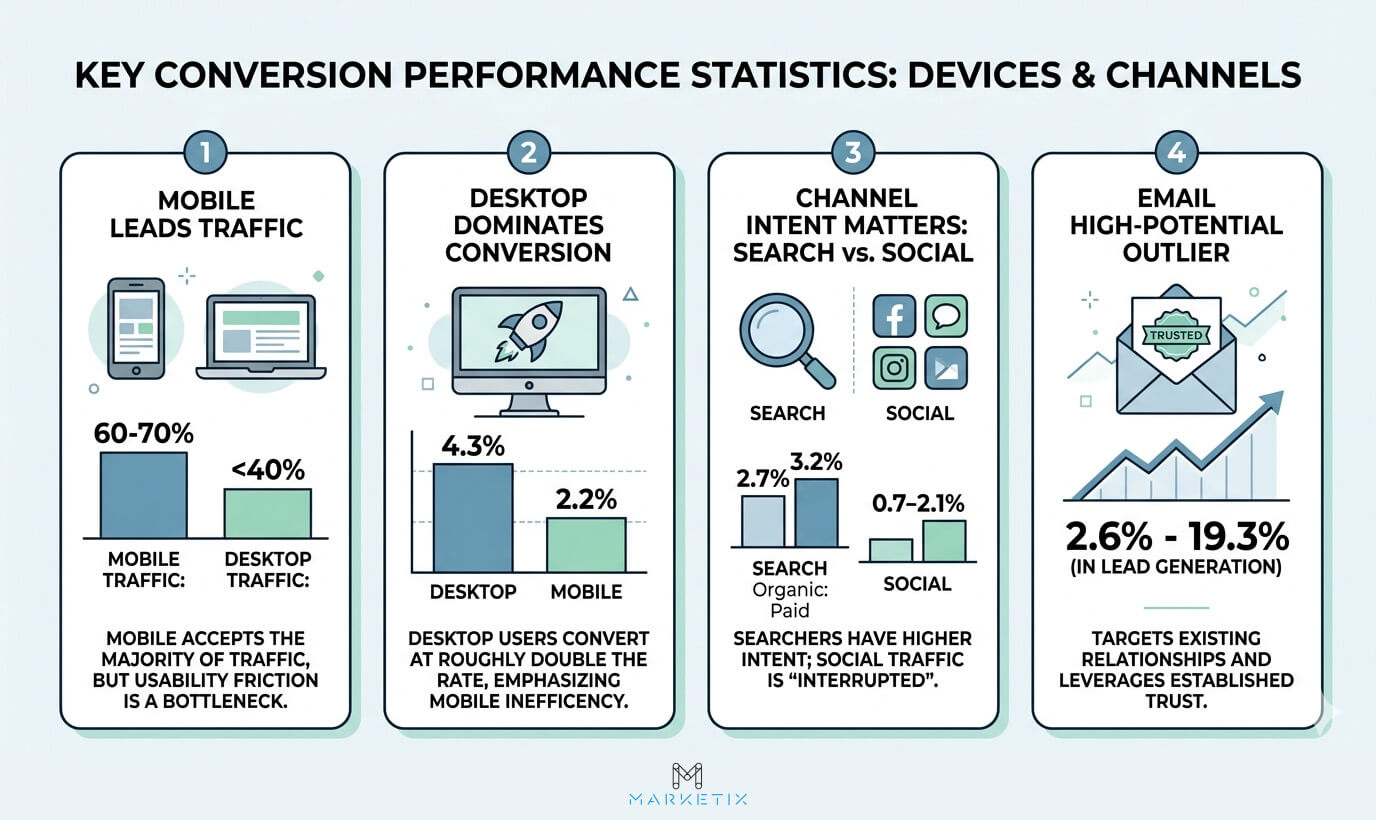
Mobile now accounts for around 60–70% of total traffic. In some cases, it exceeds that.


Yet mobile consistently underperforms in conversion.


Desktop users convert at roughly double the rate, for example, around 4.3% compared to 2.2% on mobile. This gap is not small. It represents a major inefficiency.


Even when mobile drives 73% of traffic, desktop still produces a disproportionately higher share of conversions.


The reason is usability. Smaller screens, slower load times, and more complex navigation all introduce friction. Most websites are still not truly optimised for mobile conversion.


Channel performance tells a similar story.


Organic search converts at around 2.7%, while paid search sits slightly higher at 3.2%. These users arrive with intent. They are actively looking for a solution.


Social traffic behaves differently.


Conversion rates for social typically sit between 0.7% and 2.1%, making it the lowest-performing channel. These users are not searching. They are interrupted.


Email remains the outlier.


In lead generation funnels, email converts at around 2.6–3.0%, but in some datasets reaches as high as 19.3%. This is because email targets existing relationships. Trust is already established.
In B2B environments, the pattern continues.


SEO traffic converts at approximately 2.6%, outperforming PPC at around 1.5%. This reinforces the long-term value of organic acquisition.


For businesses investing in sustainable growth, this is where SEO and CRO intersect. It is not just about rankings. It is about converting the traffic those rankings generate, a core focus in eCommerce-focused strategies such as eCommerce SEO.

 

Funnel performance: where conversions are won or lost


Conversion is not a single event. It is a sequence of steps, each with its own drop-off point.


At the top of the funnel, visitor-to-lead conversion rates typically sit between 1–3%. This is where attention turns into interest.


From there, the funnel tightens.


  • Lead to MQL: ~31%
  • SQL to close: 15–40%


Each stage introduces qualification, filtering out users who are not ready or not aligned.


At the transactional level, behaviour becomes more predictable.


Larger baskets increase commitment. Carts with 5–10+ items can increase conversion rates by up to 63%. More items often signal higher intent and stronger purchase motivation.


Payment flexibility also plays a critical role.


Accelerated checkout options such as Apple Pay or PayPal can increase conversion rates by over 50%. These methods reduce friction at the final step.


Even small changes make a measurable difference. Adding an additional payment method can increase conversion rates by 7.4% and revenue by 12%.


These are not design tweaks. They are structural improvements to how users make decisions.


Experimentation and CRO execution: what actually drives improvement


Most businesses agree that conversion matters. Far fewer execute on it properly.


The gap is not knowledge. It is a process.


Less than 0.2% of websites actively run A/B tests. That figure alone explains why performance gaps persist. The majority of sites are not testing. They are guessing.


Even among businesses that do test, results are not guaranteed.


A/B testing win rates typically sit between 25–36%, depending on the maturity of the programme and the quality of hypotheses. That means most experiments do not produce a clear uplift.


Break that down further:


  • ~36% of tests generate statistically significant wins
  • ~41% are inconclusive
  • The remainder results in losses


This is where many businesses misinterpret CRO. They expect consistent wins. In reality, optimisation is iterative. Progress comes from volume, not isolated tests.


When tests do succeed, the impact compounds.


Winning experiments deliver a median uplift of +1.88% in conversion rate and +2.77% in revenue per visitor. These are not dramatic changes on their own. Over time, they become significant.


At scale, most results are modest.


Around 60% of A/B tests deliver less than 20% uplift, while only 7–8% produce gains above 100%. Large wins exist, but they are rare.


The implication is straightforward: CRO is not about finding a single breakthrough. It is about building a system that produces consistent incremental gains.


From a Marketix perspective, this is where most businesses fall short. They run isolated tests without a structured roadmap. A stronger approach is to align CRO with broader growth channels such as SEO, ensuring that improvements are applied to high-intent traffic sources rather than low-quality volume.


UX, speed, and behavioural impact: where most gains are hidden


Many conversion issues are not strategic. They are operational.


Page speed is one of the clearest examples.


Each additional second of load time reduces conversions by approximately 7%. That loss is immediate and measurable.


Even small delays matter. A two-second slowdown can reduce revenue per visitor by around 4.3%.


This is not theoretical. It is happening on most websites without being tracked properly.


Deloitte’s research reinforces the point. Improving mobile site speed by just 0.1 seconds can increase retail conversion rates by 8.4% and travel conversions by 10.1%.


Speed is not a technical detail. It is a revenue lever.


Engagement metrics tell a similar story.


eCommerce bounce rates average around 45.7%, meaning nearly half of users leave without interacting. This is not always a traffic issue. It is often a mismatch between expectation and experience.


Users arrive with intent. If the page does not match that intent quickly, they leave.


Improving conversion in these cases is not about adding more content. It is about clarity:


  • Clear value proposition above the fold
  • Fast load times across devices
  • Minimal friction in navigation and checkout


These changes are rarely complex. They are often overlooked.


CRO ROI and business impact: why optimisation compounds growth


CRO is often treated as a supporting function. In reality, it is one of the highest-return activities in digital marketing.


High-performing CRO programmes generate an average ROI of approximately 223%. Few other channels consistently deliver that level of return.


The reason is simple. CRO improves the efficiency of everything else.


Every gain in conversion rate increases the value of:


  • SEO traffic
  • Paid campaigns
  • Email marketing
  • Referral channels


Instead of acquiring more traffic, the business extracts more revenue from existing traffic.


There is still a measurement gap.


While 84% of marketers report confidence in measuring ROI, only 38% measure performance across the full funnel. That disconnect leads to poor decision-making.


Short-term metrics dominate. Long-term impact is underweighted.


Nielsen data shows that long-term marketing efforts contribute between 10–35% of overall brand equity, and their impact can double the effectiveness of media spend over time.


This matters because conversion is not only about immediate actions. It is influenced by brand perception, familiarity, and trust.


New technologies are pushing this further.


AI-driven segmentation can increase conversion rates by up to 50% by delivering more relevant experiences to users.


At the campaign level, incentives still play a role.


Discount-led campaigns can drive conversion rates as high as 10%, compared to a 2% industry average. These tactics work, but they are short-term. They do not replace structural optimisation.


Connecting conversion to revenue


Understanding conversion improvements is one thing. Quantifying their impact is another.


A small increase in conversion rate often produces a disproportionate increase in revenue. For example:


  • Increasing conversion from 2% to 3% = 50% more customers
  • Increasing from 3% to 4% = 33% more customers


No additional traffic required.


This is where modelling becomes useful.


Tools such as the SEO ROI Calculator help translate conversion improvements into actual revenue projections. Instead of viewing CRO as a UX improvement, it becomes a financial decision.


From a strategic perspective, this changes how growth is approached.


Rather than asking, “How do we get more traffic?”, the better question becomes:
“How much more value can we extract from the traffic we already have?”


CRO is a system, not a tactic


The data across benchmarks, behaviour, channels, and experimentation points to a consistent pattern.


Conversion improvement does not come from a single change.


It comes from:


  • Removing friction at key decision points
  • Aligning messaging with user intent
  • Testing continuously and systematically
  • Improving performance across devices
  • Supporting conversion with brand and trust


Businesses that treat CRO as a structured system consistently outperform those that treat it as a one-off project.


In practical terms, growth is no longer just about acquisition. It is about efficiency.


Traffic gets you visibility. Conversion turns that visibility into revenue.