Mobile commerce is no longer a secondary sales channel for Australian retailers.
Smartphones now influence almost every stage of the online shopping journey, from product discovery and price comparison through to checkout completion, payment behaviour, retention, and repeat purchasing.
The shift has been gradual for years, but recent growth in digital wallets, social commerce, mobile-first marketplaces, and AI-driven shopping behaviour has accelerated the transition significantly.
Australian retailers are now operating in a market where mobile traffic dominates many industries, yet mobile conversion efficiency still lags behind desktop in most sectors. That gap creates both a problem and an opportunity.
Businesses improving mobile UX, checkout simplicity, site speed, and smartphone-focused SEO visibility are increasingly positioned to capture disproportionate revenue growth as consumer behaviour becomes more mobile-first.
Australia’s eCommerce market reached approximately AU$69 billion in 2024, supported by around 18 million online shoppers. Smartphones now account for 47% of online shopping activity across the country, overtaking desktop devices as the primary shopping channel.
That shift matters because device behaviour directly impacts:
Retailers can no longer treat mobile as a simplified version of desktop eCommerce. For many businesses, mobile is now the primary storefront.
Australian online retail spending also continues to climb. NAB reported Australians spent approximately AU$66.2 billion online in the 12 months leading to September 2025, with online retail now representing around 14.9% of total retail trade.
Mobile commerce revenue itself is projected to exceed AU$35 billion by 2026, representing close to half of total eCommerce revenue in Australia.
That figure is particularly important because mobile revenue growth is increasingly outpacing broader eCommerce growth. Consumer shopping behaviour is becoming structurally smartphone-driven rather than temporarily mobile-assisted.
Global data reinforces the same pattern.
The implication for Australian businesses is straightforward: mobile optimisation is no longer a UX improvement project. It directly affects revenue scalability.
At Marketix, this is increasingly visible across eCommerce SEO campaigns. Businesses growing mobile organic visibility often see stronger long-term revenue stability because smartphone discovery behaviour now influences such a large share of product research and purchase activity. Many retailers underestimate how much revenue leakage happens when mobile category pages, product pages, and collection structures are not properly optimised for mobile search intent.
Businesses forecasting future organic revenue growth are also increasingly using tools like an eCommerce SEO ROI Calculator to model how improvements in mobile rankings and conversion performance can affect long-term profitability.

Australia now has 34.1 million mobile connections, equivalent to 126% of the population.
Smartphone penetration itself is projected to exceed 90% by 2026, with Australian smartphone users expected to reach 23.6 million.
That level of saturation fundamentally changes online retail behaviour.
Consumers are no longer switching to a desktop for convenience. In many cases, smartphones are now the preferred research and purchasing device throughout the entire shopping journey.
Deloitte reported that 95% of adults now own a smartphone, while 47% regularly use smartphones or smartwatches for in-person payments using digital wallets and contactless technology.
The behavioural shift is especially visible across:
Australia Post category-level data already shows that mobile traffic dominates many retail sectors. Department stores, beauty, food, homewares, and recreational goods categories regularly receive over 60% of their traffic from smartphones.
That trend aligns heavily with mobile-first browsing behaviour because apparel purchasing increasingly overlaps with:
The broader pattern is clear.
Higher-frequency purchase categories increasingly skew toward mobile because consumers want faster purchasing journeys, easier reordering, digital wallet convenience, and lower browsing friction.
One of the biggest misconceptions in eCommerce is assuming mobile traffic growth automatically leads to proportional revenue growth.
That is rarely the case.
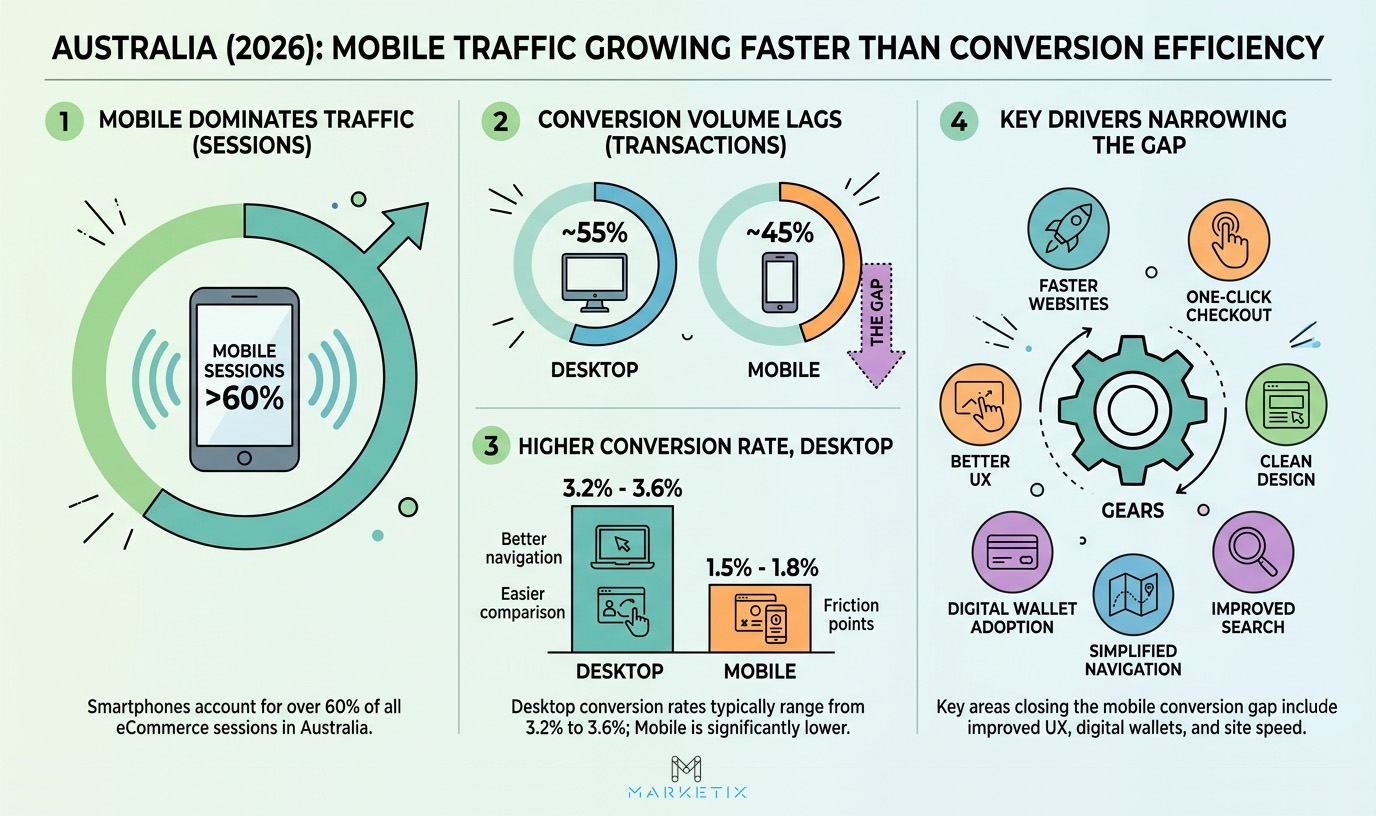
Mobile devices now account for more than 60% of eCommerce sessions in Australia.
However, mobile devices account for only around 45% of Australian eCommerce transaction volume, while desktops still contribute roughly 55%.
The gap between traffic share and revenue share highlights a major commercial issue: mobile conversion inefficiency.
Australian mobile conversion rates typically range between 1.5% and 1.8%, compared with 3.2% to 3.6% on desktop devices.
Desktop still converts materially better in most industries because desktop experiences often provide:
That said, the mobile conversion gap is beginning to narrow.
Shopify reported that global mobile conversion rates reached 2.41% in 2026, slightly surpassing desktop benchmarks.
Dynamic Yield benchmark data also shows mobile conversion rates globally averaging around 2.75%, compared with approximately 2.55% on desktop.
The difference is largely being driven by:
The retailers closing the mobile conversion gap are usually the businesses investing heavily in mobile-first CRO rather than simply increasing traffic acquisition.
This is where many businesses start reassessing their broader acquisition strategy and evaluating whether their current SEO structure, UX approach, and mobile performance align with long-term growth objectives. In practice, that often leads businesses to review resources like how to choose the right eCommerce SEO agency when comparing agencies capable of handling technical SEO, mobile UX alignment, and conversion-focused growth strategies together.
Mobile traffic may dominate online retail, but mobile checkout friction still creates enormous revenue leakage.
Dynamic Yield benchmark data shows mobile cart abandonment rates average above 80%, substantially higher than desktop abandonment rates.
PayPal research also found that 78% of Australians have abandoned an online shopping cart at some point during checkout.
The reasons are usually predictable:
Page speed alone has an enormous commercial impact.
Google research shows 53% of mobile users abandon websites that take longer than three seconds to load.
Additional benchmarking shows that pages loading in under two seconds can convert at up to double the rate of slower mobile experiences.
Baymard Institute research found mobile traffic often represents over 50% of eCommerce traffic, yet many mobile experiences still convert significantly worse than desktop because of usability issues and checkout friction.
Baymard also identified more than 3,600 mobile usability issues across major eCommerce websites during testing.
That volume of usability issues explains why so many retailers continue struggling with mobile profitability despite growing traffic numbers.
At Marketix, one recurring issue across eCommerce SEO audits is businesses focusing heavily on rankings while underestimating the commercial impact of mobile UX and checkout efficiency. Traffic growth alone rarely fixes profitability problems if mobile conversion leakage remains unresolved.
This becomes particularly important when rising acquisition costs are combined with lower mobile average order values and higher abandonment rates. Businesses increasingly need to evaluate not just traffic growth, but how efficiently smartphone traffic converts into profitable revenue. Tools like the eCommerce Profit Margin Calculator are increasingly useful for understanding how mobile conversion improvements affect actual profitability rather than simply top-line revenue.
Revenue distribution across mobile and desktop devices still varies significantly.
Australian mobile average order values currently sit around AU$128 compared with approximately AU$168 on desktop devices.
Adobe Analytics also found that mobile basket sizes remain roughly 32% smaller than desktop baskets.
Part of that difference comes down to shopping behaviour itself.
Desktop users often:
Mobile purchasing behaviour is usually faster, more reactive, and more convenience-driven.
That does not necessarily make mobile traffic less valuable.
In many industries, smartphones increasingly influence:
The eventual conversion may happen on a desktop, through an app, or through another channel entirely.
This is one reason cross-device attribution continues to become more important for Australian eCommerce businesses. Mobile often initiates the customer journey even when another device closes the sale.
Mobile payment behaviour has evolved rapidly over the past several years.
What was previously viewed as optional convenience technology has now become a mainstream consumer expectation.
More than one-third of Australians used a mobile device for contactless payments in 2022, with usage reaching almost two-thirds among consumers aged 18–29.
Mobile wallet transaction growth has been enormous.
Australia’s mobile wallet transactions increased from approximately 29.2 million in 2018 to 2.4 billion in 2022, while transaction value surged from AU$746 million to AU$93 billion.
Australians also made 520 million mobile wallet transactions in February 2025 alone, totalling AU$24.3 billion.
Apple Pay has emerged as one of the dominant mobile payment platforms in Australia.
Roy Morgan reported Apple Pay was used by nearly 4 million Australians in 2023, overtaking Afterpay as the country’s most widely used digital payment service.
Digital payment behaviour is also becoming increasingly fragmented.
Australian consumers now regularly use:
Accenture found that more than half of consumers have adopted digital payment methods such as digital wallets, while 56% now use digital wallets at least five times per month.
The commercial implication is significant.
Every additional step added to mobile checkout increases friction. Digital wallets reduce typing, shorten checkout completion time, and lower abandonment rates, particularly on smartphones.
Businesses still relying on outdated mobile checkout experiences are increasingly competing at a structural disadvantage.
Trust signals matter more on mobile than many retailers realise.
Smaller screen sizes naturally compress information. Consumers make faster decisions, scan less content, and often have lower patience thresholds during mobile purchasing journeys.
That environment increases the importance of:
PayPal research found that 78% of Australians have abandoned online shopping carts at some point during checkout.
The same report also found 84% of Australians feel uneasy if PayPal is unavailable during checkout.
That statistic highlights how payment trust directly affects mobile conversion behaviour.
Consumers increasingly associate recognised payment providers with:
This becomes especially important for:
Seasonal retail events increasingly skew toward mobile purchasing behaviour.
Black Friday, Cyber Monday, EOFY, and Christmas shopping periods now generate enormous spikes in smartphone traffic, particularly across fashion, electronics, beauty, and gifting categories.
Adobe Analytics data shows groceries, apparel, and personal care already generate extremely high mobile shopping shares globally.
That pattern intensifies during major promotional periods because consumers increasingly:
Retailers heavily reliant on seasonal revenue are increasingly prioritising:
Many businesses now see Black Friday mobile performance as a direct indicator of overall eCommerce maturity.
Marketplace behaviour continues to influence consumer expectations around mobile shopping.
Australian consumers increasingly browse and purchase through:
Amazon
Temu
eBay
Shein
TikTok Shop
Instagram Shopping
Marketplace ecosystems integrated into social platforms
The reason is largely behavioural convenience.
Marketplace apps typically provide:
That creates growing pressure for direct-to-consumer brands competing outside marketplace ecosystems.
Consumers now expect:
At Marketix, this increasingly affects how eCommerce SEO campaigns are structured. Mobile-first optimisation is no longer just about ranking collection pages. Businesses now need to compete against marketplace UX expectations while still building their own owned acquisition channels.
This is one reason many Australian brands continue investing heavily in eCommerce SEO services rather than relying purely on marketplaces and paid acquisition platforms, where margins become increasingly compressed over time.
Social commerce growth is accelerating rapidly.
PayPal reported that 30% of Australians now shop through social channels.
Platforms such as TikTok, Instagram, YouTube, and creator-led commerce ecosystems increasingly influence:
TikTok Shop transaction volume increased by nearly 80% year-on-year globally heading into 2026.
McKinsey also found live-stream shopping can generate conversion rates approaching 30%, up to ten times higher than traditional eCommerce experiences.
That conversion uplift demonstrates how strongly mobile purchasing behaviour now overlaps with:
The distinction between content consumption and shopping continues shrinking.
Consumers increasingly move directly from:
…into mobile checkout flows within seconds.
Mobile shopping journeys are also becoming increasingly AI-assisted.
Shopify reported AI-driven traffic to Shopify stores increased sevenfold between January and November 2025.
The same report found 33% of shoppers now use AI chatbots during the shopping journey.
Consumers increasingly use AI tools to:
This creates major implications for:
Mobile discovery behaviour itself is also becoming increasingly fragmented.
Consumers no longer rely solely on Google.
Discovery now happens across:
That fragmentation is changing acquisition strategy across Australian eCommerce.
Businesses increasingly need stronger omnichannel visibility rather than relying heavily on a single acquisition source.
Mobile commerce is now driving a massive share of online retail growth in Australia.
Smartphones influence how consumers discover products, compare prices, browse marketplaces, engage with creators, complete purchases, and interact with brands after checkout.
The businesses growing fastest are usually the ones improving mobile UX, speeding up checkout flows, integrating digital wallets properly, and building stronger mobile-first acquisition channels through SEO, retention, and owned audiences.
We increasingly see the same pattern across eCommerce brands. Businesses focusing only on traffic growth often struggle with profitability because mobile conversion leakage, poor UX, and weak retention systems continue hurting revenue performance.
The retailers winning long-term are the ones treating mobile commerce as a complete revenue system, not just a device category. That means improving mobile SEO visibility, conversion rates, checkout efficiency, and customer lifetime value together rather than treating them as separate strategies.
Recent Posts
Download our 24-page SEO book to learn:
You have successfully joined our subscriber list.
Recent Posts