WooCommerce Statistics Australia 2026: Market Share, Usage & Industry Trends


Australia's eCommerce Market Continues to Expand


WooCommerce's growth in Australia cannot be viewed in isolation. Its adoption is closely tied to the broader expansion of online retail, digital payments, mobile commerce, and small business digital transformation.


Australia's eCommerce sector continues to grow at a healthy pace. According to Australia Post, Australians spent $82.6 billion online during 2025, representing 24% of total retail spending across the country. Nearly 9.8 million Australian households made online purchases during the year.


These figures matter because they show that online shopping is no longer a niche behaviour. For many Australian consumers, digital purchasing has become a routine part of everyday life.


The frequency of online shopping reinforces this trend.


PayPal's 2025 eCommerce Index found that 96% of Australians shop online, while 69% purchase online at least once per week.


At a global level, the shift remains substantial. McKinsey estimates that approximately 20% of all retail sales worldwide now occur online.


For platforms such as WooCommerce, this creates a growing addressable market. More businesses are selling online, more consumers are buying online, and competition for digital market share continues to intensify.


Australia also benefits from its position within the world's largest eCommerce region.


According to NielsenIQ, Asia-Pacific accounts for 62.6% of global eCommerce sales.


The result is an increasingly digital retail environment where businesses need flexible eCommerce infrastructure capable of supporting growth, customer acquisition, retention, and long-term scalability.


Small Business Digital Adoption Is Supporting WooCommerce Growth


Australia's business landscape is dominated by small and medium-sized enterprises.


According to COSBOA, Australia has approximately 2.59 million small businesses, representing 97% of all businesses nationwide.


This is particularly relevant when evaluating WooCommerce adoption because the platform has traditionally been strongest among SMEs, independent retailers, wholesalers, service providers, and owner-operated businesses.


Digital adoption across this segment continues to accelerate.


COSBOA reports that 85% of Australian small businesses now utilise at least one digital tool within their operations, while 39% are already using AI technologies.


Businesses are increasingly investing in:


  • Online stores
  • Marketing automation
  • Customer relationship management systems
  • Analytics platforms
  • AI-powered business tools
  • Digital payment solutions


This trend aligns closely with WooCommerce's value proposition. Unlike many SaaS platforms, WooCommerce allows businesses to retain ownership of their website, customer data, content, and technology stack while remaining relatively affordable to implement.


For growing Australian businesses, that balance between flexibility and cost remains a major attraction.


WooCommerce Remains One of the World's Largest eCommerce Platforms


WooCommerce continues to hold a leading position within the global eCommerce platform market.


According to W3Techs, WooCommerce powers 48.6% of websites using a known eCommerce technology. Across the entire web, WooCommerce is used by approximately 8.2% of all websites.


Few eCommerce platforms operate at this scale.


Store Leads estimates there are more than 4.2 million live WooCommerce stores globally.


TechnologyChecker reports approximately 946,000 active domains currently running WooCommerce.


Different datasets use different methodologies, which explains the variation between figures. However, both datasets demonstrate the same underlying trend: WooCommerce remains one of the largest eCommerce ecosystems in the world.


WooCommerce at a Glance


Metric

Latest Data

WooCommerce share of websites using a known eCommerce platform

48.6%

Share of all websites globally

8.2%

Live WooCommerce stores

4.2+ million

Active WooCommerce domains

946,000+

Active WooCommerce plugin installations

7+ million

Sources: W3Techs, Store Leads, TechnologyChecker, WordPress.org


The scale of adoption matters because larger ecosystems typically create stronger plugin marketplaces, larger developer communities, broader agency support, and faster platform innovation.
 

WordPress Continues to Power WooCommerce's Growth


One of WooCommerce's greatest advantages is that it sits on top of WordPress.


WordPress remains the dominant content management system globally.


According to W3Techs, WordPress powers 41.5% of all websites and holds 59.3% of the CMS market.


TechnologyChecker estimates WordPress operates across more than six million active domains worldwide and controls approximately 63% of the CMS market.


No competing CMS comes close.


Because WooCommerce is built directly into WordPress, it benefits from the platform's enormous user base.


TechnologyChecker reports that approximately 22.45% of WordPress websites utilise WooCommerce.


That means almost one in four WordPress websites has adopted WooCommerce for eCommerce functionality.


This relationship creates a powerful growth cycle.


As WordPress adoption increases, WooCommerce gains access to a larger audience of businesses looking to add online selling capabilities. As WooCommerce grows, it further strengthens the WordPress ecosystem through plugins, themes, agencies, developers, and service providers.


Why Australian Businesses Continue Choosing WooCommerce


Market share alone does not explain WooCommerce's popularity.


The platform addresses several challenges faced by Australian businesses.


Ownership


Businesses fully own their website, customer data, content, products, and infrastructure.


Unlike closed SaaS platforms, businesses are not locked into proprietary systems.


Flexibility


WooCommerce supports:


  • Retail stores
  • Wholesale stores
  • B2B commerce
  • Subscription businesses
  • Membership websites
  • Multi-location retailers
  • Service businesses
  • Custom eCommerce solutions


This flexibility allows businesses to build highly customised online experiences without changing platforms as they grow.


SEO Capability


WooCommerce remains particularly attractive for businesses investing in organic search.


Because it runs on WordPress, businesses have extensive control over:


  • URL structures
  • Internal linking
  • Content architecture
  • Category structures
  • Technical SEO
  • Schema markup
  • Indexation management


This level of flexibility is one reason many businesses work with specialised providers such as a dedicated WooCommerce SEO agency when pursuing long-term organic growth strategies.


Cost Efficiency


Many Australian businesses view WooCommerce as a lower total-cost alternative to proprietary platforms, particularly when managing larger product catalogues or requiring advanced functionality.


While development costs can vary significantly, businesses should also understand the ongoing investment required for SEO. Our guide to WooCommerce SEO costs in Australia breaks down typical pricing models, monthly budgets, and the factors that influence SEO investment for WooCommerce stores.


WooCommerce Adoption Across Industries and Business Types


One of WooCommerce's strengths is its broad applicability across industries.


Store Leads data shows WooCommerce is widely used across:


Industry

Share of WooCommerce Stores

Home & Garden

11.2%

Apparel

8.6%

Business & Industrial

7.7%

Food & Drink

6.7%

Health & Beauty

5.5%

Source: Store Leads


The diversity is important.


Unlike platforms that focus heavily on direct-to-consumer retail, WooCommerce has developed strong adoption across B2B commerce, wholesale operations, manufacturing businesses, distributors, and service-based organisations.


From our experience at Marketix, this flexibility often becomes a deciding factor for Australian businesses that require functionality beyond a traditional online retail store.


Businesses frequently need custom pricing structures, account-based purchasing, wholesale catalogues, quote requests, complex product configurations, or integrations with existing operational systems.


WooCommerce provides significantly more flexibility in these areas than many hosted alternatives.


WooCommerce vs Shopify: The Battle for eCommerce Market Share


Although WooCommerce remains one of the largest eCommerce platforms globally, Shopify continues to be its strongest competitor.


TechnologyChecker estimates that Shopify powers more than 2.4 million active stores and holds approximately 46% of the eCommerce platform market.


WooCommerce and Shopify have emerged as the two dominant platforms serving small and medium-sized businesses.


However, they approach eCommerce differently.


WooCommerce

Shopify

Open source

Proprietary SaaS

Full ownership

Platform controlled

Highly customisable

Simpler implementation

Strong SEO flexibility

Easier maintenance

Large plugin ecosystem

App marketplace

Hosting required

Hosting included

The choice often comes down to priorities.


Businesses seeking convenience frequently prefer Shopify.


Businesses prioritising ownership, flexibility, SEO control, and customisation often favour WooCommerce.


HTTP Archive's eCommerce research also highlights how WooCommerce competes alongside Shopify, Magento, BigCommerce, Wix, Squarespace, and other major platforms within the global eCommerce landscape.


As the Australian eCommerce market matures, platform selection is increasingly becoming a strategic decision rather than simply a technical one.


The WooCommerce Ecosystem Continues to Expand


A platform's long-term success is often determined by the strength of its ecosystem.


This is one area where WooCommerce continues to hold a significant advantage.


The official WooCommerce plugin alone has more than 7 million active installations through the WordPress plugin repository.


Beyond the core platform, WooCommerce benefits from one of the largest extension ecosystems in eCommerce.


Businesses can choose from thousands of plugins covering:


  • Payments
  • Shipping
  • Inventory management
  • Wholesale functionality
  • Marketing automation
  • Loyalty programs
  • Product feeds
  • Reporting and analytics
  • Internationalisation
  • Subscription commerce


This level of extensibility is one reason WooCommerce remains attractive to businesses with unique requirements.


Store Leads data also highlights the widespread adoption of integrations such as WooPayments, PayPal Payments, Mailchimp, Klaviyo, and other business applications across WooCommerce stores.


The ecosystem extends beyond plugins.


WooCommerce is supported by thousands of themes, agencies, developers, hosting providers, and software vendors. This creates a competitive marketplace that allows businesses to customise their technology stack rather than adapting their operations around platform limitations.


Payments Are Becoming a Key Driver of WooCommerce Growth


The way Australians pay online continues to evolve.
 

Payments Are Becoming a Key Driver of WooCommerce Growth


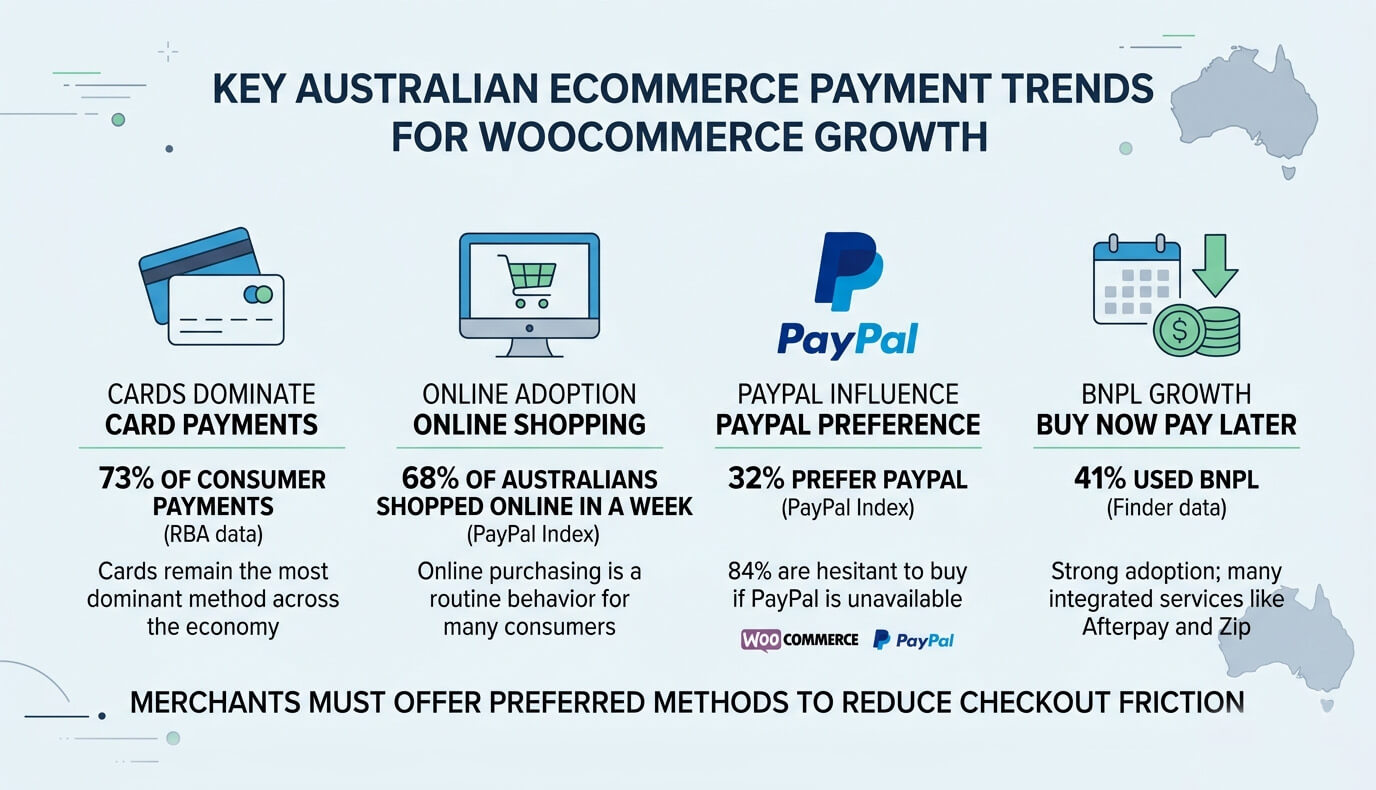
According to the Reserve Bank of Australia, cards account for 73% of consumer payments, making them the dominant payment method across the economy.


Online payments now account for 20% of all consumer payments, while 68% of Australians made at least one online payment during a typical reporting week.


For WooCommerce merchants, these trends directly influence payment gateway selection.
PayPal remains particularly influential. According to PayPal's eCommerce Index,
32% of Australian online shoppers identify PayPal as their preferred payment method.


The same report found that 84% of consumers are hesitant to purchase online if PayPal is unavailable.


This helps explain why PayPal continues to be one of the most commonly deployed payment integrations across WooCommerce stores.


However, payment preferences are becoming increasingly diverse.


Buy Now Pay Later adoption remains strong throughout Australia.


Finder reports that 41% of Australians have used a BNPL service within the past six months.


Afterpay remains the market leader, followed by Zip and other providers.


As a result, many Australian WooCommerce stores now integrate a combination of:


  • Stripe
  • PayPal
  • Apple Pay
  • Google Pay
  • Afterpay
  • Zip
  • Klarna


The objective is simple. Give customers the payment method they prefer and reduce friction during checkout.


Mobile Commerce Is Reshaping Online Shopping Behaviour


Mobile commerce continues to influence how WooCommerce stores are designed and optimised.


Australia Post reports that younger generations are increasingly shopping online multiple times per week, with Millennials and Gen Z leading digital purchasing behaviour.


The Reserve Bank of Australia also found that 46% of online payments are now completed through mobile applications.


This trend has significant implications for WooCommerce store owners.


Product pages must load quickly.


Navigation must remain intuitive.


Checkout flows must function flawlessly on smaller screens.


Payment gateways must support mobile wallets and accelerated checkout experiences.


Businesses that continue designing primarily for desktop users risk creating unnecessary friction for a growing segment of mobile-first consumers.


Product Catalogue Growth Is Driving Demand for Flexible Platforms


As online retailers expand, catalogue complexity often increases.


Many businesses begin with a small product range before expanding into hundreds or thousands of SKUs.


This is one reason WooCommerce remains attractive to growing retailers.


Unlike many hosted platforms, WooCommerce allows businesses to customise product structures, category hierarchies, filters, attributes, pricing models, and inventory workflows.


Store Leads data also shows WooCommerce supports stores ranging from small catalogues to large-scale operations managing substantial product inventories.


For wholesalers, distributors, manufacturers, and retailers managing extensive product ranges, this flexibility often becomes more valuable over time.


Checkout Optimisation Remains a Major Opportunity


Traffic growth alone does not guarantee revenue growth.


Conversion efficiency matters.


Baymard Institute's research shows average cart abandonment rates remain close to 70%.


In practical terms, most online stores lose more potential orders than they complete.


Common causes include:


  • Unexpected costs
  • Limited payment options
  • Forced account creation
  • Slow checkout experiences
  • Poor mobile usability
  • Trust concerns


WooCommerce provides businesses with extensive control over checkout functionality, allowing stores to customise the purchasing journey to reduce friction and improve conversion rates.


At Marketix, we often see stores focus heavily on traffic acquisition while overlooking checkout optimisation. In many cases, improving conversion rates generates faster revenue growth than increasing traffic alone.


What These WooCommerce Trends Mean for Australian Businesses


The data paints a clear picture.


Australian eCommerce continues to grow, online shopping has become mainstream, and more businesses are investing in digital commerce. At the same time, WooCommerce remains one of the world's most widely adopted eCommerce platforms, supported by WordPress, a large plugin ecosystem, and extensive customisation capabilities.


From our experience at Marketix, WooCommerce is often the strongest long-term choice for businesses that want greater control over their website, SEO strategy, customer data, and growth roadmap.


While platforms like Shopify offer simplicity, WooCommerce provides the flexibility needed to support more advanced SEO, content marketing, CRO, and custom functionality as businesses scale.


The opportunity is significant, but success requires more than simply launching a store. Businesses that invest in SEO, site performance, user experience, and conversion optimisation will be in the strongest position to capitalise on Australia's growing eCommerce market.


Businesses that invest in technical SEO, site performance, checkout optimisation, customer experience, and long-term platform management will be best positioned to capitalise on Australia's continuing eCommerce growth.


For many Australian retailers, wholesalers, manufacturers, and growing online brands, WooCommerce remains one of the strongest platforms available to support that growth in 2026 and beyond.