
How Marketix Digital Helped Mills Shelving Turn Search Demand Into Commercial Growth
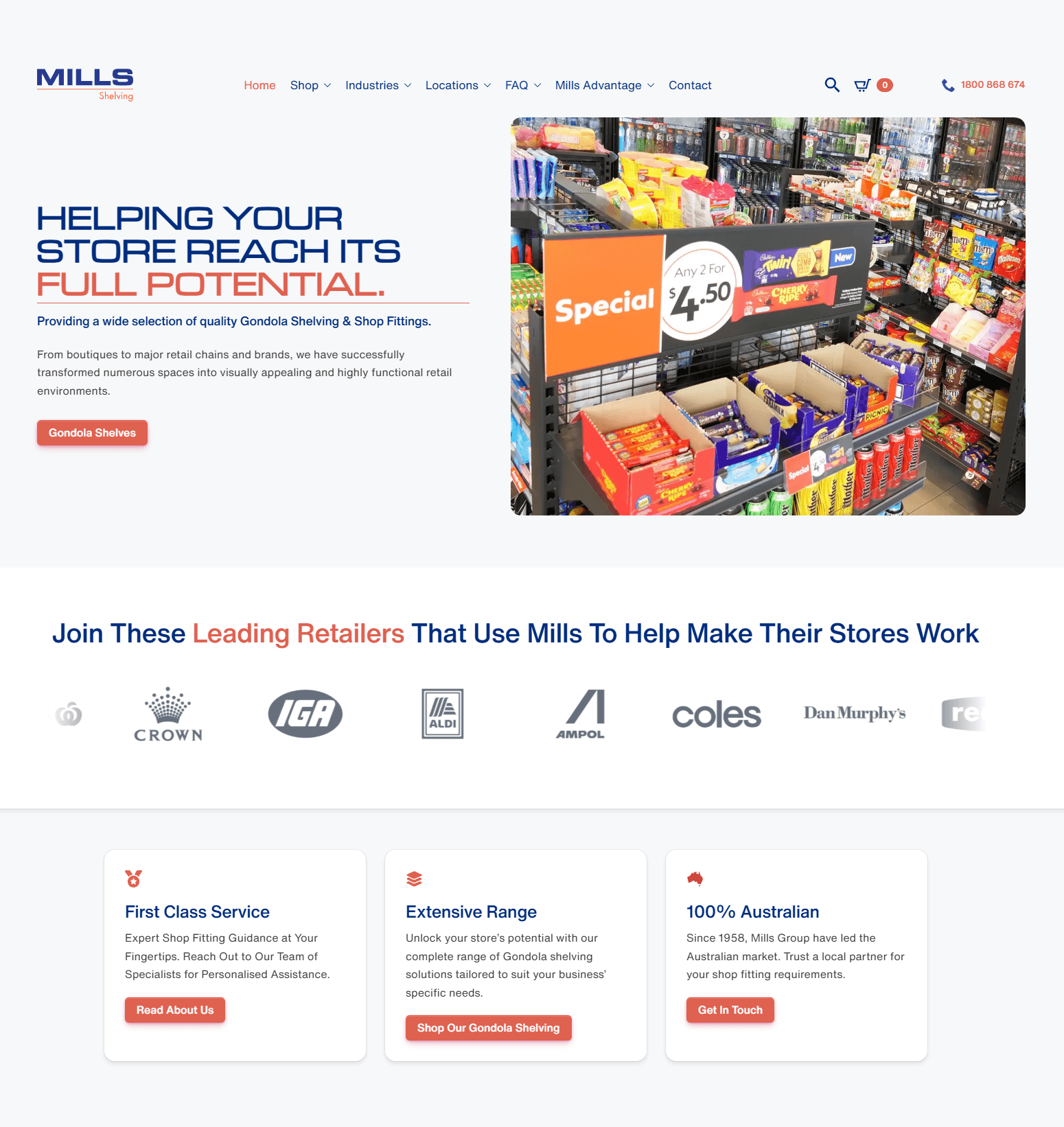
Mills Shelving was already investing in digital marketing, but its previous website was not producing the results the business expected.
Marketix Digital helped launch the new Mills Shelving website and rebuilt its search strategy around the products, markets and opportunities with the greatest commercial value.
Since then, Mills has experienced a clear uplift in enquiries and activity around its focus products while establishing strong positions across important commercial searches.
Results Achieved
✔ Increased Enquiries Around Focus Products
✔ Strong Positions Across Core Product Searches
✔ Better Results From the New Website
Client Testimonial

"What I have enjoyed about working with Shoaib and the Marketix team is the practical focus on getting the right result for our focus area, rather than the generic and theoretical marketing fluff heard from others.
And the attention to detail and updates are excellent as well.
We literally found them by Googling 'best SEO agency' and if you can win that search you must be doing something right!"
Neil Webster, CEO, Mills - Works for Retail
Key SEO Results at a Glance
Mills Shelving Results Achieved

Increased Pipeline Around Focus Product Lines
Mills has experienced a clear uplift in enquiries and activity around the product categories prioritised through the campaign.
The objective has been to capture demand for the products Mills actually wants to sell, rather than chase traffic for its own sake.
Strong Competitive Positions Across Core Product Searches
Mills now competes at or near the top of Google across a number of searches directly connected to its core product, industry and location ranges.

Better Results From Revenue Targeted Campaign
Mills was already investing in digital marketing before working with Marketix, but the previous website was underperforming.
The new website is doing a much better job of connecting customer demand with Mills' product offering and generating genuine business activity.
Turn Search Demand Into Commercial Opportunity
The strongest search strategies start with the business opportunity, not the keyword.
Marketix identifies where demand exists, which opportunities matter commercially and what should be prioritised to capture them.
The Challenge
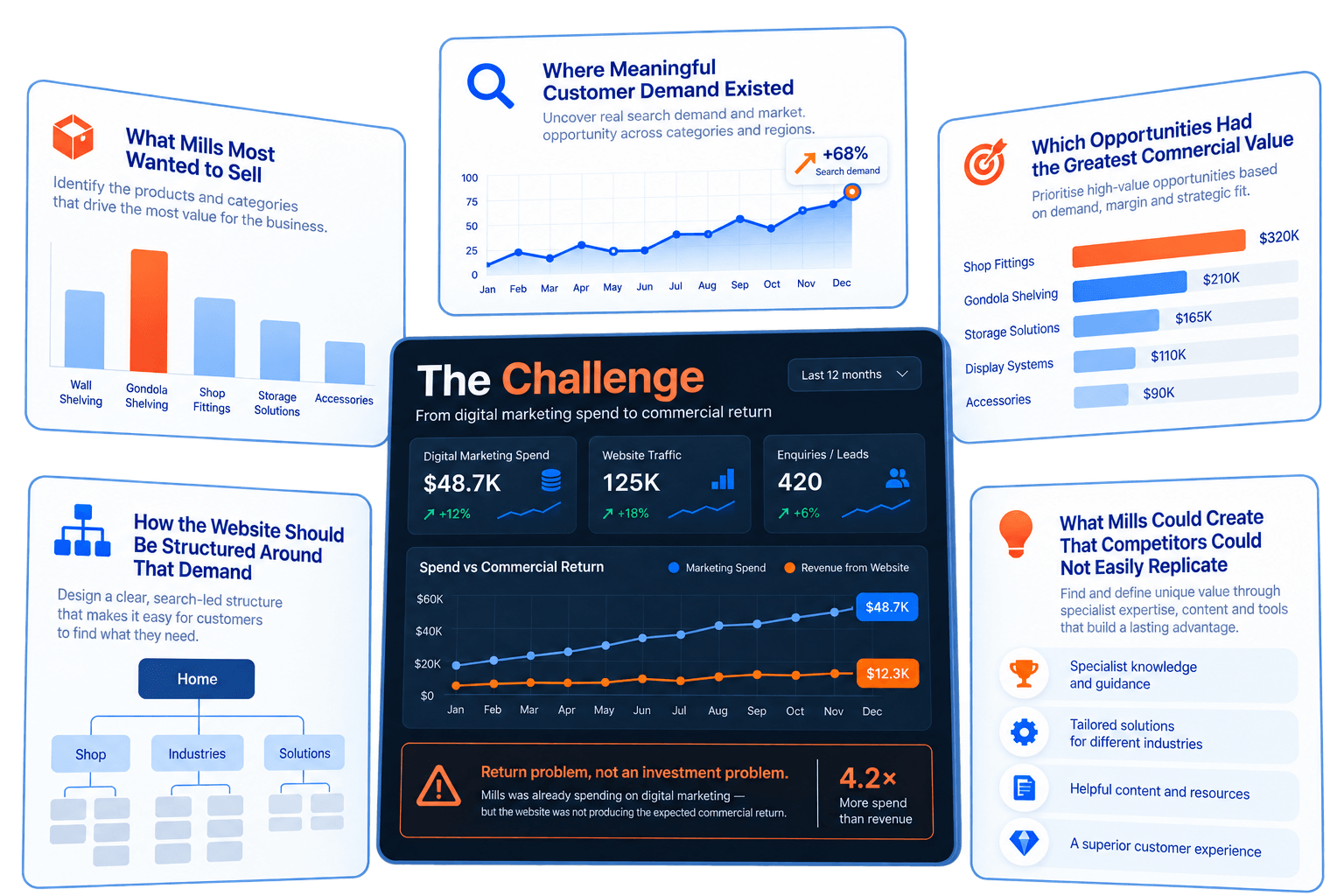
Mills did not have an investment problem. It had a return problem.
The business was already spending on digital marketing, but its previous website was not producing the results expected from that investment.
Our job was to determine:
- what Mills most wanted to sell
- where meaningful customer demand existed
- which opportunities had the greatest commercial value
- how the website should be structured around that demand
- what Mills could create that competitors could not easily replicate
The Marketix Framework
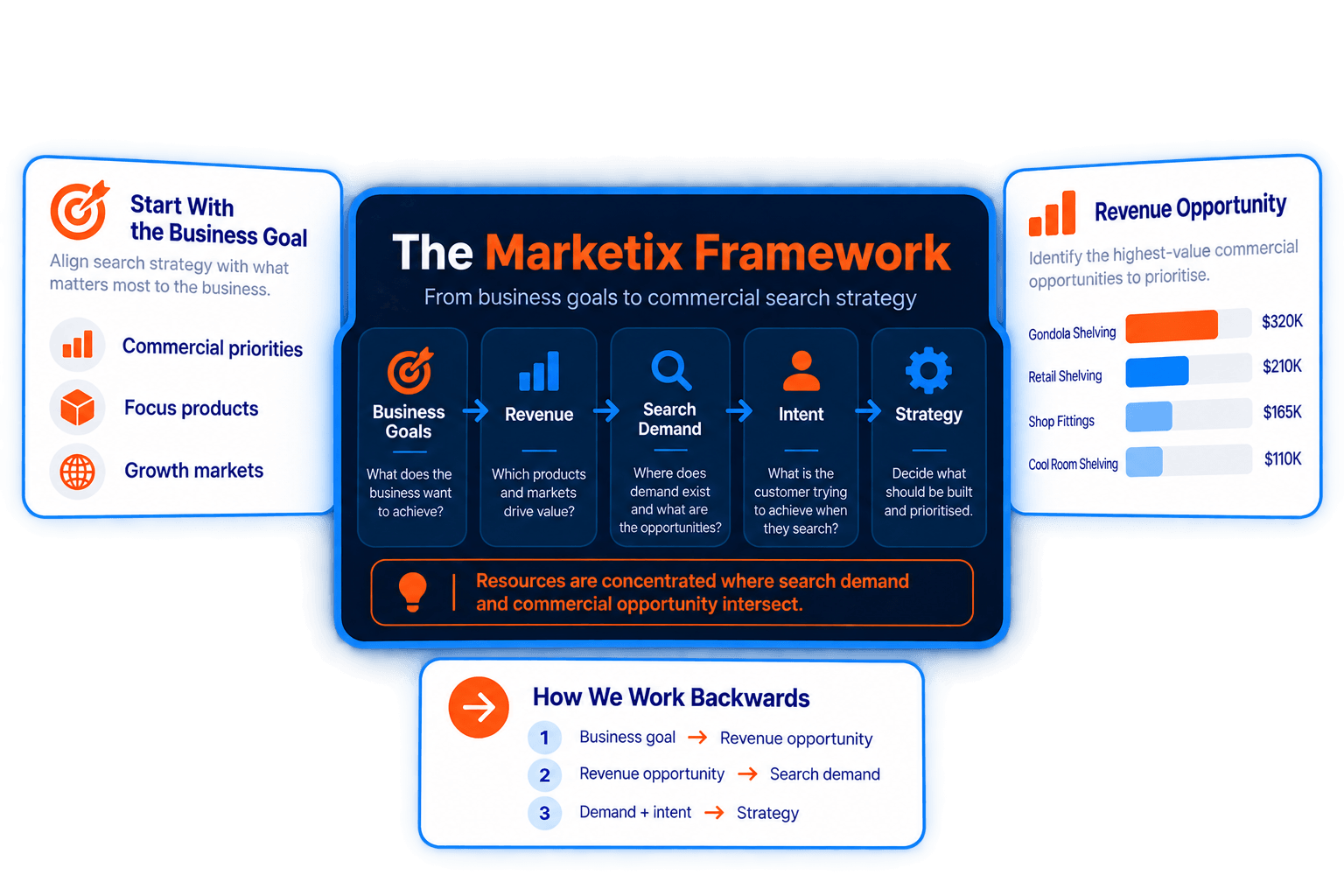
Our work with Mills follows the Marketix commercial search framework:
Business Goals → Revenue → Search Demand → Intent → Strategy
We start with what the business wants to achieve and work backwards.
Which products and markets can contribute meaningfully to revenue? Where does search demand exist around those opportunities? What is the intent behind that demand?
Only then do we determine the SEO strategy.
"SEO shouldn't begin with a keyword. It should begin with the business goal. We work backwards from the revenue opportunity, understand the demand and intent around it, and only then decide what search strategy is worth executing."
Shoaib Mughal, Managing Director, Marketix Digital
For Mills, this means resources are concentrated where search demand and commercial opportunity intersect.
The Strategy
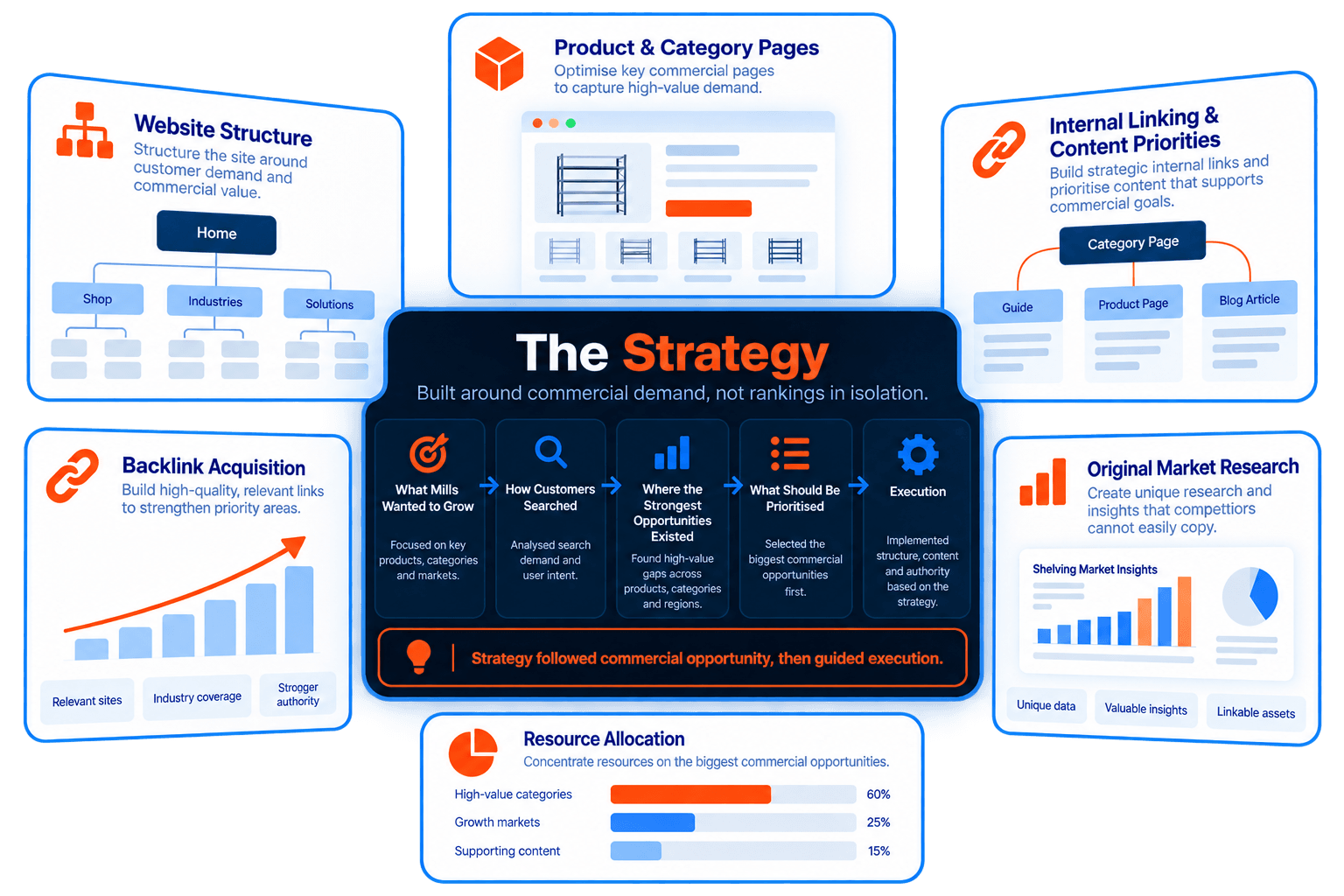
The Mills strategy was built around commercial demand rather than rankings in isolation.
We looked at what Mills wanted to grow, how customers searched for those products and where the strongest opportunities existed.
That informed:
- website structure
- product and category pages
- internal linking
- content priorities
- backlink acquisition
- original research
- allocation of SEO resources
We also wanted Mills to create assets that competitors could not simply copy by producing another article.
That led to a significant focus on original market research.
Original Market Research
Marketix has conducted detailed research into Mills' markets, often bringing together information that was fragmented across multiple sources.
Depending on the project, this has involved combining:
search demand data
industry datasets
geographic and market information
public statistics
commercial assumptions
For more complex work, data analysts have been used to process the underlying data and build market models.
The resulting research serves two purposes.
It gives Mills better intelligence about its own market.
It also creates genuinely linkable assets based on information that did not previously exist in one place.
Harder to Replicate
This creates a much higher barrier to competition.
A competitor cannot reproduce the work by commissioning another article.
They would need to identify the right datasets, reconcile conflicting sources, define defensible assumptions, build the underlying model, validate the analysis and turn it into something worth publishing.
That requires data capability, analytical judgement and commercial understanding alongside SEO.
They are no longer competing against a webpage. They are competing against the information behind it and the capability required to produce it.
Execution
Across the engagement, Marketix has:
✔ helped launch and develop the new Mills Shelving website
✔ structured the site around customer demand and commercial priorities
✔ developed and improved core product and category pages
✔ used internal linking around strategically important products
✔ built backlinks where additional competitive strength was required
✔ conducted original market research
✔ combined multiple datasets to produce new market analysis
✔ used data analysts to support complex research and market modelling
The question throughout has been:
Where is the revenue opportunity, where does search demand intersect with it, and what do we need to build to capture it?
The Outcome
Mills Shelving has experienced a real uplift in enquiries and activity around the products prioritised through the campaign.
The new website is producing better results than its predecessor, while Mills has established strong positions across searches closely connected to the products it wants to sell.
The engagement has also evolved beyond conventional SEO.
Search demand, commercial analysis and original market research are now being used together to identify opportunities and create assets that competitors cannot easily reproduce.
For Mills, SEO has become less about accumulating rankings and more about understanding demand and capturing the parts of it that matter commercially.
Get Results Like Mills Shelving
Search should contribute to commercial growth, not just rankings and traffic.
Marketix identifies where customer demand exists, how it intersects with your business priorities and what needs to be built to capture the opportunity.